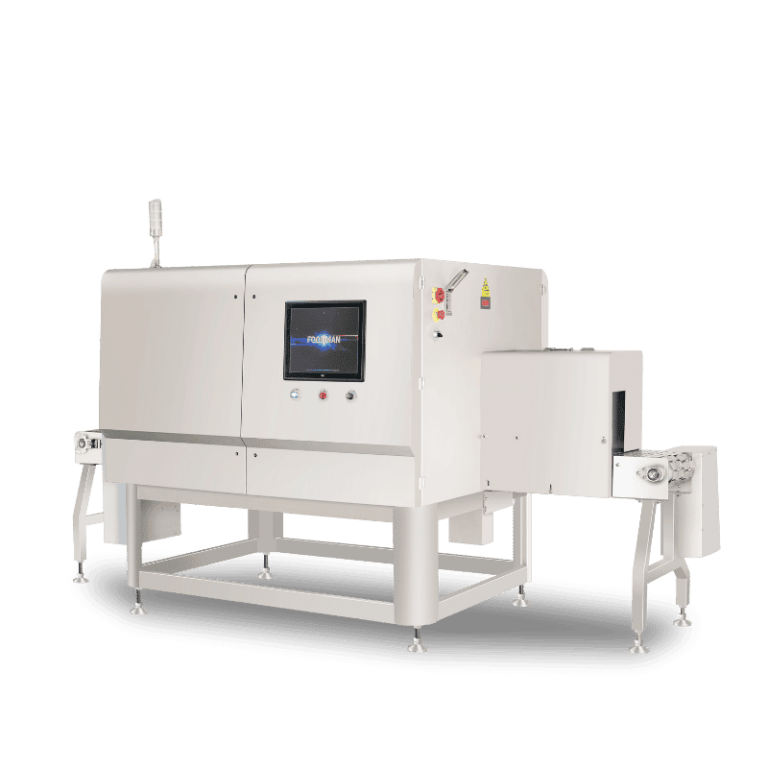

Introduction: Why Modern Baking Companies Prioritize Metal Control
The aroma of freshly baked bread and the crisp texture of cookies represent a perfect fusion of centuries-old craftsmanship and modern industrial speed. However, in today’s high-volume baking industries, even invisible contaminants can destroy decades of consumer trust and brand reputation. This is why metal control has evolved from a regulatory supplement to a core pillar of baking operations.
Unlike other food industries, the baking industry faces a unique paradox: its products vary greatly in moisture content, salt content, and density—all factors that can interfere with detection technology. To address this challenge, the baking industry relies on sophisticated screening at every stage. Modern baking metal detectors are no longer just simple gates at the end of the production line; they are comprehensive guardians adaptable to various product conditions, from dusty flour and sticky dough to pastries wrapped in foil. This article explores how bakery metal detectors in the food industry have evolved from receiving docks to shipping areas, focusing on a key variable that determines technology selection: packaging.
Risk: Where Does Metal Contamination in Baking Come From?

Understanding the enemy is the first step in defense. In bakeries, metal fragments don’t appear out of thin air; they come from the machines that produce food.
Main sources include:
Raw Material Impurities: Supplier processing equipment may mix metal fragments into impurities such as flour, sugar, or chocolate chips.
Equipment Wear and Tear: Friction occurs in sieves, mixer blades, and conveyor belts. Broken bolts from mixers or fragments from worn screw conveyors can enter the product flow.
Maintenance Debris: During maintenance, small tools, wires, or welding spatter may accidentally fall into open dough troughs or ingredient bins.
These threats are invisible to the naked eye, but once ingested, the consequences can be dire. Therefore, deploying metal detector for bakery at critical control points in the baking production line and employing a multi-layered defense strategy is not optional, but essential for survival in the modern food industry.
Raw Material Control: Bulk Raw Materials and Free Fall Detection
The first line of defense begins before mixing. Bulk raw materials typically enter the silo via pneumatic or gravity conveying. At this stage, the product is dry, free-flowing, and unpackaged.
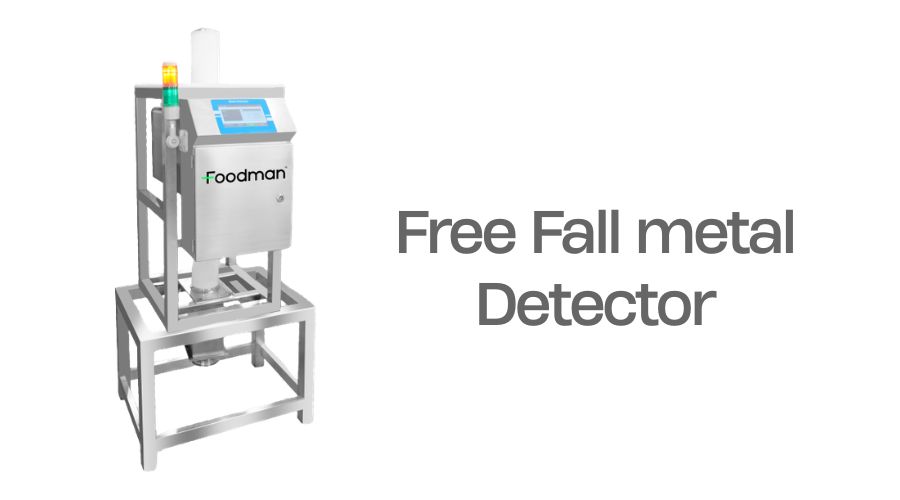
This environment requires specialized equipment: free fall metal detectors. These devices are installed in pipes or vertical chutes to detect the falling of granular materials such as flour, sugar, and coarse wheat flour. They are extremely fast and highly accurate.
Free fall metal detection systems must be fast enough to detect tiny iron filings or stainless steel fragments and trigger diversion valves within milliseconds to flush out contaminated material without interrupting production. By intercepting contaminants before they enter the mixer, bakeries can prevent a single piece of metal from being shredded into dozens of invisible fragments throughout the batch. This initial screening, provided by sensitive bakery-specific metal detector for bakery, is the most cost-effective insurance a baker can purchase.
Process Control: Inspection on the Mixing and Shaping Production Line
After raw materials pass inspection, they enter the mixing and shaping stage. At this stage, the product undergoes transformation, but new risks also arise. Mixer blades may break, and forming dies may wear down.
Inspecting the product at this stage is challenging because it is typically wet, viscous, and dense—this “wet” product interferes with electromagnetic fields. However, metal detector for bakery designed specifically for the food industry can be integrated into dough conveyors or extruder exits.
These systems must be robust enough to handle the high throughput of the shaping production line while ignoring signals from the dough itself. Before the product is packaged, the inspection process is simple, but the “product effect” begins to emerge. This stage acts as a safety net, intercepting any metal introduced during machining before the product enters the oven.
Core Control: Post-Baking Unpackaged Inspection
After baking, the product is presented as bread, rolls, or slices. At this point, the product is still unpackaged but is typically hot, moist, and salty. This is a “core” inspection area for many bakeries.
The post-baking stage is crucial because any metal contamination (from slicing blades or cooling conveyors) that goes undetected will directly reach the consumer. However, the conductivity of freshly baked goods presents a “product effect” problem, where the moisture and salt in the bread can signal contamination.
To address this, high-performance metal detector for food industry for the baking industry employ advanced multispectral technology.
This technology can “see through” the product’s natural conductivity. By inspecting the product unpackaged (packaging adds complexity), bakeries can maximize sensitivity to the product’s core components.
Technical Challenge: Overcoming the "Product Effect"
To truly understand the intricacies of baking metal detectors, one must understand the “product effect.”
Baked goods are not inert substances; they are electromagnets. The moisture and salt in fresh bread make it conductive. When this conductive product passes through the detector’s aperture, it generates a signal. If this signal is strong enough, it can resemble the signal of a metal contaminant, leading to false positives. Worse still, if the detector is set to ignore product signals, it may become “blind,” missing actual metal.
The solution lies in phase-sensitive detection. Modern metal detector for food industry, the standard in the food industry, employ multi-frequency technology. By analyzing the phase difference between the product signal and the metal signal, the device can be “balanced,” allowing it to ignore bread and detect metal fragments. This technological breakthrough enables modern high-speed baking, ensuring that metal detectors for food industry on baking production lines are intelligent enough to distinguish between delicious bread and dangerous metal fragments.
Packaging Control: The Paradox of Finished Product Inspection
This is the most complex variable in the baking process. Packaging used to keep products fresh can also interfere with metal detection. Therefore, the detection strategy depends entirely on the type of bag or film used for packaging.
1. Non-metallic Packaging: The Ideal Solution
For products packaged in plastic bags, cartons, or standard pillow packaging (e.g., biscuits and cookies), detection is straightforward. Standard baking metal detectors installed after the packaging machine can scan finished retail packaging with high sensitivity, ensuring no contaminants are introduced during the final sealing process.
2. Metallized Film: The Faraday Cage
Many snack cakes use metallized film to keep them fresh. However, the thin aluminum layer forms a barrier that ordinary metal detectors cannot penetrate. Therefore, metal detectors specifically designed for the food industry are required. These detectors use a lower frequency to penetrate the film, but with slightly reduced sensitivity.
3. Aluminum Foil Trays: The Ultimate Challenge
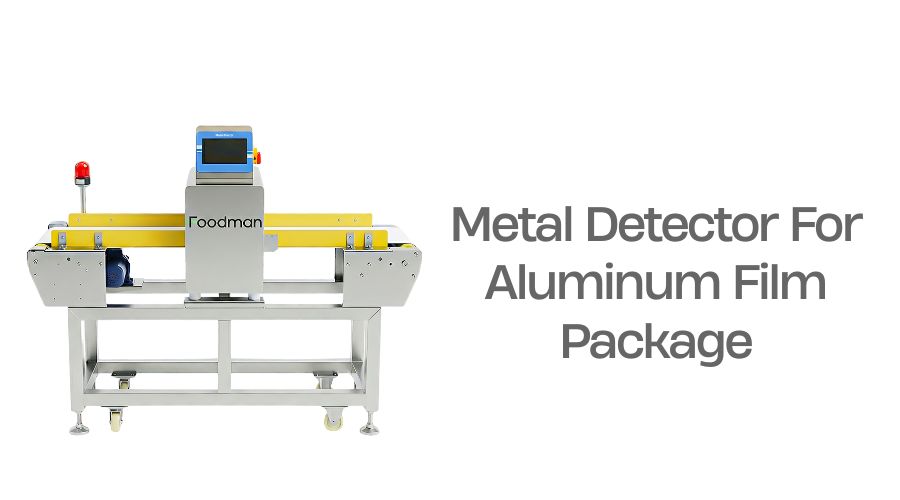
The rise of ready-to-eat pies and quichees packaged in aluminum foil trays was once a major challenge for quality control. Today, specialized systems have solved this problem. A metal detector specifically designed for aluminum foil packaging utilizes advanced magnetic field technology to ignore the stable signal from the aluminum foil tray and focus on detecting the weak signals generated by contaminants inside the food. This represents the pinnacle of packaging-specific detection technology, enabling metal detector for aluminum film package to achieve what was considered impossible twenty years ago.
Innovation: Multi-Frequency Adaptive Technology

The diversity of baking workshops demands flexible inspection equipment. The rise of multi-frequency technology represents a paradigm shift in the industry.
In the past, bakers might need one machine to inspect dry cookies and another to inspect wet bread. Today, a single food industry metal detector equipped with multi-frequency scanning can store information on dozens of products. The machine automatically adjusts when the production line switches from dry, bagged pretzels to moist, foil-wrapped Danish pastries.
This ensures that the bakery metal detector always operates at optimal sensitivity. The same device can function as a free-fall metal detector in the morning to inspect raw flour, and in the afternoon, as a metal detector inspecting foil-wrapped baked goods. This flexibility reduces equipment costs and ensures that even complex products receive the highest level of inspection.
Conclusion: Building Trust Through Multi-Layered Defense
From a single grain of wheat to a packaged loaf of bread, the entire process is fraught with risk. From receiving raw materials to the final packaged product, every step faces the threat of metal contamination, requiring sophisticated and customized defense systems to address.
We have seen that bakery metal detectors are not just a single tool, but a powerful and comprehensive defense system. It starts with a free-fall detector protecting flour silos, moves to a high-frequency analyzer checking hot bread right after baking, and ends with a foil-specific detector inspecting products in aluminum packaging—every stage covered, every package safe. By deploying the right technology at the right time—matching the detector to the product’s condition and packaging—the bakery builds a seamless safety net.
It never shows its face, yet protects every bite. From flour to finished product, layer upon layer of checks filter out potential hazards, leaving behind peace of mind. This is the warmth of technology, and the essence of trust.
FAQ
Because the product state changes significantly from powder to dough to packaged finished product. Each stage requires a metal detector specifically designed for the different processing steps in the baking industry to maintain sensitivity and minimize false detections.
Free-fall metal detectors are used to detect bulk, dry, free-flowing raw materials such as flour, sugar, and grains, which are conveyed to hoppers or mixers via pneumatic or gravity conveying. It protects the raw materials before mixing begins.
Yes. Packaging equipment can introduce contamination. Metal detectors specifically designed for aluminum foil packaging can provide critical final verification.