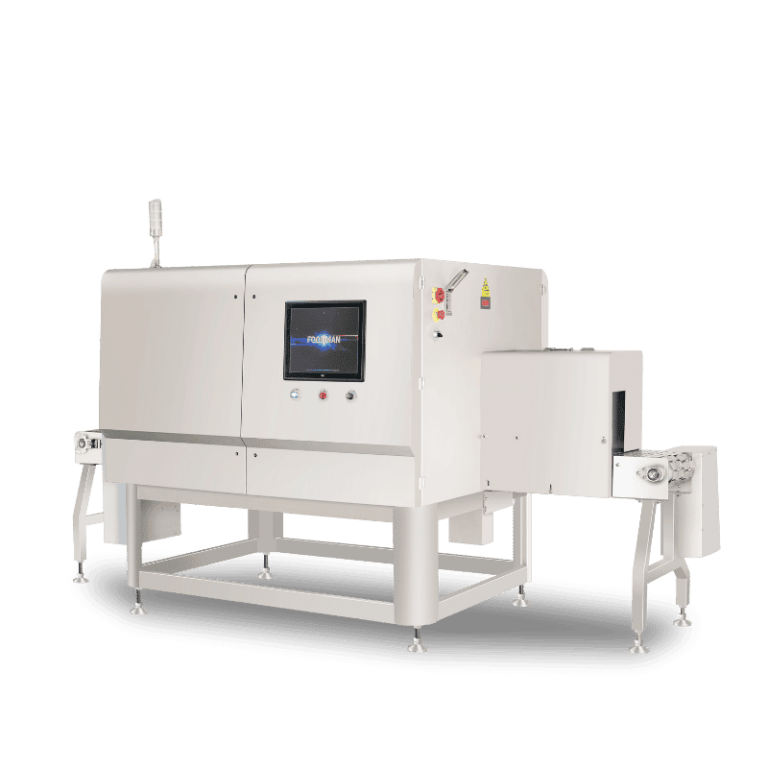

Preface: The Invisible Threat in Our Daily Sustenance
In the modern food supply chain, the journey of a simple coffee bean or a wholesome almond from farm to table is a marvel of logistics and processing. Yet, this journey is fraught with potential hazards. Among the most insidious contaminants are metal fragments—tiny, often invisible pieces of machinery, wire, or hardware that can inadvertently mix with bulk food products during harvesting, transportation, or processing.
For consumers, encountering a metal fragment is not just an unpleasant surprise; it is a serious health risk. For manufacturers, it represents a catastrophic failure in quality control, leading to product recalls, brand erosion, and legal liability. This is where the unsung hero of the food safety line steps in: the free fall metal detector. This technology stands as the vigilant guardian, ensuring that the grains for our breakfast cereal, the nuts for our snacks, and the beans for our morning coffee are pure and safe for consumption.
The Industry Pain Point: Why Bulk Food is Vulnerable
The processing of dry, bulk food products presents unique challenges for contaminant removal. Unlike pumped liquids or conveyed packaged goods, materials like grains, granola, seeds, and nuts move rapidly and in large volumes. The primary pain point for manufacturers in this sector is the high risk of metal inclusion originating from the production environment itself. Think of the constant friction and wear on harvesting equipment, milling machinery, sieves, and transport augers. A single broken bolt from a hammer mill or a shard of worn screen wire can shed metal into tons of product, contaminating an entire batch.

Traditional detection methods, such as magnetic separators or manual inspection, are insufficient for capturing non-ferrous metals like stainless steel, aluminum, or copper, which are commonly used in food processing equipment. Furthermore, inspecting bulk flows before they are packaged is critical; finding a contaminant in a finished, sealed bag of nuts is a costly waste of product and packaging. The industry demands a solution that can inspect 100% of the product stream at high line speeds without causing bottlenecks. This necessity has driven the widespread adoption of the metal detector for bulk food, specifically engineered for free-fall applications.
Understanding the Technology: The Mechanics of the Free Fall Metal Detector
To appreciate its efficacy, one must understand how a free fall metal detector operates. Unlike conveyorized systems that pass a packaged product through a coil, this system is integrated directly into the pneumatic conveying or gravity-fed stream. The product, whether it’s coffee beans or hazelnuts, enters a vertical drop chute or pipe that passes through a highly sensitive high-frequency electromagnetic coil. This aperture is the heart of the detection system.
As the bulk food falls freely by gravity, it passes through the electromagnetic field. When a metal contaminant—be it ferrous, non-ferrous, or stainless steel—passes through, it disrupts this field. The sophisticated electronics within the automatic metal detector for bulk food products analyze this disturbance, distinguishing between the product signal (product effect) and the contaminant signal.
Modern digital signal processing allows for incredibly precise discrimination, ignoring the “noise” of the product itself while identifying even microscopic pieces of metal.
This technology ensures that the integrity of the inspection is maintained even at extreme throughput rates, making the metal detector for nuts and grains one of the most reliable tools in the food safety arsenal.

Detection Capabilities and Rejection Systems: Precision in Action
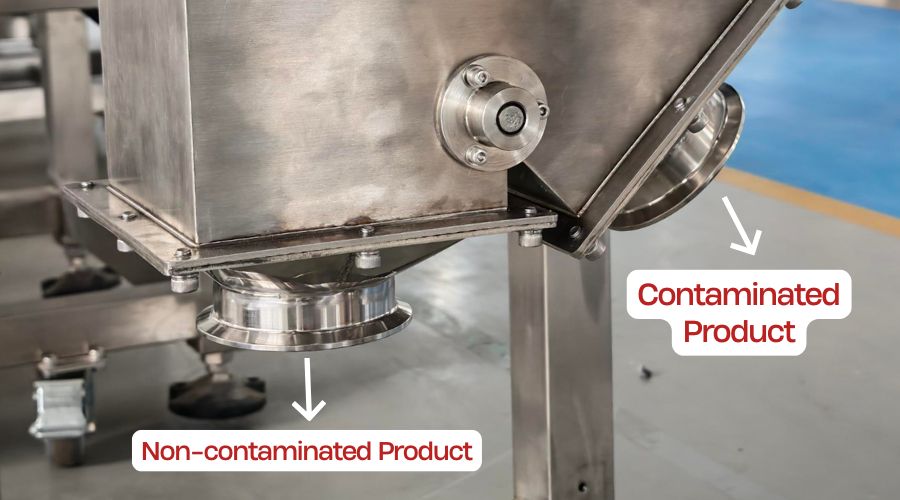
The true value of a free fall metal detector lies not just in its ability to detect, but in its capacity to remove the contaminant without wasting good product. The moment a contaminant is identified, a high-speed rejection system is activated. This is typically a pneumatically operated flap or a diversion valve located just below the detection coil. Contaminants can typically be removed using various rejection methods, such as a pneumatic baffle or a diversion valve located directly below the detection coil, non-contaminated product and contaminants have their own separate diversion channels.
When the contaminated slug of product reaches the diverter, the system kicks into action in milliseconds. A blast of air or a mechanical flap redirects the contaminated portion—often just a small fraction of the total flow—into a separate reject bin.
The non-contaminated product continues its uninterrupted path to packaging or the next processing stage. This level of automation is what makes the automatic metal detector for bulk food products so indispensable. It ensures that the production line remains continuous and efficient, while guaranteeing that every grain, nut, or bean that passes through is contaminant-free.
The ability to reliably detect and reject stainless steel, which is notoriously difficult to detect due to its low conductivity, is a hallmark of a high-quality metal detector for bulk food.
Core Advantage: Beyond simple pollutant removal
Implementing a free fall metal detector offers a multitude of benefits that extend beyond basic hazard control.
Uncompromised Hygiene and Sanitary Design: In the food industry, equipment must be easy to clean to prevent bacterial growth and allergen cross-contamination. These detectors are typically constructed from food-grade stainless steel with polished surfaces and minimal crevices. They are designed for quick disassembly without tools, facilitating rapid cleaning and validation.
Maximized Throughput and Efficiency: Because the inspection occurs during free fall, there is no bottleneck. The system can handle high tonnages per hour, matching the capacity of the fastest production lines. This ensures that the safety check does not slow down the manufacturing process.
Reduced Product Waste: As mentioned, the precision of the reject mechanism ensures that only the contaminated portion of the product is removed. This minimizes the giveaway of good product, resulting in significant cost savings over time.
Enhanced Brand Protection: By preventing metal-contaminated products from reaching the consumer, manufacturers safeguard their brand reputation and avoid the immense costs associated with public recalls.
Application Scenarios: Where Free Fall Detection is Essential
The versatility of the free fall metal detector makes it suitable for a wide array of dry bulk products. Some of the most common and critical applications include:
Nut Processing (Almonds, Peanuts, Cashews): Nuts are often harvested with mechanical shakers that can pick up stones and metal fragments from the ground. A metal detector for nuts is essential after shelling, sorting, and roasting to ensure no hardware contamination remains.
Grain and Cereal Production: From wheat and rice to oats and corn, grains pass through numerous metal components during milling. A free fall metal detector placed before packaging or further processing ensures the final flour or cereal is safe.
Coffee and Cocoa Beans: These beans undergo hulling, grinding, and roasting, all processes involving heavy machinery. Detecting metal before the beans are ground into powder or packaged is crucial.
Snack Foods and Granola: Ingredients for trail mix, muesli, and granola bars are often mixed in bulk. Inspecting each ingredient stream with a dedicated metal detector for bulk food ensures the final blend is free of contaminants.
Powders and Granules: Products like sugar, salt, flour, and spices flow freely and are ideal for free-fall inspection.
Conclusion: A Non-Negotiable Investment in Safety
In the delicate ecosystem of food production, trust is the most valuable currency. Consumers trust that the products they buy are safe. Manufacturers trust their processes to deliver on that promise. The free fall metal detector is the technological bedrock of that promise for countless dry bulk products. It provides a final, unwavering check against the physical hazards that can infiltrate the most pristine processing environments.
By investing in a high-performance automatic metal detector for bulk food products, companies are not just buying a piece of machinery; they are investing in consumer safety, regulatory compliance, and the long-term resilience of their brand. As food production lines become faster and safety standards become stricter, the role of this vigilant technology will only grow in importance, silently and efficiently protecting the purity of the world’s food supply, one grain at a time.
FAQ

High-quality free-fall metal detectors are designed to detect all types of metal contamination. This includes ferrous metals (such as iron wire, iron balls, and steel wire), non-ferrous metals (such as copper wire and aluminum), and even the most difficult-to-detect metal contaminants like stainless steel. Sensitivity depends on the aperture size and product characteristics.
Conveyor belt systems transport packaged products through a detection channel via a conveyor belt. In contrast, free-fall metal detectors for bulk foods are installed at a vertical drop. Bulk products fall into the detection head by gravity, making them ideal for detecting bulk, free-flowing materials before packaging.
Modern automated bulk food metal detectors use a high-speed pneumatic rejection system with extremely high accuracy. This system is precisely timed and activates immediately when a contaminated piece of product enters the rejection zone, ensuring that only the contaminated portion is rejected. This minimizes the waste of qualified products.