Introduction
Rising Consumer Demand for Transparency and Traceability in the Food Industry
In recent years, consumers have become increasingly concerned about the origins and safety of the food they consume. Digital traceability has emerged as a critical tool in addressing these demands, allowing manufacturers to track products from raw materials to the finished goods on store shelves. Today’s food industry is no longer just about production efficiency; it is about delivering food safety and transparency that consumers can trust.
Manufacturers are expected to provide detailed records of every batch, including production dates, ingredient sources, and quality inspection results. In this context, metal detector in food industry operations play a pivotal role by providing verified data on contamination prevention. By linking metal detection logs to traceability systems, companies can demonstrate accountability at every step of production, ensuring consumers that their food is safe and compliant with industry standards.

The Evolving Role of Metal Detection in Modern Food Safety
While traditional metal detectors for food production lines have long been essential for identifying ferrous, non-ferrous, and stainless steel contaminants, their role is evolving. Modern systems are increasingly integrated with digital technologies, providing not just detection, but also real-time monitoring, automated alerts, and audit trails.
Understanding how a metal detector works is critical for operators to optimize sensitivity for various product types—whether wet, dry, frozen, or coated foods. Advanced AI-assisted metal detection systems now allow for predictive calibration, minimizing false positives while ensuring even the smallest metallic fragments are reliably identified. This evolution positions metal detection as a cornerstone of proactive food safety management rather than just a reactive tool.
How Digital Traceability Enhances Accountability and Trust Across Production Lines
Integrating metal detectors in food industry operations with digital traceability systems transforms raw inspection data into actionable insights. Every detection event can be logged and linked to a specific batch, production line, or shift, providing transparency to regulators, auditors, and consumers alike.
This digital integration not only strengthens regulatory compliance but also enhances operational efficiency. For example, manufacturers can quickly trace contamination sources, execute targeted recalls, and generate comprehensive reports for authorities—all while maintaining uninterrupted production flow. By combining metal detector for food production line technology with digital traceability, companies build a foundation of trust, accountability, and verifiable food safety across their operations, meeting the growing consumer demand for transparency in today’s food industry.
The Shift Toward Digital Traceability in Food Production
Definition and Significance of Digital Traceability for Food Manufacturers
Digital traceability refers to the ability to track and record every stage of a product’s journey—from raw material sourcing to final packaging—using digital systems. For food manufacturers, this capability is no longer optional; it has become a core component of food safety and regulatory compliance. By implementing end-to-end traceability, manufacturers can ensure that every product leaving the facility is safe, high-quality, and fully auditable.
In modern production lines, metal detector in food industry data forms a crucial part of this traceability framework. Recording detection events digitally allows operators to verify that metal detectors for food production lines are functioning correctly, that contaminants are being identified, and that preventive actions are documented. This integration provides a reliable, verifiable trail for both internal quality management and external regulatory audits.
Role of IoT, Cloud Platforms, and Data Analytics in Real-Time Monitoring
The rise of IoT in food production and cloud-based traceability platforms has transformed how manufacturers monitor metal detector for food production line performance. Sensors and connected devices on production lines can now transmit data in real-time, providing instant insights into machine performance, detection events, and potential contamination risks.
AI-assisted metal detection further enhances this capability by analyzing patterns in detection data, automatically adjusting sensitivity settings based on the product matrix, and reducing false positives. Cloud platforms allow these insights to be aggregated across multiple facilities, creating a centralized dashboard for operational monitoring. By leveraging data analytics in combination with metal detection, manufacturers gain a proactive approach to food safety, enabling faster response to anomalies and continuous process improvement.
Integrating Metal Detection Data into Traceability Systems for End-to-End Transparency
One of the most impactful applications of digital traceability is the integration of metal detection data into broader food production tracking systems. Every detection event, including sensitivity calibrations, test piece validations, and contaminant rejections, can be logged automatically.
By linking this data to specific batches, production shifts, and raw material lots, food manufacturers can achieve end-to-end transparency. This integration ensures that operators, quality managers, and regulatory auditors have a complete view of the product’s safety history. Understanding how a metal detector works within these systems allows manufacturers to validate detection accuracy while maintaining traceability compliance.
This combination of metal detector in food industry technology and digital traceability not only strengthens regulatory adherence but also builds consumer trust. Shoppers today demand visibility into the production process, and companies that can demonstrate comprehensive, auditable food safety measures gain a competitive advantage in the market.
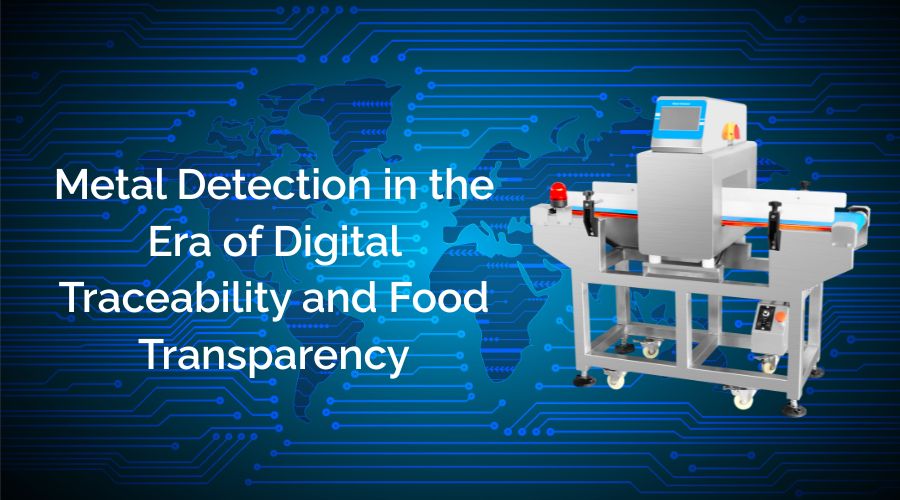
Metal Detection in the Context of Food Transparency
Linking Metal Detector Logs to Batch Tracking and Product History
In today’s food industry, transparency and accountability are key drivers of consumer trust. Integrating metal detector in food industry data with batch tracking systems enables manufacturers to create a detailed product history. Every detection event—including sensitivity calibrations, test piece validations, and contaminant rejections—is automatically logged and associated with the corresponding production batch.
By understanding how a metal detector works, operators can ensure that each batch has been thoroughly inspected, and that any metallic contaminants, whether ferrous, non-ferrous, or stainless steel, are identified before products leave the facility. This traceable record provides verifiable proof of food safety measures and forms the foundation for effective recall management if a contaminant is discovered post-distribution.

How Automated Detection Systems Support Recall Management and Consumer Notifications
Modern metal detectors for food production lines are increasingly integrated with automated detection and reporting systems. These systems can instantly flag contaminated batches, halt production, and trigger alerts to quality managers. When combined with digital traceability platforms, this automation ensures that any affected product is quickly identified, isolated, and recalled.
AI-assisted metal detection further enhances these capabilities by analyzing patterns in detection data, reducing false positives, and identifying potential contaminants in real-time. This not only minimizes operational disruption but also strengthens consumer protection by enabling rapid, targeted notifications for affected products. In this way, metal detection becomes a proactive tool, supporting both regulatory compliance and food safety objectives.
Demonstrating Regulatory Compliance and Consumer Trust Through Documented Detection Data
Documented evidence of detection performance is essential for meeting global food safety regulations, including HACCP, BRC, and FDA standards. By integrating metal detector in food industry logs with traceability systems, manufacturers can generate comprehensive reports showing consistent monitoring, sensitivity validation, and contaminant management across production lines.
These records allow operators to demonstrate how a metal detector works in practice and prove that preventive measures are effectively enforced. Transparent, documented metal detection data not only satisfies regulatory audits but also reinforces consumer trust. In an era where shoppers demand visibility into production processes, companies that can show verified inspection histories for every batch gain a distinct competitive advantage, highlighting their commitment to food safety and operational transparency.
Enhancing Metal Detection with Digital Technologies
AI-Assisted Metal Detection and Predictive Analytics
Modern metal detectors for food production lines are evolving beyond traditional detection methods by incorporating AI-assisted metal detection and predictive analytics. These technologies allow operators to analyze detection patterns, anticipate potential contamination events, and optimize sensitivity settings for different food matrices such as wet, dry, frozen, or coated products.
Understanding how a metal detector works in conjunction with AI enables manufacturers to reduce false positives and ensure that even small or irregular metallic fragments are consistently detected. By integrating predictive analytics with historical detection data, food producers can proactively address contamination risks, maintain food safety, and meet regulatory requirements more efficiently.
Real-Time Alerts and Automated Reporting for Faster Corrective Actions
Digital technologies enhance metal detector in food industry systems by providing real-time alerts and automated reporting. When a metallic contaminant is detected on a production line, these systems immediately notify operators, halt the affected batch, and trigger corrective actions without manual intervention.
Automated reporting also generates detailed logs of detection events, including sensitivity settings, test piece validations, and contaminant types. This ensures that every action is recorded for regulatory compliance and supports traceability. Operators gain clear visibility of the production line, enabling faster decision-making and minimizing the risk of recalls, operational disruption, or brand damage.
Cloud-Based Dashboards and Mobile Access for Remote Monitoring of Production Lines
The integration of cloud-based dashboards and mobile access transforms how food manufacturers monitor metal detectors for food production lines. Real-time data from multiple production sites can be centralized in a cloud platform, providing remote visibility into detection performance, batch inspection records, and compliance metrics.
By understanding how a metal detector works and leveraging cloud connectivity, operators and quality managers can monitor production lines from any location, quickly adjust sensitivity settings, and respond to potential contamination events promptly. This digital traceability not only enhances operational efficiency but also strengthens food safety and transparency, reinforcing consumer confidence in the brand.
Benefits of Combining Metal Detection with Digital Traceability
Improved Food Safety and Contamination Prevention
Integrating metal detectors for food production lines with digital traceability systems significantly enhances food safety and contamination prevention. By linking detection data to batch records and production logs, operators can track every inspected product in real time.
AI-assisted metal detection further improves accuracy, ensuring even small ferrous, non-ferrous, and stainless steel contaminants are reliably identified. Understanding how a metal detector works and combining it with digital monitoring allows manufacturers to proactively address potential risks, minimizing the chances of contaminated products reaching consumers.

Faster Recall Response and Reduced Financial Risk
Digital traceability enables food manufacturers to react quickly in the event of contamination detection. When a metal detector in food industry identifies a foreign object, automated reporting and real-time alerts allow production teams to isolate affected batches immediately.
This data-driven approach not only shortens recall response time but also reduces the financial impact of recalls and liability exposure. By maintaining accurate logs of metal detection performance and batch traceability, companies can demonstrate regulatory compliance while protecting brand reputation.
Enhanced Operational Efficiency Through Data-Driven Insights
Linking metal detector for food production line systems with digital platforms provides actionable insights into production performance. Real-time monitoring, historical detection data, and predictive analytics help operators fine-tune sensitivity, optimize line speed, and reduce false positives.
This data-driven approach ensures consistent detection across different food matrices—wet, dry, frozen, or coated products—while minimizing unnecessary production stoppages. Ultimately, integrating metal detectors in food industry with digital traceability streamlines operations, boosts throughput, and maximizes overall efficiency.
Building Consumer Trust and Brand Reputation in the Era of Transparency
In today’s market, consumers increasingly demand transparency and traceability in the food they purchase. By combining metal detection systems with digital traceability, manufacturers can provide documented proof of contamination prevention and batch-level safety monitoring.
Transparent reporting of metal detector performance and inspection results fosters consumer confidence and strengthens brand reputation. Demonstrating commitment to food safety, operational excellence, and proactive contamination control positions companies as leaders in responsible manufacturing and regulatory compliance.
Challenges and Considerations
Data Security and Integration with Existing ERP/Quality Management Systems
Integrating metal detectors for food production lines with digital traceability systems requires careful attention to data security. Sensitive inspection and production data must be protected from unauthorized access or tampering, especially when leveraging cloud-based dashboards or real-time monitoring tools.
Seamless integration with existing ERP or quality management systems ensures that detection results, audit trails, and batch histories are accurately recorded and accessible across the organization. Understanding how a metal detector works and linking its output to digital platforms can enhance food safety monitoring but requires robust IT infrastructure and cybersecurity protocols.
Standardization of Detection and Traceability Protocols Across Facilities
Consistency is critical when deploying metal detector in food industry systems across multiple production sites. Standardizing test procedures, calibration schedules, and digital traceability protocols ensures that AI-assisted metal detection and automated reporting function uniformly, maintaining reliable contamination prevention.
Without standardized protocols, discrepancies in sensitivity, detection thresholds, or data logging can create blind spots, reduce operational efficiency, and compromise food safety. Companies must define clear SOPs for metal detector for food production line operations, including integration with batch tracking and digital traceability systems.
Training Operators to Leverage Digital Tools Alongside Traditional Metal Detection
Adopting digital traceability and advanced metal detection systems introduces new skills requirements for operators. Employees must understand both how a metal detector works and how to interpret digital dashboards, real-time alerts, and AI-generated insights to make informed decisions.
Comprehensive training programs ensure operators can effectively combine traditional inspection techniques with data-driven monitoring, optimizing detection accuracy and minimizing false positives. Well-trained staff enhance operational efficiency, support compliance with regulatory standards, and strengthen consumer trust by ensuring every product is inspected thoroughly and recorded digitally.

Future Trends in Metal Detection and Digital Traceability
Fully Connected “Smart Factories” with Integrated Metal Detection and Traceability
The future of food manufacturing is moving toward fully connected smart factories, where metal detectors for food production lines are seamlessly integrated with digital traceability systems. Real-time monitoring, automated alerts, and AI-assisted detection are linked to production management platforms, creating a centralized ecosystem that tracks every product batch from raw material intake to final shipment.
In such environments, metal detector in food industry systems not only identify metallic contaminants but also feed data directly into dashboards for proactive contamination prevention. This integration supports operational efficiency, reduces the risk of recalls, and ensures that food safety standards are maintained consistently across all production lines.

Blockchain-Based Traceability for Immutable Contamination Records
Blockchain technology is emerging as a transformative tool for digital traceability in food production. By recording metal detector for food production line results on an immutable ledger, manufacturers can ensure tamper-proof, auditable records of contamination detection and corrective actions.
This technology enhances regulatory compliance by providing verifiable proof of inspection activities, audit trails, and performance validation. Consumers benefit from improved transparency, as they can trust that every batch has been inspected thoroughly. Understanding how a metal detector works and integrating its output into blockchain systems ensures that every potential contaminant is tracked and documented for maximum accountability.
Predictive Compliance and AI-Driven Quality Assurance
Advances in AI-assisted metal detection enable predictive compliance, where data from metal detectors in food industry systems can anticipate potential contamination risks before they occur. Machine learning algorithms analyze historical detection patterns, product matrices, and production conditions to optimize sensitivity settings and identify high-risk points along production lines.
Combining digital traceability with AI-driven insights allows manufacturers to automate quality assurance processes, reduce false positives, and minimize waste. Predictive analytics enhances operational efficiency, supports rapid recall management, and strengthens food safety protocols. By leveraging these technologies, food producers can stay ahead of evolving regulatory requirements and maintain consumer trust in an era of heightened transparency.
Conclusion: Embracing Metal Detection in the Era of Digital Transparency
The Strategic Importance of Metal Detection in Digital Food Ecosystems
In today’s food industry, metal detectors in food industry operations are more than a regulatory necessity—they are strategic tools for safeguarding food safety and ensuring contamination prevention across production lines. When integrated with digital traceability, these systems provide a comprehensive view of every product batch, enabling manufacturers to monitor and record metallic contaminants in real time.
By understanding how a metal detector works and leveraging metal detector for food production line technology, companies can maintain high sensitivity across diverse food matrices, from wet and frozen products to coated or multilayered items. This combination of advanced detection and real-time monitoring strengthens both operational reliability and consumer protection.
Encouraging Manufacturers to Adopt Integrated Detection and Traceability Solutions
Food manufacturers are encouraged to implement integrated metal detection and digital traceability solutions to meet evolving regulatory standards and growing consumer demand for transparency. By combining AI-assisted metal detection, cloud-based dashboards, and automated reporting, operators gain actionable insights that optimize production performance and minimize false positives.
Integrating these solutions across metal detectors for food production lines ensures end-to-end monitoring, supports rapid recall management, and demonstrates compliance with global food safety standards. Manufacturers adopting these technologies gain not only enhanced operational efficiency but also the ability to provide verifiable proof of product safety, reinforcing brand credibility in the market.
Combining Regulatory Compliance, Operational Efficiency, and Consumer Confidence through Digital Transparency
The synergy between metal detector in food industry systems and digital traceability creates a transparent and accountable production environment. By systematically recording detection results, maintaining audit trails, and leveraging predictive analytics, manufacturers can proactively manage contamination risks while maintaining regulatory compliance.
This approach enhances operational efficiency by reducing downtime, minimizing waste, and improving throughput. At the same time, documented detection data builds consumer confidence, showcasing a commitment to safety, quality, and transparency. In an era where trust and traceability are paramount, integrating advanced metal detectors for food production lines with digital traceability represents a forward-looking strategy that balances safety, efficiency, and brand reputation.
FAQ
Q1: What is digital traceability in food production?
A1: Digital traceability is the use of digital systems to track every stage of food production, from raw materials to finished products. It integrates metal detector for food production line data, batch records, and quality inspections for end-to-end transparency.
Q2: What role does metal detection play in digital food production?
A2: Metal detectors in food industry identify ferrous, non-ferrous, and stainless steel contaminants. Integrated with digital traceability, they provide real-time logs, support recalls, and ensure regulatory compliance.
Q3: What are the benefits of AI-assisted metal detection?
A3: AI-assisted metal detectors analyze detection patterns, predict contamination risks, adjust sensitivity automatically, reduce false positives, and improve both detection accuracy and production efficiency.