Introduction
Growing Regulatory Requirements in Food Safety and Contamination Prevention
In today’s food industry, regulatory bodies are placing increasingly strict demands on manufacturers to ensure food safety and prevent contamination. Global standards, including HACCP, FDA, and EU food safety regulations, require companies to implement reliable detection methods to identify foreign objects in production lines. Failure to comply with these standards can result in costly recalls, fines, and reputational damage.
One of the most critical areas of compliance is the detection of metallic contaminants. This is where metal detectors in food industry operations play a pivotal role. By integrating high-performance metal detectors for food production lines, manufacturers can identify even the smallest metallic fragments before products reach consumers, ensuring both regulatory compliance and consumer protection.

The Critical Role of Metal Detection Systems in Food Production Lines
Metal detection systems are no longer optional—they are essential tools for safeguarding products and upholding food safety standards. Advanced food industry metal detectors are capable of identifying a variety of metallic contaminants, including ferrous, non-ferrous, and stainless steel. Understanding how a metal detector works allows operators to implement these systems effectively, optimizing sensitivity for different food types, from wet, frozen, or dry products to coated or multilayered items.
Modern metal detectors for food production lines provide real-time monitoring, automated alerts, and data logging, all of which support proactive contamination control. These systems not only detect contaminants but also enhance operational efficiency by minimizing production stoppages, reducing false positives, and ensuring high-speed inspection across production lines.
Introduction to Test Pieces as a Tool for Validating Metal Detector Performance
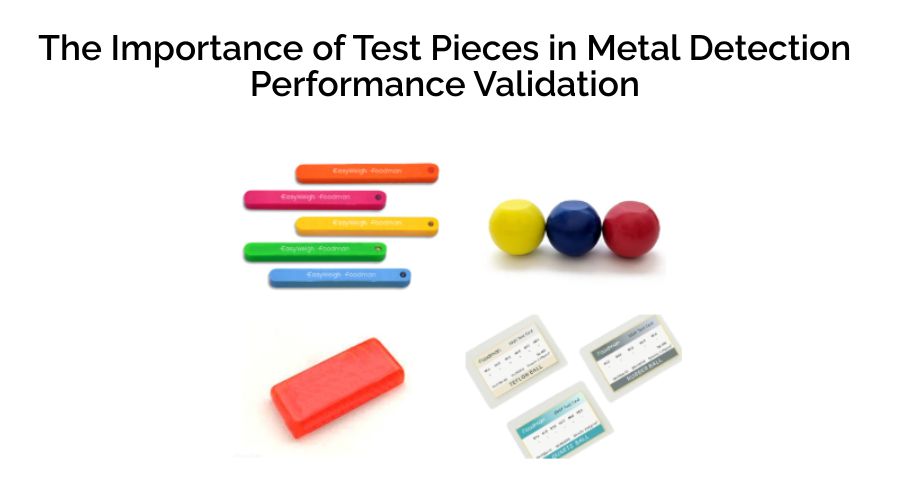
To maintain consistent detection reliability, manufacturers rely on test pieces—standardized metallic samples used to validate metal detector performance. Test pieces simulate real-world contamination scenarios and allow operators to verify that metal detectors in food industry are functioning correctly.
By using test pieces, operators can understand what can a metal detector detect and ensure that even the smallest contaminants are identified under various production conditions. These validations are essential for regulatory compliance, as authorities often require documented evidence of routine performance checks.
Moreover, test pieces help optimize the calibration of metal detectors for food production lines, ensuring high sensitivity without generating unnecessary false positives. Integrating test piece validation into regular quality control routines strengthens food safety practices, minimizes product recalls, and builds consumer confidence in brand reliability.
What Are Test Pieces and Why They Matter
Definition and Types of Test Pieces (Ferrous, Non-Ferrous, Stainless Steel)
In the context of metal detection in food industry, test pieces are standardized metallic samples specifically designed to validate and challenge the sensitivity of metal detectors for food production lines. These test pieces replicate the size, shape, and composition of potential contaminants that could appear in real-world scenarios.
Test pieces come in three main types:
Ferrous test pieces: Containing iron-based metals, often representing machinery wear particles.
Non-ferrous test pieces: Comprising metals such as aluminum, copper, or brass, simulating packaging fragments or raw material contamination.
Stainless steel test pieces: Representing the most challenging contaminants due to their lower magnetic properties and prevalence in modern food processing equipment.
Understanding how a metal detector works with these different metal types is crucial for operators. Each metal interacts differently with the detection field, so calibration using diverse test pieces ensures that food industry metal detectors can detect all types of metallic contaminants effectively.
Role of Test Pieces in Simulating Real Contamination Scenarios
Test pieces are essential for creating realistic contamination simulations, allowing food manufacturers to evaluate how metal detectors in food industry respond under typical production conditions. They are used in combination with various product types, such as wet, frozen, dry, or coated foods, to replicate the “product effect” that can sometimes mask metallic contaminants.
By testing with different sizes, shapes, and metal compositions, operators can determine what a metal detector can detect in real operational scenarios. This proactive approach ensures that any potential hazards, from tiny wire fragments to small stainless steel particles, are reliably detected, enhancing food safety and regulatory compliance.
How Test Pieces Ensure Consistent Metal Detection System Performance
Regular use of test pieces allows operators to verify that metal detectors for food production lines maintain consistent performance over time. By systematically checking detection sensitivity, production teams can ensure that food industry metal detectors are functioning within required specifications and regulatory standards.
Test piece validation also supports routine audits and documentation for regulatory compliance. Food safety managers can demonstrate that metal detectors in food industry are regularly calibrated and tested, providing evidence that all preventive measures are in place to avoid contamination.
Furthermore, using test pieces minimizes false positives and unnecessary product waste, optimizing production efficiency while safeguarding food safety. This ensures that both high-speed lines and complex food matrices are effectively monitored, reinforcing consumer trust and brand reputation.
How Test Pieces Validate Metal Detection Performance
Checking Sensitivity Across Different Food Matrices (Wet, Dry, Frozen, Coated)
Test pieces play a crucial role in verifying the sensitivity of metal detectors for food production lines across a variety of food matrices. Whether inspecting wet, dry, frozen, or coated products, it is essential to understand how a metal detector works in different conditions.
Different food types can create a “product effect,” which may mask metallic contaminants and reduce detection accuracy. By testing with standardized test pieces, operators can adjust sensitivity settings to ensure that even minor fragments are reliably detected. This proactive calibration allows food industry metal detectors to maintain consistent performance, protecting food safety and ensuring compliance with industry regulations.

Ensuring Accurate Detection of Small or Irregularly Shaped Contaminants
Small or irregularly shaped metallic fragments are often the hardest to detect, posing significant risks in food production. Test pieces simulate these challenging contaminants, enabling metal detectors in food industry to be evaluated for their ability to identify even the tiniest or oddly shaped metal objects.
By understanding what a metal detector can detect and systematically testing with diverse test pieces, food manufacturers can minimize false negatives and improve detection reliability. This approach not only enhances food safety but also prevents costly recalls, protects brand reputation, and supports high-speed production efficiency on modern lines.
Verifying Compliance with Industry Standards and Regulatory Requirements
Regulatory authorities often require documented evidence that metal detectors in food industry are functioning effectively. Test pieces are a standardized tool for demonstrating compliance with these standards, including HACCP, BRC, IFS, and other global food safety protocols.
By routinely validating performance with metal detectors for food production lines, operators can generate audit trails, maintain logs of sensitivity checks, and provide proof of consistent monitoring. Understanding how a metal detector works and using test pieces ensures that contamination risks are managed proactively, helping manufacturers meet legal obligations and maintain consumer trust.
Best Practices for Using Test Pieces
Regular and Systematic Testing Schedules
One of the most effective ways to maintain metal detector performance is to establish regular and systematic testing schedules using standardized test pieces. Consistent checks ensure that metal detectors in food industry and metal detectors for food production lines remain highly sensitive to metallic contaminants across all product types.
Routine testing allows operators to identify any deviations in detection performance early, reducing the risk of undetected fragments in finished products. Understanding how a metal detector works helps determine the optimal frequency for testing, which may vary based on the complexity of food matrices, line speed, and product type, including wet, dry, frozen, or coated foods.
Placement Strategies on Production Lines for Representative Validation
The location of test pieces during validation is critical for ensuring accurate results. For food industry metal detectors, placing test pieces at multiple points along the production line—such as raw material intake, post-mixing, and final packaging stages—provides a comprehensive assessment of detection performance.
Proper placement simulates real-world contamination scenarios, allowing manufacturers to verify what a metal detector can detect under typical operating conditions. This approach helps identify blind spots, optimize metal detector for food production line positioning, and improve overall food safety.
Documenting Results and Maintaining Audit Trails for Regulatory Inspections
Regulatory authorities require documented proof that metal detectors in food industry are operating correctly. Maintaining detailed logs of test piece performance tests, including sensitivity checks and detection outcomes, provides verifiable audit trails for inspections.
Using automated reporting systems or integrated metal detection equipment, manufacturers can track how a metal detector works, record testing frequency, and ensure compliance with standards like HACCP, BRC, and ISO 22000. This not only demonstrates regulatory adherence but also reinforces internal quality control protocols and protects brand reputation.
Avoiding Common Errors in Test Piece Use That Can Cause False Positives or Undetected Contaminants
Incorrect use of test pieces can lead to false positives or missed contaminants, undermining both food safety and regulatory compliance. Common mistakes include placing test pieces in non-representative locations, using inappropriate sizes or materials, or failing to account for product effects in wet, dry, frozen, or coated foods.
By understanding how a metal detector works and what a metal detector can detect, operators can avoid these pitfalls. Proper training, careful calibration, and adherence to standardized test protocols ensure that metal detectors for food production lines provide reliable, consistent detection without unnecessary production downtime or product waste.
Benefits of Test Pieces in Food Safety and Production Efficiency
Ensuring High Detection Accuracy to Protect Consumer Safety
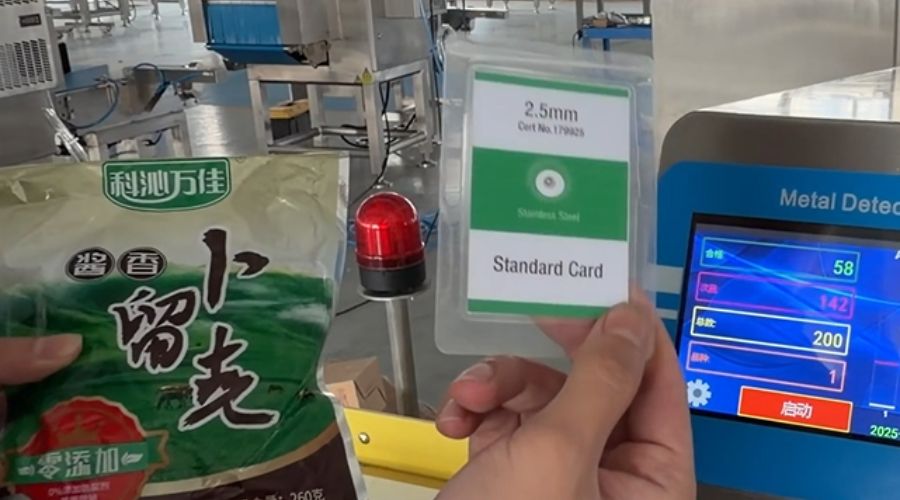
Test pieces play a crucial role in verifying the sensitivity and effectiveness of metal detectors in food industry. By routinely using test pieces across production lines, manufacturers can ensure that metal detectors for food production lines accurately identify both ferrous and non-ferrous contaminants, including stainless steel fragments.
This high detection accuracy is vital for food safety, as it protects consumers from potential injuries caused by metal contaminants. Understanding how a metal detector works and what a metal detector can detect allows operators to fine-tune detection thresholds for different food types—wet, dry, frozen, or coated—ensuring that every product leaving the facility meets stringent safety standards.
Reducing Recalls, Liability, and Operational Risks
Undetected metal fragments can lead to costly recalls, legal liability, and damage to brand reputation. By incorporating test pieces into regular validation routines, food manufacturers can proactively identify gaps in metal detector performance before contaminated products reach the market.
Knowing how the metal detector works and leveraging food industry metal detectors across key points in the production line minimizes the risk of operational disruptions and recalls. This not only safeguards consumers but also reduces financial exposure and strengthens regulatory compliance, making test pieces an essential tool for risk management.
Enhancing Operator Confidence and Training Efficiency
Regular use of test pieces also benefits operators by providing practical, hands-on experience with metal detectors for food production lines. This strengthens understanding of what do metal detectors detect, familiarizes staff with how a metal detector works, and builds confidence in identifying and responding to contamination events.
Training with test pieces ensures consistent application of inspection protocols, reduces human error, and improves overall line efficiency. Operators who are confident in their detection equipment can maintain continuous quality control while minimizing production downtime.
Supporting Long-Term Sustainability by Minimizing Waste from Undetected Contaminants
Accurate detection facilitated by test pieces helps prevent contaminated products from reaching consumers and avoids unnecessary waste caused by false positives or missed detections. By knowing what a metal detector can detect and how to adjust settings for different food matrices, manufacturers can optimize metal detectors in food industry performance while conserving raw materials and reducing environmental impact.
This approach not only improves food safety but also supports sustainable production practices. Minimizing food waste from undetected contaminants contributes to energy efficiency, responsible resource use, and cost savings, making test pieces a critical component of both compliance and sustainability strategies.
Integration with Other Metal Detection Practices
Combining Test Piece Validation with AI-Assisted Metal Detectors
Modern food industry metal detectors are increasingly equipped with AI-assisted detection to enhance contaminant identification. By integrating test piece validation with these intelligent systems, manufacturers can ensure that metal detectors for food production lines accurately detect even the smallest ferrous, non-ferrous, and stainless steel fragments.
Understanding how a metal detector works in conjunction with AI allows operators to differentiate between actual contaminants and harmless product characteristics, reducing false positives and improving overall food safety. Routine use of test pieces confirms that the AI-enhanced systems remain calibrated and reliable, providing confidence in high-speed production environments.
Using Data from Test Piece Validation to Adjust Sensitivity for Different Products
Data collected from test piece testing can guide manufacturers in optimizing metal detector performance across various food matrices, including wet, dry, frozen, or coated products. By analyzing what a metal detector can detect, operators can adjust sensitivity settings for each product type, ensuring consistent contaminant detection without slowing production.
Test piece validation also enables real-time adjustments in response to changes in ingredients, packaging, or processing conditions. This data-driven approach enhances compliance with regulatory standards while maximizing production efficiency and minimizing unnecessary waste.
Multi-Layered Quality Control: Metal Detectors, X-Ray, and Vision Systems
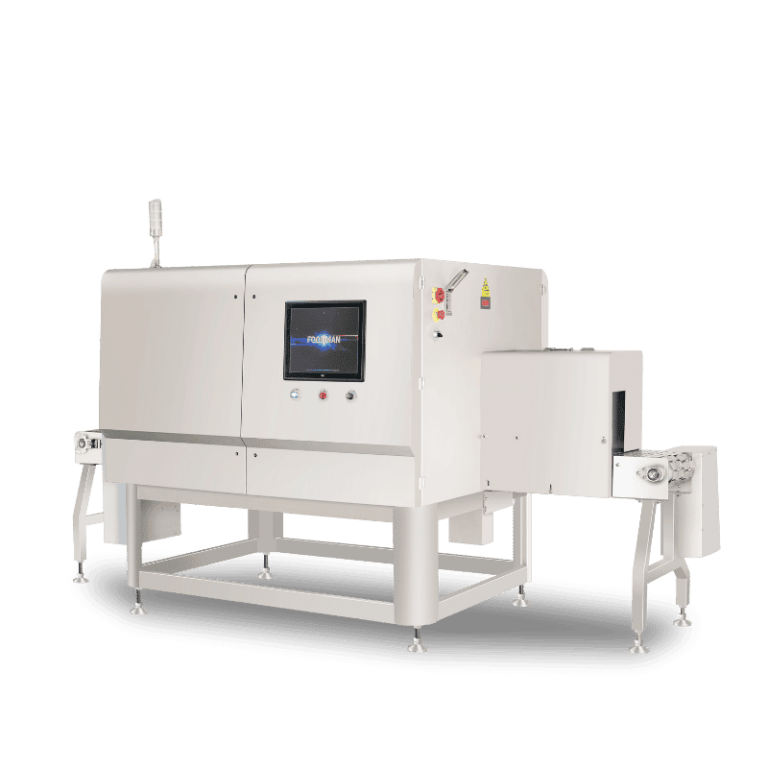
For comprehensive contamination control, test piece validation should be part of a multi-layered quality control strategy that includes metal detectors in food industry, X-Ray inspection machines, and vision systems. While metal detectors identify metallic fragments, X-Ray systems detect dense non-metallic contaminants such as glass, stones, or hard plastics, and vision systems verify packaging integrity, fill levels, and labeling.
By integrating test piece validation into this multi-layered inspection framework, manufacturers ensure that metal detectors for food production lines are performing optimally and that the overall food safety ecosystem is robust. This integration minimizes the risk of recalls, strengthens compliance, and reinforces consumer trust.
Conclusion
Recap of Why Test Pieces Are Essential for Metal Detector Performance Validation
Test pieces are indispensable tools for ensuring the reliability of metal detectors for food production lines. They provide a controlled and standardized way to check what a metal detector can detect—from ferrous and non-ferrous metals to stainless steel fragments—across different food matrices such as wet, dry, frozen, or coated products. By routinely using test piece validation, manufacturers can maintain consistent metal detector performance, uphold food safety, and reduce the risk of recalls, liability, and consumer harm.
Understanding how a metal detector works and how metal detectors in food industry detect contaminants ensures that both operators and management teams can confidently monitor high-speed production lines while complying with stringent regulatory requirements.
Encouragement for Manufacturers to Implement Systematic Test Piece Protocols
Manufacturers are encouraged to adopt systematic test piece protocols as part of their routine quality assurance processes. Scheduled testing, proper placement of test pieces, and meticulous documentation provide a solid foundation for verifying metal detector performance and supporting regulatory compliance.
Integrating test piece validation into standard operating procedures not only ensures that metal detectors in food industry continue to function at peak efficiency but also builds operator confidence and reinforces the company’s commitment to food safety.
Emphasizing the Combination of Validated Metal Detection Systems, Operational Efficiency, and Consumer Safety
By combining validated metal detectors for food production lines with complementary inspection technologies—such as X-Ray systems and vision inspection—manufacturers can establish a multi-layered quality control strategy. This approach safeguards consumers, minimizes production disruptions, and optimizes operational efficiency.
Ultimately, test piece validation is more than a regulatory requirement—it is a strategic tool that links metal detector performance, operational excellence, and food safety. Companies that embrace systematic validation protocols can confidently deliver safe, high-quality products while protecting their brand reputation and maintaining compliance with evolving food industry standards.

FAQ
Q1: What is a test piece in metal detection?
A1: A test piece is a standardized metallic sample—ferrous, non-ferrous, or stainless steel—used to validate the performance of metal detectors in food production lines.
Q2: Why are test pieces important for food safety?
A2: Test pieces simulate real contamination scenarios, ensuring metal detectors can accurately detect contaminants, protecting consumers and preventing recalls.
Q3: How often should test piece validation be performed?
A3: Testing should follow regular, systematic schedules—daily, per shift, or according to regulatory requirements—depending on production speed and product type.