
Introduction: X-Ray Inspection vs. Metal Detectors
Food safety is no longer merely a regulatory requirement; it is a critical factor that determines brand trust, operational efficiency, and global competitiveness. As food supply chains become increasingly complex, manufacturers face mounting pressure to detect and eliminate foreign contaminants from their products before they reach the consumer.
Traditionally, metal detectors have served as the first line of defense. While effective at detecting ferromagnetic metals and certain non-ferromagnetic metals, they possess inherent limitations. It is precisely these “blind spots” that have driven the rapid adoption and application of industrial X-ray inspection technology on modern production lines.
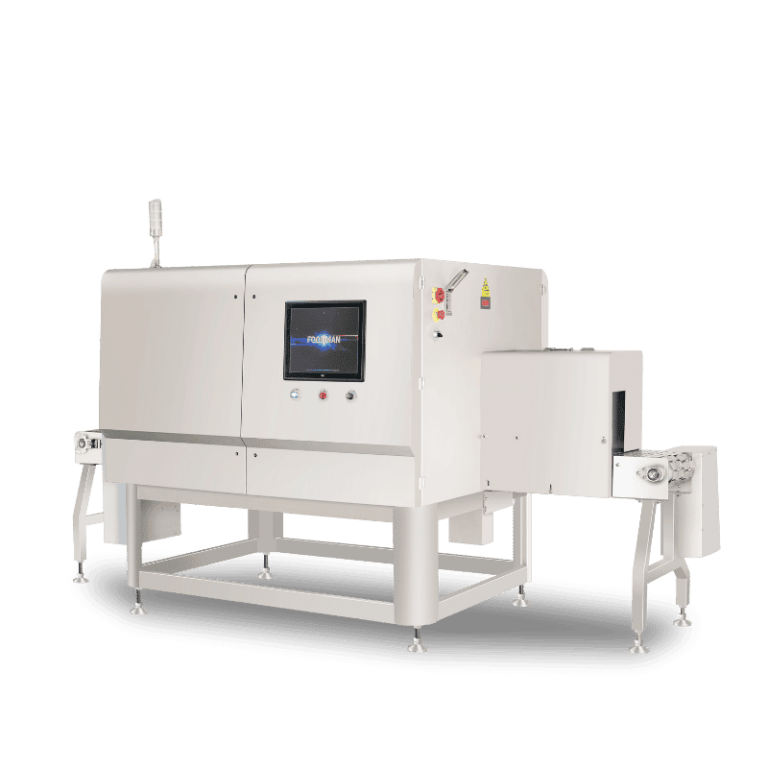
What is X-Ray Inspection? X ray food inspection technology utilizes X-ray beams to penetrate products and generate grayscale images based on material density. Unlike metal detectors—which rely on electromagnetic signals for detection—X-ray inspection systems operate by analyzing density variations, thereby enabling the detection of a much wider range of foreign objects.
The Blind Spots of Metal Detectors. Metal detectors are primarily limited to detecting conductive materials. This limitation means that various hazardous contaminants may be missed—posing serious risks to both consumers and manufacturers alike.
Five Types of Contaminants That Metal Detectors May Miss
Glass Shards — Commonly found in bottled or canned products
Stones and Ceramics — Often introduced during raw material processing
Bone Fragments and Shells — Particularly prevalent during meat and seafood processing
Non-Magnetic Stainless Steel — Difficult for traditional detectors to identify
Hard Plastics and Rubber — Often originating from packaging materials or worn machinery components
These challenges underscore the growing necessity for food X-ray inspection equipment, establishing it as an indispensable supplementary inspection method—and, in some cases, even as the primary inspection solution.
Equipment Comparison: X-Ray Systems vs. Other Inspection Technologies
To fully appreciate the value of X-ray inspection in the realm of food safety, it is essential to compare it with other inspection systems commonly utilized within the food processing industry.
Metal Detectors
Metal detectors offer the advantages of being cost-effective and widely applicable; however, their detection capabilities are subject to limitations. They are primarily designed to detect contaminants consisting of ferrous metals, non-ferrous metals, and stainless steel—yet they are unable to identify non-metallic hazards.
Dynamic Checkweighers
Dynamic Checkweighers are primarily employed to ensure product weight consistency, but they are incapable of detecting foreign objects. While checkweighers are critical for meeting regulatory requirements and implementing quality control, they offer no assurance against foreign object contamination.
X-Ray Inspection Machines
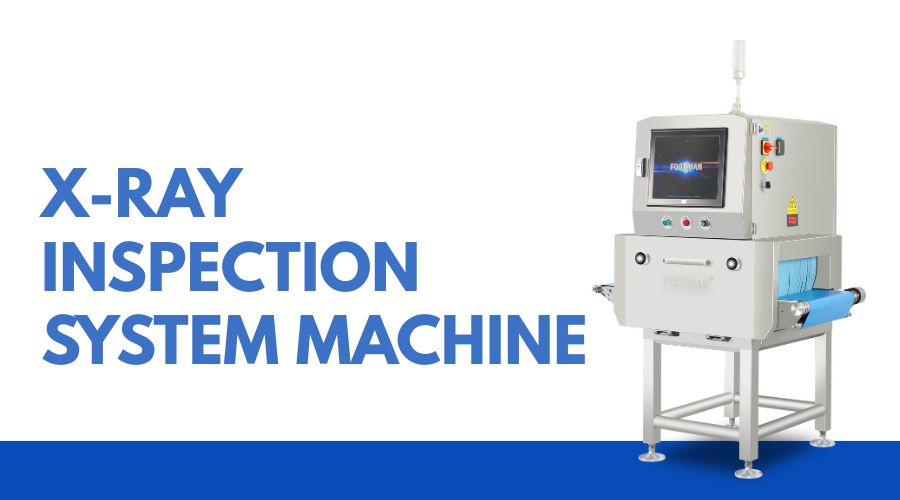
X-ray inspection machines distinguish themselves through the unique advantage of combining density imaging with foreign object detection. They are capable of identifying contaminants regardless of their electrical conductivity, thereby serving as a cornerstone of modern industrial x-ray inspection systems machine.
Vision Sorters
Vision sorters utilize cameras and Artificial Intelligence (AI) to classify or reject products based on their color, size, shape, or surface defects. While these devices are effective at detecting surface imperfections, they cannot identify contaminants located within the product—making them an ideal complement to X-ray food inspection systems.
Integrated Inspection Systems
Today, leading manufacturers are increasingly adopting integrated solutions that consolidate multiple functions into a single unit: weight verification (checkweighing), metal detection, X-ray inspection, and vision sorting. This comprehensive, all-encompassing approach maximizes detection accuracy and production efficiency, thereby underscoring the pivotal role that X-ray food inspection equipment plays within a holistic quality control strategy.
Working Principle: The "Five-Step Process" of X-Ray Inspection
Understanding the working principles behind x ray food inspection helps us appreciate why it proves so highly effective in detecting a wide variety of contaminants.
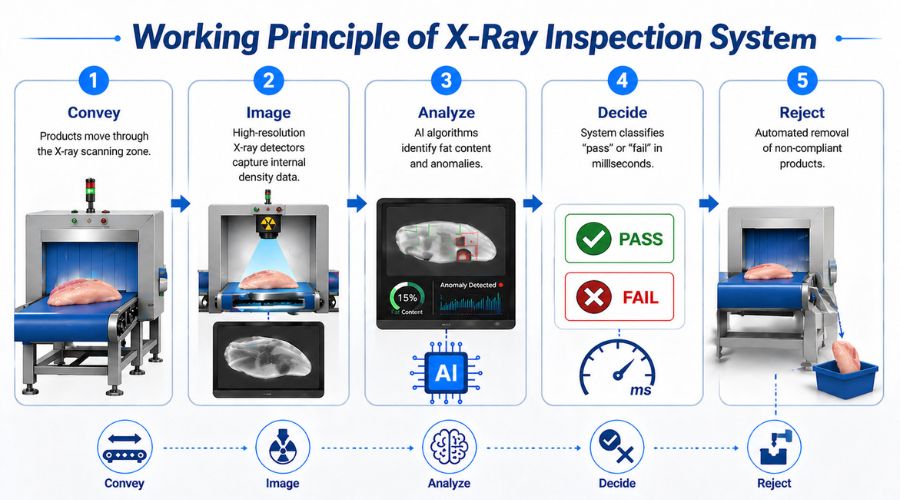
Step 1: Product Conveyance. Products enter the X-ray inspection machine via a conveyor belt system, ensuring they maintain a consistent position and speed throughout the inspection process.
Step 2: X-Ray Imaging. An X-ray generator emits a beam that penetrates the product. Denser materials absorb more radiation and, consequently, appear darker in the resulting image—this constitutes the core principle of industrial X-ray inspection technology.
Step 3: Algorithmic Analysis. Advanced software performs real-time analysis of the images. Modern food X-ray inspection systems utilize Artificial Intelligence (AI) algorithms to identify anomalies based on characteristics such as density, shape, and contrast.
Step 4: Decision Making. The system compares any detected anomalies against pre-set thresholds. Once the presence of a foreign object is confirmed, the product is flagged as “anomalous.”
Step 5: Automatic Rejection. Contaminated products are removed from the production line via an automatic rejection system, thereby ensuring that only safe, compliant products proceed to subsequent stages.
It is precisely through this seamless, interconnected process that food X-ray inspection equipment achieves such exceptional efficiency and precision, making it perfectly suited for high-speed production environments.
Key Technologies Behind X-Ray Inspection Systems
The effectiveness of industrial X-ray inspection depends largely on the following key advanced technologies:
1. Dual-Energy X-Ray Technology. Dual-energy X-ray systems are capable of distinguishing between different materials based on their atomic composition, thereby significantly improving the detection accuracy for low-density contaminants (such as plastics, bones, etc.)—a capability that greatly enhances the overall performance of X-ray inspection systems in food safety applications.
2. High-Sensitivity Detectors. Modern detectors are capable of capturing high-resolution images, enabling X-ray inspection systems to identify even extremely minute foreign objects.
3. AI-Assisted Inspection. Artificial intelligence technology enhances pattern recognition capabilities, allowing x ray for food inspection systems to adapt to variations in product diversity while effectively reducing false alarm rates.
4. Adaptive Compensation Technology. Traditional inspection systems often struggle to handle products with non-uniform density—such as mixed or layered food items. Adaptive compensation technology ensures that food X-ray inspection equipment maintains stable and consistent performance even when processing such products.
5. Low-Dose Radiation Safety. Despite common concerns, industrial-grade X-ray inspection equipment utilizes extremely low radiation doses, thereby ensuring the safety of both operators and consumers while remaining in full compliance with all applicable regulatory requirements.
Key Application Scenarios
The broad applicability of X-ray inspection technology within the food safety sector enables it to effectively meet the diverse inspection requirements of various food processing industries.
Meat, Poultry, and Seafood Products: Detecting bone fragments, shell shards, and metal contaminants is of critical importance. X-ray inspection systems excel at identifying these hazards, accurately detecting them even when they are embedded deep within high-density protein products.

Baked Goods and Grain Products: During the raw material handling process, stones, glass shards, and plastic fragments may inadvertently find their way into the products. Food X-ray inspection equipment ensures that all such contaminants are detected and removed before the products proceed to packaging.
Canned and Glass-Jarred Foods: Contamination by glass shards poses a significant safety hazard. Industrial-grade X-ray inspection systems are capable of detecting glass fragments embedded within the product—even through the glass container itself—a task that traditional metal detectors are unable to accomplish.
Frozen Foods: Fluctuations in temperature and variations in product density can potentially compromise inspection accuracy. Advanced food X-ray inspection systems feature automatic compensation capabilities, enabling them to effectively mitigate the impact of these variables.
Bulk Powders and Granular Products: Spices, flour, and various other powdered products are highly susceptible to contamination. When handling these particularly challenging inspection subjects, X-ray inspection technology provides a reliable and robust layer of detection security.
Conclusion: Bridging the Detection Gaps of Metal Detectors
Although metal detectors remain highly valuable inspection tools, they are no longer sufficient on their own to meet today’s rigorous inspection demands. Glass, stones, bone fragments, non-magnetic metals, and hard plastics—these five major categories of “detection blind spots”—pose significant safety hazards that can only be effectively identified and eliminated by industrial-grade X-ray inspection systems.
Balancing Product Recall Costs Against ROI. A single product recall incident can result in direct financial losses amounting to millions of dollars—not to mention the long-term damage inflicted upon a brand’s reputation. Therefore, investing in food X-ray inspection equipment is not merely about meeting regulatory compliance requirements; it is a highly strategic decision capable of delivering a quantifiable and tangible Return on Investment (ROI).
How to Choose the Right X-ray Inspection Solution?
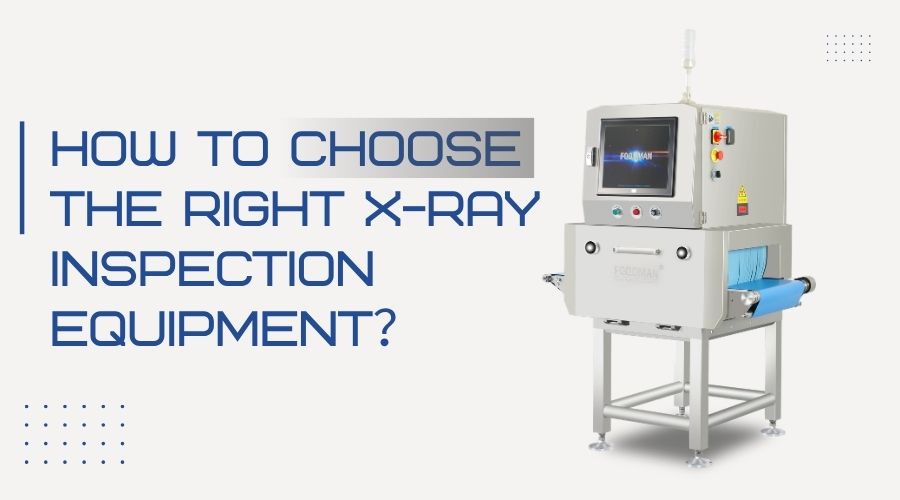
When selecting X-ray inspection equipment, please consider the following factors: product type and density, packaging shape, production line speed, required detection sensitivity, and integration capabilities with existing systems.
Foodman: Your One-Stop Solution Provider
Foodman has developed a suite of AI-centric algorithms specifically designed for X-ray inspection systems. These algorithms possess the capabilities for real-time analysis, autonomous learning, and complex decision-making—thereby elevating standards for safety, quality, and operational efficiency to levels unattainable by traditional inspection methods, with the aim of effectively addressing the real-world challenges facing the food industry. Furthermore, Foodman offers integrated solutions that combine X-ray for food inspection with automated checkweighing and sorting technologies, empowering manufacturers to build smarter, safer production lines.
Frequently Asked Questions
Yes. Whether the products are liquid or solid, packaged or in bulk, X-ray food inspection equipment can be customized to meet specific application requirements and satisfy the inspection needs of virtually all food categories.
X-ray inspection systems are capable of detecting a wider range of contaminants—including non-metallic foreign objects—making them superior to traditional metal detectors in terms of both detection scope and comprehensiveness.
Yes. X-ray equipment is capable of detecting foreign objects within products packaged in aluminum or metalized films. Furthermore, an increasing number of canned food manufacturers utilize X-ray inspection to detect foreign objects inside cans, thereby ensuring the safety of their food products.