Introduction
For decades, food safety inspection has revolved around a single primary objective: detecting physical contaminants. Metal detectors, checkweighers, and X-ray systems have become the industry standard for identifying foreign objects such as metal fragments, glass, stones, and high-density plastics. These technologies have significantly enhanced production safety and helped food processors meet increasingly stringent regulatory requirements.
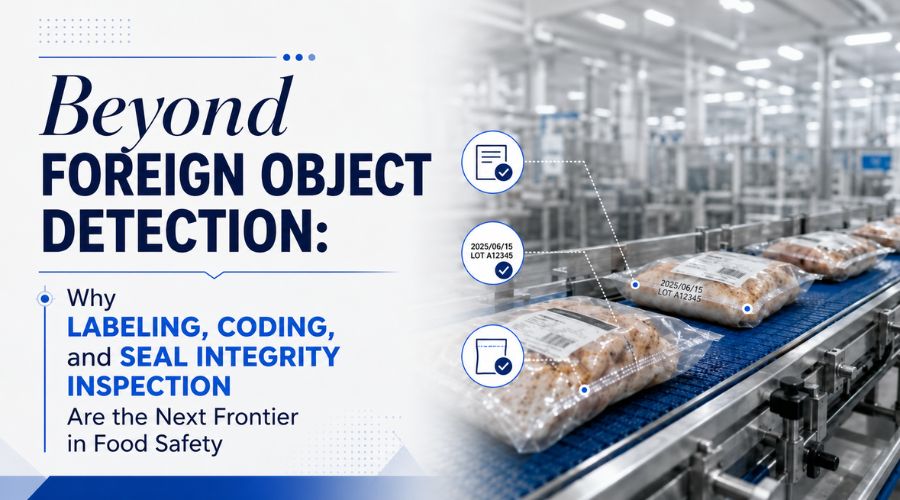
However, the modern food production environment has evolved far beyond simple contaminant control. Today’s packaging lines operate at extremely high speeds. They often handle multiple SKUs simultaneously while serving demanding global markets. In these markets, traceability, label accuracy, and packaging integrity are just as important as foreign object detection.
Today’s product recalls reveal a different reality. Millions of products are pulled from shelves not because of metal or glass other foreign objects contamination, but due to mislabeled allergens, missing date codes, illegible batch numbers, or compromised seals that jeopardize product sterility. Traditional inspection methods—such as manual vision checks, pressure decay testers, or random sampling—are no longer sufficient. They are slow, subjective, and highly susceptible to human error.
New challenges have further exacerbated this issue: faster production lines, thinner packaging materials, more complex recyclable seals, and regulatory mandates for complete traceability. In this environment, vision inspection systems have evolved from a mere “nice-to-have” feature into an operational necessity. This article explores why label compliance, print verification, and seal integrity have become the three pillars of modern food safety, and how advanced automated packaging inspection strategies can effectively balance safety assurance with profitability.
The New Frontiers: Labels, Codes, and Seals
1. Label Compliance Inspection: The First Line of Defense Against Allergen Recalls
Packaging label errors are not minor mistakes; they carry legal liability. Imagine a consumer with a peanut allergy picking up a jar of curry sauce labeled “nut-free”—the consequences could be catastrophic. Over the past five years, regulatory bodies such as the U.S. Food and Drug Administration (FDA) and the European Commission have issued more allergen-related recalls than those caused by physical contamination.
Label compliance inspection involves more than just verifying the presence of a label. It also validates:
The system verifies that the SKU matches the correct packaging format, including standard and gluten-free variants.
It also checks whether ingredient lists and allergen declarations remain clear and readable.
Label orientation and positioning are inspected to ensure labels are not skewed, inverted, or misplaced.
In addition, the system confirms that barcodes and QR codes can be scanned accurately.
Vision-based coding systems play an indispensable role in this process. Unlike human inspectors, who may experience fatigue after just 20 minutes on the job, vision-based systems can capture multiple images per second and cross-reference each label against a standard template. They can detect issues such as a 1mm positional shift, a missing “Contains: Milk” declaration, or an illegible batch code—all before the packaging leaves the production line.
2. Code Verification: Ensuring Traceability and Regulatory Compliance
Date codes, batch numbers, and expiration dates serve as the silent chroniclers of a product’s journey. If a production line prints “2026-02-30” (an invalid date) or if half the digits are missing due to a clogged inkjet nozzle, traceability collapses. In the event of a product recall, a manufacturer might be forced to recall six months’ worth of production—rather than just six hours’—because illegible codes make it impossible to identify the specific affected batches.
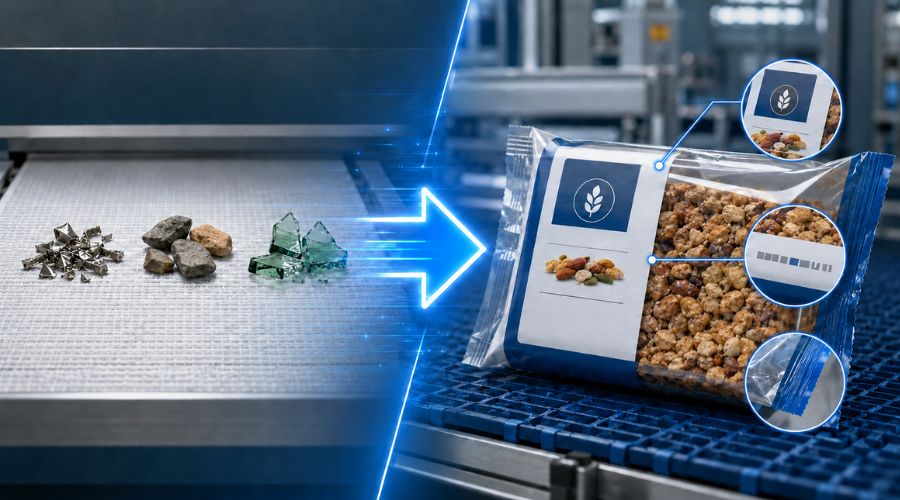
Print integrity verification is designed to address the following four common failure modes:
Common coding failures include:
Missing prints caused by ink or ribbon supply problems.
Partially printed characters that result in incomplete codes.
Low-contrast or smudged markings that reduce readability.
Incorrect information such as invalid dates, wrong timestamps, or line ID errors.
Modern vision coding inspection systems combine high-speed industrial cameras, OCR technology, and AI-based validation tools. These systems can verify multiple packaging parameters in real time, including:
Inkjet print quality
Laser marking consistency
Character spacing
Date accuracy
Code positioning
Barcode grading
QR code readability
Print contrast
In production environments characterized by high humidity or elevated temperatures, coding quality often fluctuates due to factors such as condensation, vibration, or printer wear. A robust automated packaging inspection system can continuously monitor print quality in real time and immediately reject non-compliant products.
This constitutes real-time correction, rather than merely retrospective quality assurance. The system can trigger alarms, halt filling operations, or divert defective packaging—all without the need for human intervention. For high-speed production lines manufacturing 600 bottles per minute, this level of automation is indispensable.
3. Seal Integrity Inspection: The Invisible Threat to Food Safety
Missing or compromised seals pose physical, chemical, and biological hazards. A loose lid on a jar of baby food or a pinhole in the film seal of a modified-atmosphere meat tray can allow the ingress of oxygen, moisture, and pathogens. Unlike metal fragments—which can be detected via X-ray—compromised seals remain invisible to traditional metal detectors.
Whether involving flexible pouches, bottle caps, tray seals, or can seams, even a microscopic leak can trigger the following consequences:
Oxygen ingress
Moisture contamination
Microbial proliferation
Product spoilage
Reduced shelf life
Traditional leak detection methods are often destructive, rely on random sampling, or operate too slowly to keep pace with the throughput demands of modern production lines. Consequently, an increasing number of manufacturers are deploying AI-based vision coding inspection system to achieve non-contact verification of seal integrity.
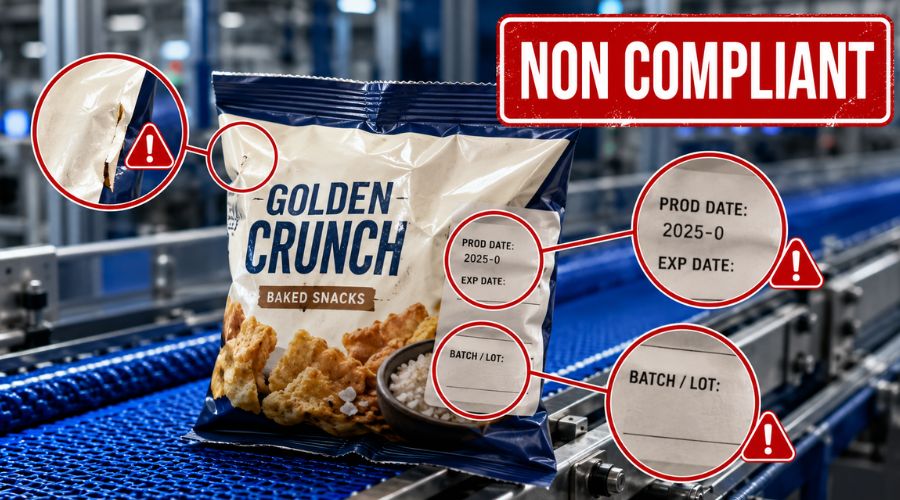
An advanced automated packaging inspection platform integrates machine vision, thermal imaging, and intelligent defect analysis technologies to precisely detect the following anomalies:
Incomplete heat seals
Wrinkling in the seal area
Misaligned caps
Tamper-evident ring defects
Contamination at the seal interface
Cracks in the container rim
Improper vacuum sealing
Inconsistent double seals
The system uses 3D laser profiling and infrared imaging to identify microscopic leak channels. These tiny defects can compromise vacuum integrity and shorten product shelf life. For bottled products utilizing induction seals, the vision system verifies the uniformity of the seal foil’s adhesion; even if the foil appears to be “present” and intact, any wrinkling will prevent it from providing an effective airtight barrier.
The economic impact of such quality issues is both direct and significant: a single leaking item within a case of products can often contaminate adjacent items, triggering customer complaints, product returns, and even the loss of valuable retail shelf space. For a full pallet of premium organic soups, a single seal failure can result in retailers levying chargebacks exceeding $50,000. By instantly identifying defective items within just three seconds of cap tightening, automated packaging inspection systems effectively eliminate such losses.
Foodman's Integrated Solutions
As food safety challenges continue to evolve, manufacturers require more than just standalone inspection equipment. They need an integrated quality control ecosystem capable of safeguarding every stage of the packaging process.
Bidding Farewell to Fragmentation: The Shift from "Point-to-Point" to "End-to-End"
Traditional production lines often treat metal foreign object detection, date coding, seal integrity monitoring, and manual label verification as isolated steps. This decentralized architecture frequently creates inspection blind spots, thereby increasing brand risk.
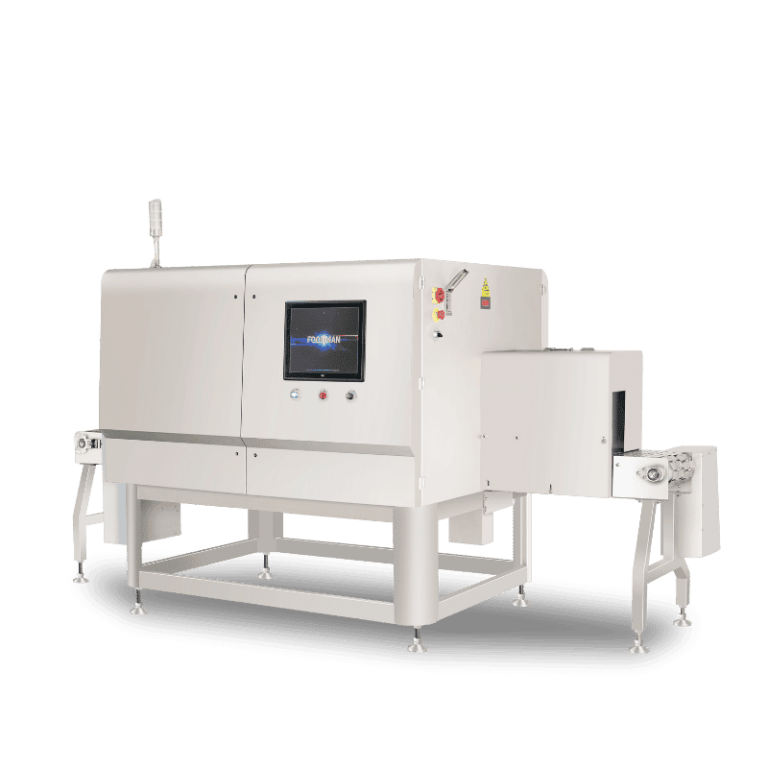
Foodman combines advanced machine vision technology with intelligent automated packaging inspection solutions to create a comprehensive packaging validation platform for food and beverage manufacturers. Rather than relying solely on foreign object detection at the end of the production line, Foodman’s systems provide multi-layered protection throughout the entire manufacturing process. This is precisely where Foodman’s true value lies.
At the core of Foodman’s value proposition is “integration.” We break down the logic of isolated inspections, transforming the entire packaging line into an intelligent, organically integrated whole.
Core Components of Foodman's Integrated Intelligent Inspection Architecture:
Multi-Dimensional Protection: Combines high-precision X-ray systems with high-efficiency checkweighers to ensure precise weight accuracy and completely eliminate foreign objects.
AI Vision Evolution: Leverages an AI vision inspection system and intelligent vision encoding modules to enable millisecond-level automated verification of labels, barcodes, caps, and seal integrity.
Closed-Loop Control: Integrated with a real-time rejection mechanism to ensure that no non-conforming products ever reach the market.
Data-Driven Insights: Utilizes a centralized production analysis platform to transform inspection data into predictive production insights.
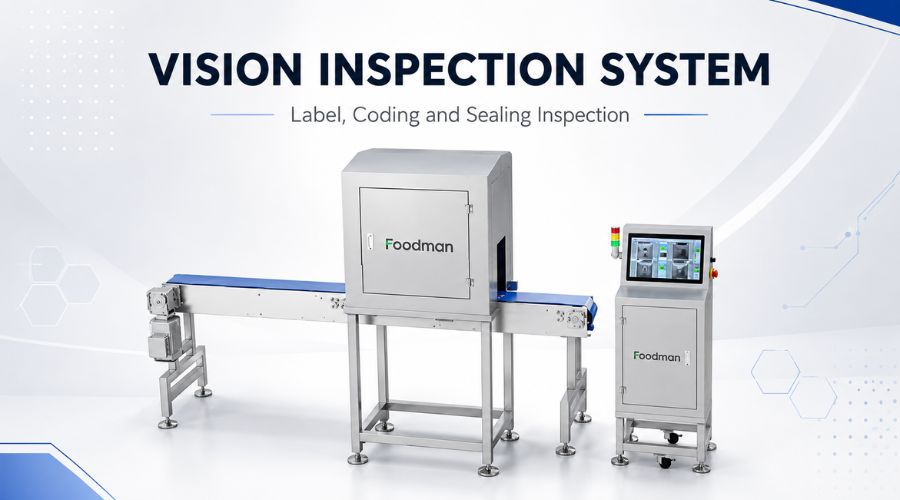
How Foodman's vision Coding System Works
Foodman’s vision coding system achieves deep synergy with quality inspection systems by embedding label compliance verification directly into the closed-loop packaging process.
During product manufacturing, the system first utilizes a dynamic checkweigher to weigh each individual product in real-time, identifying and rejecting any non-conforming items that exceed permissible weight deviation limits.
Subsequently, an X-ray inspection module scans the interior of the weight-verified products for foreign objects; this module effectively identifies contaminants such as metal, glass, and high-density plastics, and automatically rejects any products containing such foreign bodies directly on the production line.
Upon completion of these physical inspections, the products proceed to the packaging stage—a critical phase involving label application, code printing, and seal integrity verification.
At this juncture, the vision coding inspection system assumes the role of final compliance arbiter, performing real-time checks to detect missing labels, positional misalignments, or data errors; it also verifies the completeness and legibility of printed codes, as well as the reliability of the product seals.
Throughout this process, Foodman’s vision coding system integrates coding traceability capabilities, linking the inspection results of each individual product to a unique identifier code.
This integration enables the automated determination of label compliance status and facilitates the comprehensive traceability of process data. Through this collaborative mechanism, the system is able to identify and intercept all visionly non-compliant products before packaging is finalized, thereby ensuring that every product leaving the facility meets both regulatory mandates and internal corporate standards across the three critical dimensions of labeling, coding, and sealing integrity.
Foodman’s AI-powered vision inspection solution supports rapid recipe changeovers and flexible inspection settings. Manufacturers can maintain high inspection accuracy while preserving production speed. This inherent flexibility is particularly vital for beverage bottlers, canned food producers, dairy manufacturers, and contract packagers that manage diverse and varied product portfolios.
Real-World Application Case Study
A U.S.-based manufacturer of pre-packaged food products integrated checkweighing, X-ray foreign object detection, and AI-based vision inspection into a unified, end-of-line quality control system.
This solution enables the simultaneous verification of product weight, contaminant detection, seal integrity checks, and the validation of labels and date codes—all while the production line operates at speeds exceeding 250 packages per minute.
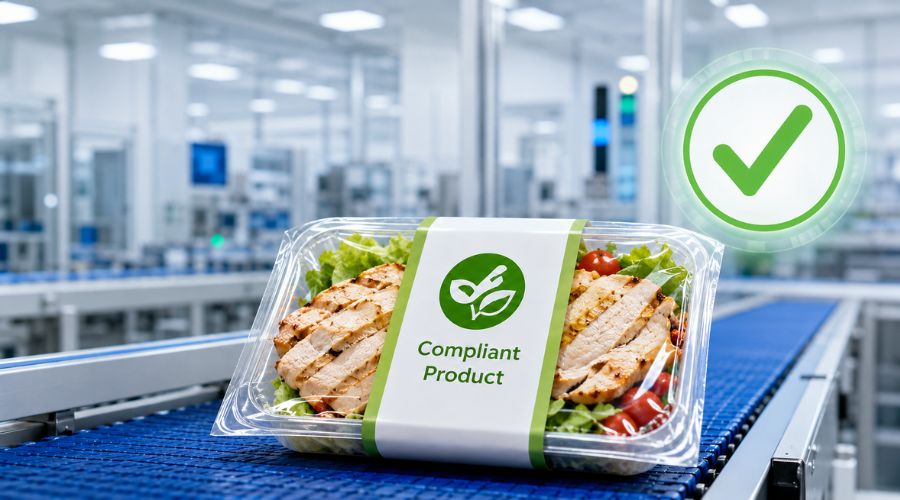
This comprehensive approach embodies the future direction of food safety and packaging quality assurance. By consolidating contaminant detection, weight verification, seal integrity testing, and AI-driven label and code validation into a single integrated inspection system, manufacturers can significantly mitigate recall risks, enhance regulatory compliance, and comprehensively boost production efficiency.
As food production lines continue to accelerate and face increasingly stringent quality standards, integrated inspection systems are becoming indispensable tools for achieving operational excellence and earning consumer trust.
Conclusion: New Standards for Food Safety
The food industry has mastered foreign object detection technologies; however, the greatest risks still lie in what consumers see—or fail to see—on product packaging. Incorrect allergen labeling, illegible production codes, or compromised seals all pose direct safety hazards—issues that traditional metal detectors and X-ray machines are unable to address.
The next frontier is vision inspection. Vision coding systems improve traceability across the production line. Meanwhile, vision inspection systems verify label compliance, confirm seal integrity, and automate packaging inspections. Together, these technologies help manufacturers eliminate hidden safety risks.
Foodman’s integrated solutions demonstrate that shifting from single-point detection to comprehensive line-wide assurance can simultaneously enhance both safety and profitability.
In the coming years, regulatory oversight is expected to become even more stringent. Regulators and major retailers are increasingly mandating the implementation of automated label and code verification. The critical question is not whether to vision coding inspection systems, but rather how quickly your facility can complete this transition. This strategic decision will define the landscape of food safety for the next decade.
FAQ
A: While foreign object detection can screen for physical contaminants, it cannot detect issues such as mislabeled allergens, incorrect expiration dates, or compromised package seals—which are precisely some of the leading causes of food recalls today.
A: Seal integrity refers to the airtightness of the packaging. Even a minuscule leak can lead to bacterial growth and food spoilage—processes that often begin long before the consumer ever opens the product.
A: Yes. Modern solutions like those offered by Foodman feature a modular architecture design, allowing them to integrate seamlessly into existing production lines to provide a unified data monitoring dashboard and automated rejection mechanisms.