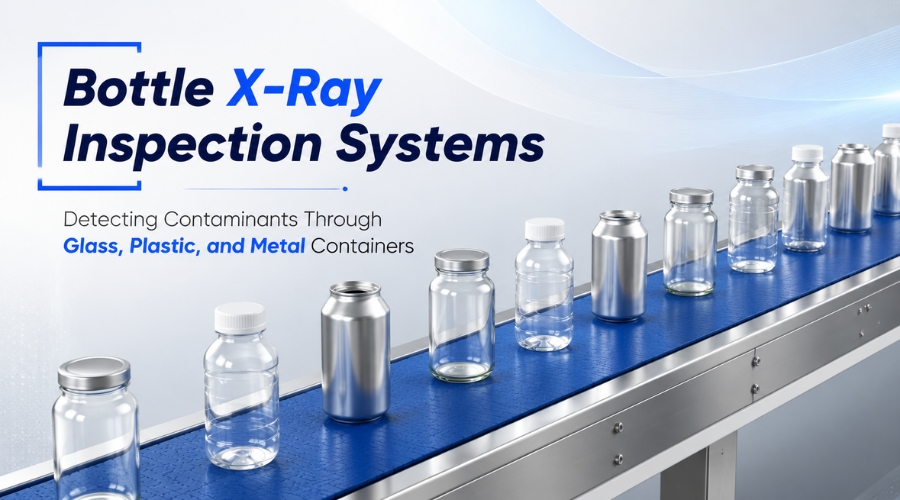
Introduction: Increased Demand for Advanced Container Inspection Technology
Product safety has become a vital aspect of remaining competitive in the highly regulated food and beverage business. Every day, a billion glass jars, PET bottles, metal cans, and composite packaging are processed on production lines around the globe. Foreign item contamination—caused by raw materials, equipment wear, packing problems, or the manufacturing environment—can be disguised within sealed containers, making it difficult to detect with the human eye or typical inspection procedures.
As a consequence, contemporary X-ray inspection systems for containers have emerged as a vital tool for assuring food safety. Unlike equipment that can only detect metal, modern X-ray technology can accurately identify both metallic and non-metallic foreign items. However, conventional single-beam inspection can still have blind areas due to container geometry, liquid sloshing, or packaging overlaps.
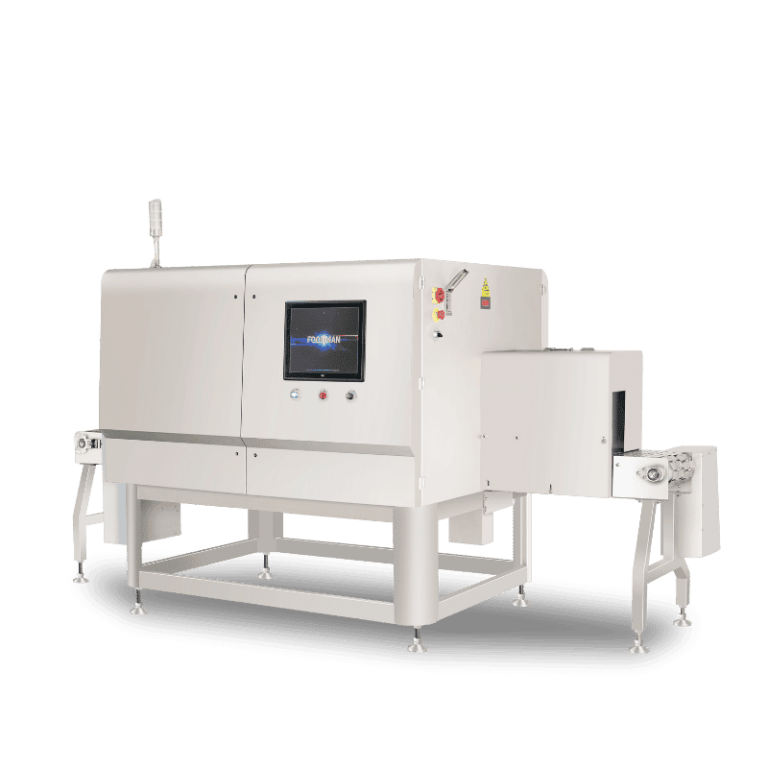
Foodman specialises in cutting-edge inspection technology. Our dual-beam X-ray systems—designed specifically for glass jars and bottled foods—utilise X-ray sources from two different angles to perform cross-scanning. This effectively eliminates blind spots and enables comprehensive inspection of various packaging types, including glass bottles, metal cans, and plastic bottles. By delivering superior reliability and higher quality assurance standards for the food, beverage, and pharmaceutical industries, we help ensure your production lines remain safe and compliant.
Why Traditional Inspection Methods Fall Short of Modern Demands
In the past, food manufacturers relied primarily on basic checkweighers and simple metal detectors. While effective for basic applications, these methods face significant challenges in today’s complex packaging environments:
Limitations of Metal Detectors:
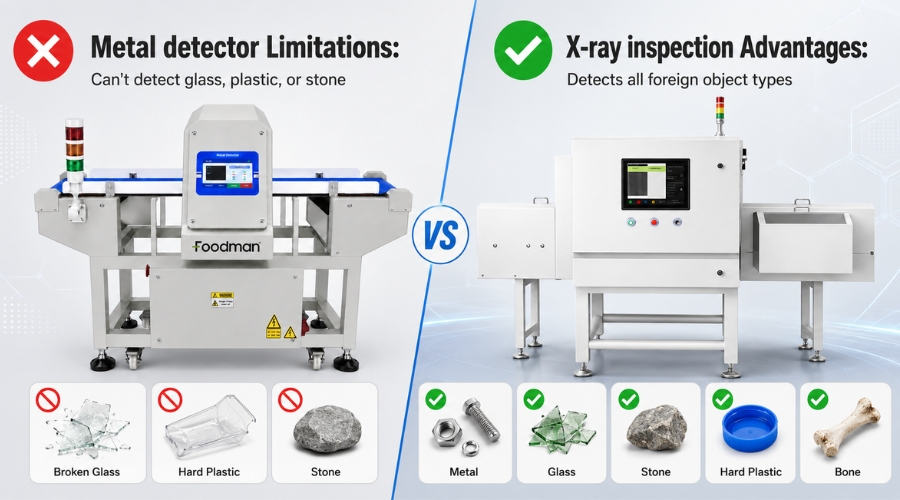
Traditional metal detectors struggle to inspect products packaged in aluminium foil or metal containers. Because the containers themselves are conductive, the detectors cannot distinguish between the packaging and tiny metal contaminants inside, leading to high false-rejection rates or even a complete inability to detect contaminants.
The “Shadow” Effect:
Standard X-ray food inspection systems relying on a single beam are often constrained by geometry. When bottles or cans have thick bases, curved sidewalls, or complex cap structures, contaminants can “hide” within the shadows cast by the packaging material.
Material Diversity:
Detecting tiny glass fragments inside glass jars or stones within dense plastic containers requires a higher level of sensitivity than basic inspection equipment can provide.
Companies producing bottled and canned products are raising their inspection requirements in response to worldwide food safety standards such as FSMA, HACCP, and GFSI. Because of the opacity of glass bottles, plastic bottles, and metal cans, standard hand inspection usually fails to detect foreign objects hidden within the packaging.
Advanced X-ray inspection systems for bottles and cans use dual X-ray beams to penetrate packaging materials and perform non-destructive internal inspection. Even with complex products—such as liquid beverages, sauces, and canned goods—these systems reliably detect metal, glass, stone, and other high-density contaminants, ensuring food manufacturers meet international safety standards.
Working Principle of X-ray Inspection Systems for Bottled and Canned Products
Modern X-ray inspection systems for bottles and cans (dual-source X-ray foreign object detection machines) operate by simultaneously scanning products from two different angles or using two different energy levels to capture multi-dimensional image data.
As a bottle passes through the inspection zone, the system generates a high-resolution density map. Computer vision algorithms then analyse the map and compare it to a “clean” baseline. If the system detects an object with a density much higher than that of the product (for instance, metal, glass, ceramic, or high-density plastic), it immediately begins a rejection process.
For X-ray inspection systems handling glass jars and bottled foods, the container base often presents a challenge. Advanced Foodman systems utilise a specialised geometric design that employs cross-imaging to scan the “blind spot” at the bottom of the container, thereby ensuring comprehensive coverage from the cap down to the base.
Dual-source X-ray technology enables contaminant detection
Dual-beam X-ray inspection systems offer capabilities for inspecting bottled and canned foods that far surpass those of metal detectors and single-beam X-ray foreign object detection systems.
By utilising X-rays at both high and low energy levels, dual-source systems can distinguish between materials that have similar densities but different atomic numbers. This technology filters out interference from packaging—such as glass bottle walls—to precisely identify foreign objects inside the container, representing a breakthrough solution for bottled food inspection.
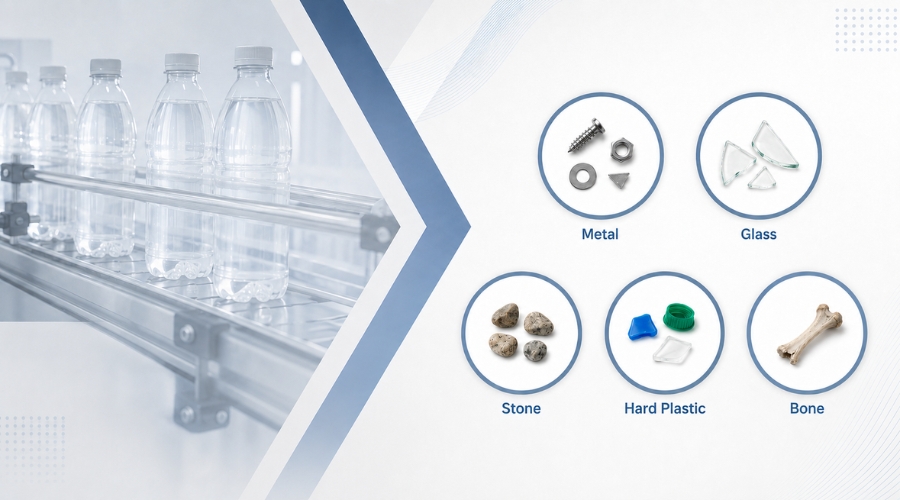
High-quality X-ray food inspection systems can identify various foreign objects that pose a risk to consumer safety, including:
Ferrous, non-ferrous, and stainless metals: Even tiny fragments that conventional metal detectors cannot detect.
Glass fragments: Often transparent to the naked eye, these can be identified by contrasting their density with that of the liquid or solid food product.
Stones and minerals are high-density natural contaminants found in fresh foods.
High-density plastics and rubber are frequently used in industrial parts that may accidentally come off during processing.
Calcified bone fragments are a serious hazard for meat and poultry products.
By utilising two distinct energy levels (high and low), the system can differentiate between materials of similar mass but different atomic numbers. This represents a groundbreaking innovation for X-ray inspection systems used for glass jars and bottled foods; it enables the machine to “ignore” packaging materials—such as the glass walls of a jar—and focus instead on detecting foreign objects inside.
Common application
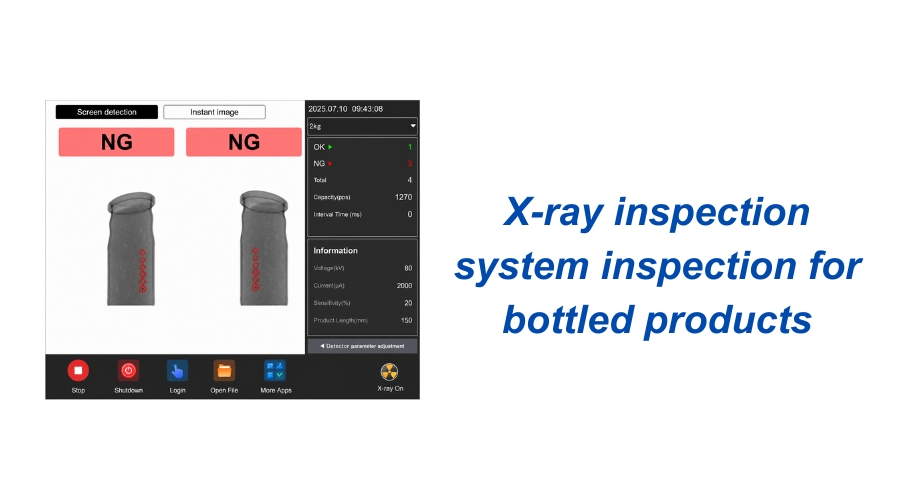
Highly slender containers:
The special shape of the container can easily interfere with side wall detection and imaging, and dual light source X-rays can avoid detection errors caused by geometric structures.
Multi-density mixed materials:
Sauces, pickles and other materials with solid blocks have uneven density distribution and can accurately identify foreign objects such as mixed stones.
Detection of foreign matter in metal cans:
It can detect impurities inside steel cans, making up for the shortcomings of traditional metal detectors that cannot penetrate the tank for detection.
Relying on the advantages of dual-light X-ray differential imaging, foreign object detection problems in various complex packaging and special material scenarios can be efficiently solved to fully ensure product safety and compliance.
Key Advantages of Dual-Beam X-Ray Inspection Systems
Superior Inspection Performance
Compared to single-beam systems, dual-beam technology offers substantial performance enhancements, like higher foreign item identification rates and fewer false rejections of good products. It determines a wide range of metallic and non-metallic contaminants, accommodates materials of varying densities and packaging types, and works in a stable, reliable way.
Lower Long-Term Total Cost of Ownership
While the initial investment is slightly higher, the total lifecycle cost is more favourable: reduced false rejections minimise raw material waste; the equipment is durable with low maintenance requirements; stable operation reduces production line downtime; and product changeovers are quick and easy, enhancing line efficiency.
Compliance with Global Food Safety Regulations
The system complies with HACCP, FSMA, and BRC standards, as well as export requirements from different nations. It provides hazard evaluations, preventive controls, and third-party compliance certification, leading to smooth and seamless regulatory inspections.
Safeguarding Brand Reputation Across the Board
Incidents involving foreign objects can trigger multiple losses, including product recalls, customer churn, regulatory fines, shrinking market share, and rising insurance costs. Equipping your facility with this system demonstrates a commitment to quality control and safety, effectively mitigating both reputational and financial risks.
Seamless Production Line Integration
The system integrates effortlessly with existing production line equipment: it pairs with metal detectors for dual-layer protection, links with checkweighers for weight verification, connects with vision systems for comprehensive quality inspection, and interfaces with factory management systems to capture and archive inspection data.
The dual-beam X-ray inspection system represents not merely a generational technological upgrade but a tangible fulfilment of a company’s commitment to quality. Through superior detection precision, lower total costs, and robust compliance assurance, it ensures that every product on the line stands the test of both the market and time.
Why Choose the Foodman Dual-Source X-Ray Inspection Solution?
Foodman recognises that operating conditions vary significantly across food production lines, meaning there is no “one-size-fits-all” inspection solution. For bottled and canned products, we provide customised X-ray quality inspection equipment designed to accommodate diverse packaging types, varying material densities, and rigors hygiene standards, thereby establishing a comprehensive quality assurance system.
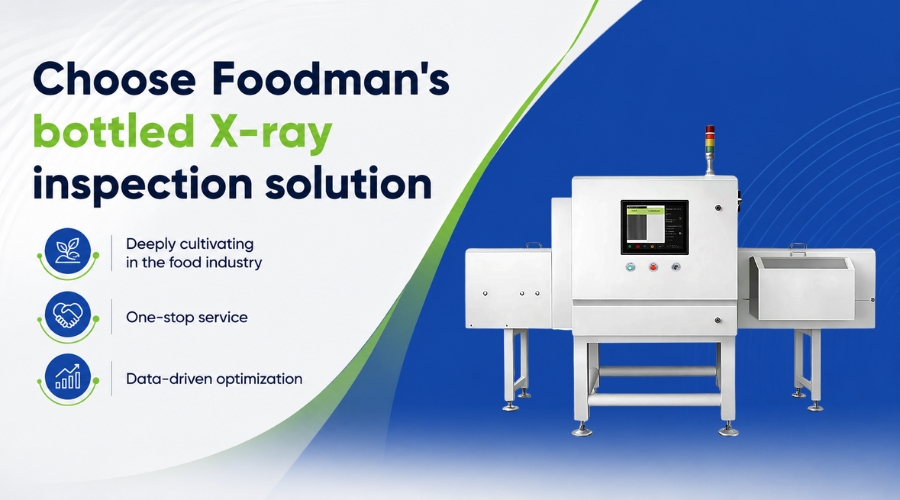
Key Advantages
Superior Inspection Accuracy: Powered by proprietary intelligent algorithms, the system significantly enhances sensitivity in detecting minute foreign objects while strictly controlling false rejection rates to minimise the waste of good products.
Rapid Production Line Integration: The unit integrates seamlessly with existing conveyor lines and can interface with our automatic checkweighing and sorting equipment to create a complete, one-stop quality inspection station.
Hygienic and Durable Design: The entire machine meets the IP69K high-protection standard, withstanding high-temperature, high-pressure washdowns and suiting the frequent, deep-cleaning requirements of food processing environments.
Intelligent Data Management: Real-time generation of production and foreign object trend reports supports predictive maintenance and process optimisation, enabling digital quality control.
Proven Global Partnership Capabilities
Foodman boasts a wealth of experience in successful global implementations, having established long-term, in-depth partnerships with food enterprises in Russia, Côte d’Ivoire, and beyond. Clients consistently report that integrating our inspection systems significantly enhances product safety and compliance, drastically reduces recall risks, and effectively solidifies market reputation and consumer trust.
Choosing Foodman’s dual-source X-ray equipment means more than just acquiring a quality inspection tool; it signifies a long-term partnership dedicated to safeguarding consumer safety and upholding brand reputation. Leveraging our mature technology and extensive global project experience, we work hand-in-hand with enterprises to build a robust defence for product quality.
Conclusion
The evolution of bottled product inspection technology from single-beam to dual-beam X-ray systems marks a significant advancement in food safety assurance capabilities. For manufacturers of bottled products—whether glass bottles, plastic bottles, or metal cans—the ability to comprehensively detect contaminants is no longer optional; it is a necessity.
Dual-beam X-ray systems designed for bottle and can inspection deliver the performance, reliability, and versatility required to meet modern production demands. This technology eliminates the blind spots inherent in single-beam systems, ensuring effective contaminant detection regardless of the contaminant’s location within the container or the material of the container itself.
Foodman has developed specialised solutions to address the unique challenges of bottle inspection, thereby realising these advantages. Backed by comprehensive technical support and a suite of complementary inspection technologies, Foodman provides the expertise and hardware—whether you require a dedicated X-ray system for glass bottles and canned foods or a versatile system for mixed-product lines—to ensure your production operations remain safe and efficient.
Frequently Asked Questions
A: Yes. We specialise in end-to-end inspection lines. We can combine X-ray inspection systems with high-precision automatic checkweighers to create an integrated “safety and quality” verification workstation.
A: Using dual-beam technology, our system simultaneously scans products from multiple angles. This allows it to distinguish density differences between the glass container and contaminants, effectively filtering out interference from the container walls while accurately identifying foreign objects inside.
A: Not at all. The radiation dosage used by the system is strictly controlled and safe; it does not alter the chemical composition, flavour, or safety of the food.