Introduction: Why Bone Detection is a Challenge for Poultry Processor
“Boneless” poultry does not always match its labelling. Chicken tenders, breast fillets, mechanically separated meat, nuggets, sausages and ready-to-eat meals can retain bone chips, cartilage or fibrous connective tissue. These residuals survive deboning, trimming and grinding steps.
Risks extend past consumer complaints and injury liability. Retail buyers now set strict limits on acceptable bone fragment sizes within supplier specifications. Many regulatory regimes treat hard foreign bodies as identifiable hazards. They demand formal, traceable control measures.
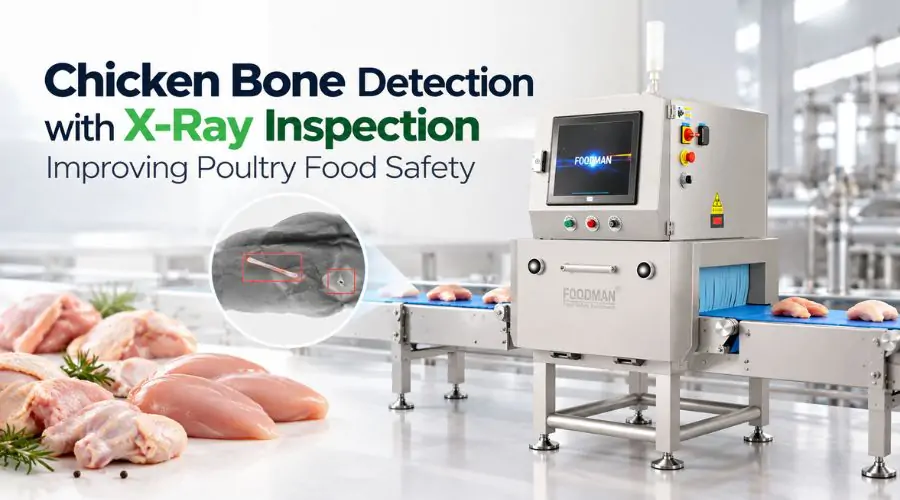
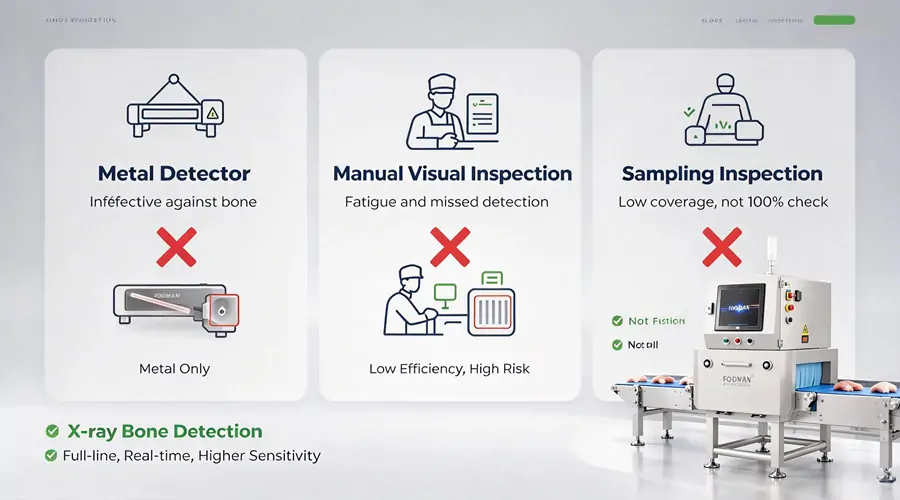
Metal detection has inherent limitations here. Metal detectors respond only to conductive and magnetic materials. Bone is neither. Visual inspection reaches only exposed surfaces. Even highly trained operators miss tiny fragments lodged in formed or breaded products. X-ray inspection has thus moved from niche method to mainstream control tool in modern chicken processing.
These systems detect residual bone without cutting into the product. They analyze variation in X-ray attenuation. They identify skeletal structures within the meat. They flag items for removal or closer review. Where conventional imaging cannot reliably separate bone from surrounding tissue, dual-energy X-ray technology adds detail on material composition.
Bone detection matters greatly in poultry processing
Why? “Boneless” products carry a promise—one of quality and food safety that customers expect to be kept. Meeting that promise is hard. Complete bone removal is difficult at any speed. In high-volume, high-speed environments, it becomes harder still.

Residual bone contamination arises at multiple process stages. Mechanical deboning can shatter bone material. Stripping meat around intricate skeletal structures frequently leaves minute fragments. Manual trimming carries inherent human error. This risk rises when bone sits embedded deep within thick muscle.
Subsequent operations can expose concealed fragments. Slicing and portioning may dislodge trapped bone. Grinding, blending, moulding and cutting distribute fragments through entire batches. Visual checks cannot reliably catch these hazards.
Risk profiles differ by product type. Chicken breast, thigh cuts, boneless wings, mechanically separated poultry and formed items each create unique detection hurdles. Duck and goose processing carry comparable bone-contamination risks.
Manual visual inspection still has value. It helps assess overall product condition and remove visible bone fragments. But its limits are real. Bone embedded within meat is often invisible from the outside. Inspection effectiveness also depends on lighting, operator attentiveness, product orientation, and the time allotted.
X-ray inspection delivers internal product checks. Products move along a conveyor for scanning. No unpacking. No destructive cutting. The system flags suspicious regions.
X-ray technology is not a substitute. It cannot replace careful deboning, strict hygiene, solid process controls or full food safety programmes. It functions as a critical secondary control. It lowers the chance residual bone reaches consumers.
How X-ray Inspection Identifies Bone Fragments in Poultry
Dual-energy X-ray systems target residual bone in poultry. They capture scans at two separate X-ray energy bands.
Bone carries a higher effective atomic number than muscle or fat. It absorbs radiation differently from soft tissue across these two energy levels.
Meat thickness and uneven shape create signal noise. The system calculates the ratio between the two energy readings to offset this interference. It suppresses signals from soft tissue background. This isolates bone fragments for algorithm detection and flagging.
Against single-energy setups, the method performs better on small bone chips. It cuts false positive and false negative events.
Four steps carry a product from imaging to automatic rejection
- Product scanning. Poultry pieces travel a conveyor belt into the inspection tunnel. An X-ray source and detector collect data as they pass through the inspection zone.
- Image analysis. The system processes images to identify suspicious structures. Analysis varies with equipment type and application—intensity variations, shape, local contrast, material-specific characteristics.
- Inspection decision. Pre-set algorithms judge whether a product meets rejection criteria. Parameter settings must be validated against representative products and samples containing known bone fragments.
- Product rejection. A synchronized mechanism removes non-compliant products from the flow of acceptable ones. Confirming the rejection and following established handling procedures keeps flagged items from re-entering the production line.

In actual applications, the goal goes beyond just starting crisp images. The major goal is to reliably detect relevant bone fragments and remove the afflicted items without disturbing the production process.
Use of Single- and Dual-Energy X-ray Inspection in the Poultry Industry
Traditional single-energy X-ray systems produce images depending on the degree to which materials attenuate X-rays under certain operating conditions. These systems can detect a wide range of foreign objects, as long as there is enough contrast between the object and the surrounding product.
Detecting bones in chicken is more difficult because both bone and meat are biological substances. The picture contrast may be reduced, especially if the bone fragments are tiny or surrounded by thick layers of tissue.
Advantages of Dual Energy Technology
Dual-energy X-ray inspection collects information from two different energy bands. Because materials attenuate X-rays differentially at these two energy levels, the system can exploit these disparities to help identify between materials that appear identical in conventional X-ray images.
In poultry processing, this extra information sharpens the system’s ability to separate specific bone structures from surrounding meat. The approach proves especially valuable for deboned chicken products, where conventional imaging alone struggles to flag residual bone fragments.
Dual-energy inspection is no guarantee. It will not catch every fragment. Effectiveness depends on the composition and size of the fragments, the thickness and density of the product, the imaging configuration, and the quality of the detection algorithms.
Processors should therefore test both single-energy and dual-energy systems on their own products. Assuming one technology performs identically across all poultry applications is a mistake.
Application of X-ray Technology in Poultry Processing Lines
Infeed and In-Process Inspection
Bone contamination may enter the process at multiple points. These include raw material intake, deboning, trimming, grinding and further handling.
Inspect right after deboning. Bone fragments are caught before they are worked into finished, higher-value cuts. Waste costs stay lowest at this stage. For ground or emulsified poultry, inspection commonly happens at filling or before packaging.
End-of-Line Inspection Before Packaging
Some processors install X-ray units downstream of packaging. This position captures contamination introduced anywhere earlier in the line. It acts as a final verification step. It has limits, though. Packaged products may overlap. Packaging materials themselves attenuate the X-ray beam. End-of-line inspection works best when packaging formats and product orientation are tightly controlled.
Comprehensive Contaminant Detection
Modern systems detect far more than bone. One scan can flag metal, glass, high-density plastics, stones, and calcified materials alongside bone. Processors who also need weight verification should consider an integrated checkweigher. For products of consistent composition, in-line X-ray systems can estimate mass from X-ray attenuation. Foodman offers metal detectors, checkweighers, and X-ray systems—as standalone units or integrated configurations. The inspection architecture adapts to the production process, not the reverse.
What Factors Affect Bone Fragment Detection Performance?
What factors shape bone fragment detection performance? X-ray inspection is a measurement process—not an absolute guarantee. Quality teams need to understand the key variables to set realistic acceptance criteria.
Bone size, density, and orientation. Larger or denser fragments usually produce stronger image signals. Size alone does not decide the outcome. A thin fragment may look different on its edge than laid flat. Mineral content, fragment shape, and the contrast between bone and surrounding tissue all affect results. Detection outcomes should always tie back to clearly defined test methods and representative samples.
Meat thickness and product overlap. Thicker material attenuates X-rays more. Thick cuts or overlapping pieces cut contrast, and small fragments become harder to spot. A configuration that works well on single, thin pieces may falter on stacked products or thick cuts. Consistent spacing between products and controlled overlap improve reliability.
Conveyor speed and product presentation. Faster lines demand more from image acquisition, processing, and rejection timing. The system must capture enough information to evaluate each item. The rejection device must stay synchronized with the target product. Consistent presentation, proper conveyor loading, and validated rejection timing help minimize both false negatives (missed detections) and false positives (unnecessary rejections).
Inspection settings and false rejections. Sensitivity settings set the balance between catching target bone fragments and avoiding false rejection of acceptable products. Criteria too strict invite unnecessary rejections from normal natural variation. Criteria too loose let some target fragments pass undetected. Manufacturers should run structured testing to establish acceptable rates for false rejections and missed detections. Any change to product dimensions, formulations, packaging, conveyor speeds, or inspection settings may require further validation.
Capabilities and Limitations of X-ray Bone Detection
Food-grade X-ray systems peer inside products. They need no destructive sampling. Even so, their performance can only be assessed when operational boundaries are well defined.
Capabilities A correctly set-up system finds foreign material when validated inspection conditions are met. Targeted contaminants include bone chips (calcified brittle bone), stones, glass and metal. The right setup enables continuous inline scanning. It automatically rejects contaminated units and logs data for quality tracking.
Limitations No system catches every bone fragment in every production scenario. Tiny fragments, low-contrast contaminants, thick or stacked product, and awkward fragment orientation all reduce detection success.
Basic engineering rules govern performance. Larger, denser fragments return more consistent detection. Detection probability drops as fragment size nears the system’s resolution threshold. All performance claims rely on fixed test boundaries: fragment dimensions, product type, line speed and pass fail rules. Treat single “detection accuracy”values from suppliers with caution if supporting test conditions are missing.
How to Select an X-ray Inspection System for Poultry Processing
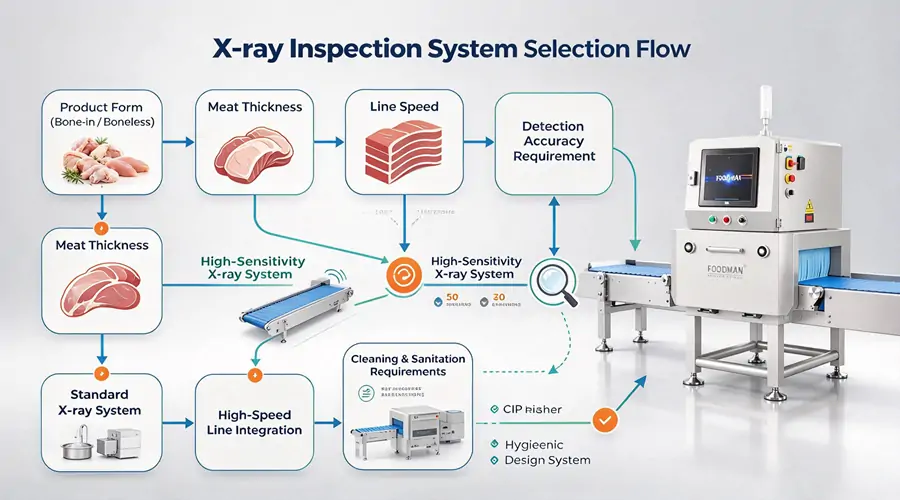
When choosing an X-ray system, the decision should be based on the specific challenges encountered in actual production, rather than focusing solely on a nominal “sensitivity” figure.
Map products and bone contamination risks first. Inspect chicken breast, thigh, wing cuts, ground poultry, frozen portions and packaged product. Define expected bone fragment size, shape and location based on your deboning and trimming process. For multi-product lines on one machine, confirm a single inspection setting works for all.
Run application-specific testing. Use production samples seeded with known bone fragments, plus normal uncontaminated controls. Test difficult targets, not just easy ones. Ask suppliers to record test conditions, target details, results, false rejects and limitations. Match test speed and product presentation to real production.
Compare single energy and dual energy X-ray configurations. If low bone-meat contrast limits detection, measure whether dual-energy improves performance for your product. Choose based on test data, not technology branding.
Validate throughput and rejection functions. Confirm line speed, belt width, product spacing and maximum product size. Ensure the reject mechanism removes contaminated product reliably at full speed. Assess reject bin containment, ejection confirmation, cleanability and failure risks.
Review hygienic design and integration. Poultry plants are wet, accumulate protein residue and require frequent washdowns. Check material selection, IP rating, cleaning guidance and fit with your sanitation procedures. Do not assume uniform washdown tolerance across X-ray systems; verify full-unit protection.
Check integration with upstream deboners, downstream cut/pack equipment, line controls and your quality system.
Foodman X-ray Inspection Solutions for the Poultry Industry
Foodman designs and manufactures X-ray inspection systems, metal detectors, checkweighers, vision inspection systems, and sorting equipment for food producers. For poultry processing applications, Foodman offers X-ray inspection systems that are not sold as off-the-shelf, standardized units; instead, they are custom-configured based on the specific characteristics of your products and the conditions of your packaging line.
As Foodman provides both checkweighing and vision inspection systems, we can offer integrated solutions for product inspection and weight control tailored to your production line requirements. We do not make unsubstantiated claims regarding inspection performance; the actual results depend on factors such as the product type, the nature and size of potential foreign objects, the packaging format, and the specific operating conditions of your production line. Therefore, we recommend conducting validation tests using actual samples before finalizing your equipment selection.
To discuss your requirements for bone detection in poultry products, please contact the Foodman team and provide details regarding your products, production line speed, packaging format, and the size of the foreign objects you need to detect. A thorough assessment of these key variables is the most efficient way to establish practical and effective technical specifications.
Conclusion
Detecting bones in poultry meat is fundamentally a matter of “density contrast” rather than “metal detection.” This distinction shapes every decision, from hazard analysis to equipment selection. While X-ray inspection systems can reliably detect larger, denser bone fragments—and, with appropriately set thresholds, even smaller fragments in certain products—it is important to recognize that they cannot detect every single bone fragment in every type of product or packaging configuration.
Whether a system effectively protects consumers or, conversely, leads to customer complaints depends on several factors: the establishment of clear specifications tailored to actual operating conditions, validation using real-world samples, and proper, ongoing maintenance following installation.
For processors currently developing a bone-control program, we recommend beginning with a hazard analysis to define the minimum size of bone fragments that must be detected. This will guide the selection of equipment capable of meeting those requirements—given your specific production line speeds and packaging formats. Foodman’s X-ray inspection systems can be configured to address these precise operational conditions; our team is ready to evaluate your application requirements and recommend a practical, effective system configuration.
FAQ
Yes. X-ray inspection can detect residual chicken bones, provided that the bone fragments create sufficient contrast in the image and the system is configured to meet the specific application requirements. Detection performance depends on factors such as the size, density, and orientation of the fragments, the thickness of the meat, and the inspection conditions. Testing with representative samples is essential to determine the achievable performance.
Dual-energy X-ray technology enhances material discrimination by comparing how a product attenuates X-rays across two different energy ranges. This helps distinguish certain bone fragments from the surrounding meat. However, it does not guarantee the detection of every fragment; the advantages of this technology should be verified against single-energy inspection using actual poultry products.
First, clearly define the product to be inspected, the types of bone fragments expected, production line speed, packaging format, and acceptable rejection rates. Where applicable, compare single-energy and dual-energy X-ray technologies and conduct sample testing under actual production conditions. Additionally, evaluate the equipment’s hygienic design, rejection mechanisms, integration capabilities, maintenance requirements, and the supplier’s ability to provide support for application validation.