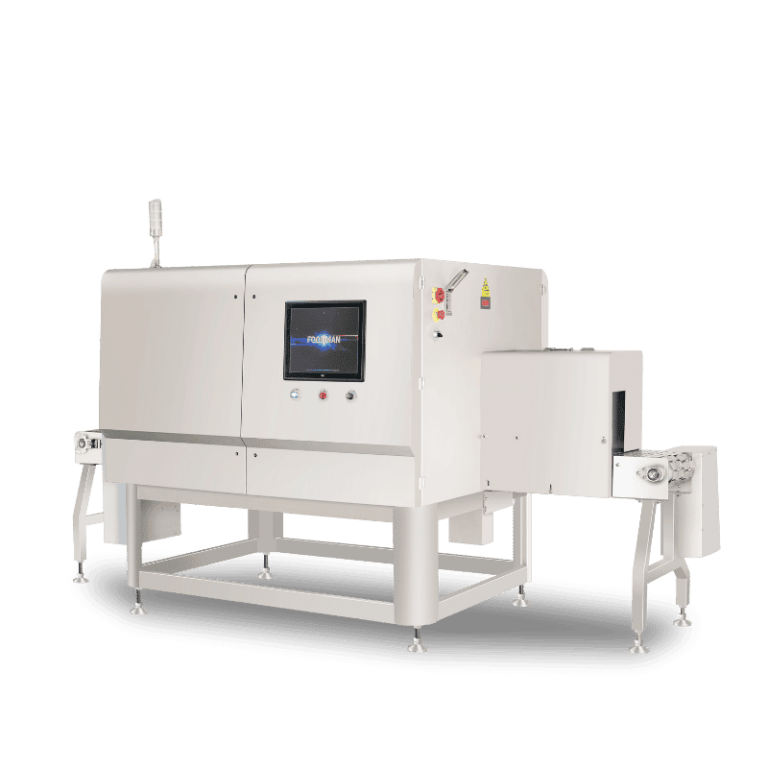

Introduction: Dairy Industry Food Safety Challenges
The dairy industry is subject to some of the tightest food safety laws in the world. On an average day, billions of people consume dairy products, including milk, cheese, yogurt, butter, ice cream, and baby formula. Dairy producers face increasing pressure to protect product safety, quality, and brand reputation as consumer expectations rise and regulatory requirements increase.
One of the most serious hazards to dairy producers is foreign item contamination. Foreign item contamination continues to be a major factor in dairy product recalls, according to international food safety reports. Metal fragments from equipment, damaged machine parts, stainless steel particles, glass shards, stones, and high-density plastic can all enter the production line by accident. Even a single tainted batch can cause widespread product recalls, regulatory penalties, legal liabilities, and long-term harm to customer trust.
Foodman specializes in advanced inspection solutions to help businesses solve these difficulties ahead of time. We specialize in checkweighers and sorters, as well as important dairy-specific X-ray inspection and industrial metal detection equipment. These technologies provide the final, critical line of defense before items reach the market. This comprehensive book looks at how these systems protect dairy products, reduce recall risks, and provide a measurable return on investment through improved quality assurance.
Understanding the Threat Landscape: Common Contamination Risks in Dairy Production
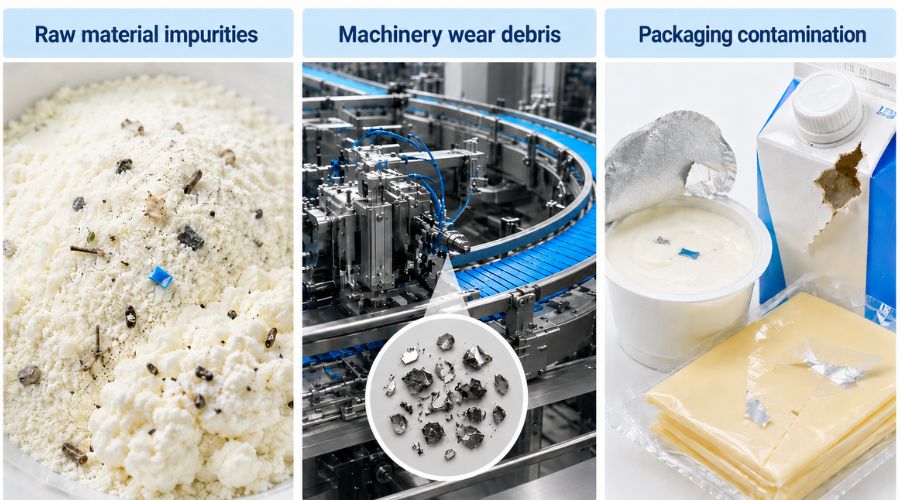
To effectively manage contamination, dairy manufacturers must first understand the sources. Physical foreign objects typically enter the production process via three main pathways:
1. Contaminants introduced via raw materials
Milk powder, fruit preparations, almonds, and cocoa powder—all of which are used in ice cream and dairy beverages—come from a variety of nations and institutions.
Foreign matter such as sand, small stones, glass shards, and metal shavings can be introduced during cultivation, transportation, grinding, and filtering processes.
Without stringent inbound inspections, these pollutants can remain throughout the process and eventually end up in the finished product.
2. Debris resulting from machinery wear and tear
Modern dairy production lines are complex, involving a wide array of equipment such as mixers, pumps, homogenizers, heat exchangers, and cutters.
Despite daily maintenance, parts inevitably deteriorate over time:
Metal components: Loose screws, fractured blades, or worn bearings can generate fine metal shavings;
Non-metal components: Plastic scrapers, rubber gaskets, or ceramic parts can crack; such fragments are far harder to detect and are often invisible to standard metal detectors.
3. Risks introduced during the packaging process
The packaging stage also presents significant risks:
Paper dust from carton edges or scraps from plastic film;
Residue from sealing adhesives;
Metal ties or clips from outer packaging—all of which can potentially fall into the product.
Identifying these risks is the first step. The second step is to employ appropriate inspection technologies—specifically, metal detectors and X-ray inspection systems designed for the dairy industry—to detect and reject these hazards at critical control points.
Applications of Dairy Industrial Metal Detectors
Metal detectors are widely used for:
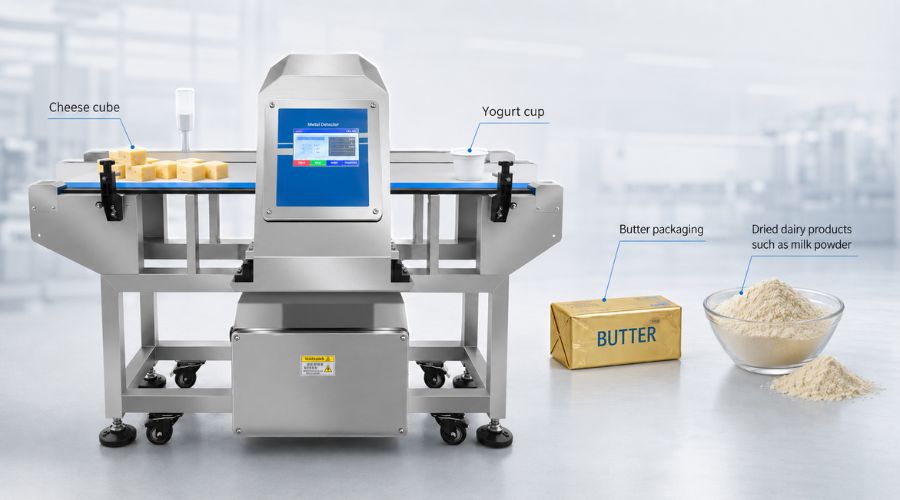
Cheese blocks
Yogurt cups
Butter packaging
Milk powder
Whey powder
Ice cream products
Infant formula
For dry dairy products such as milk powder, industrial metal detectors typically offer extremely high sensitivity.
Advantages of Metal Detection
Key advantages include the following:
Continuous inspection
Compliance with regulatory requirements
Reduced risk of product recalls
Minimized product waste
Enhanced consumer confidence
Cost-effective implementation
However, dairy industrial metal detectors have limitations when dealing with non-metallic contaminants. In such cases, X-ray inspection systems for dairy products become essential.
The Role of Industrial Metal Detectors in Dairy Processing
For decades, industrial metal detectors have served as a primary line of defense against metal contamination in the dairy industry. These systems utilize balanced-coil technology, generating an electromagnetic field to detect the presence of conductive materials. When metal particles pass through the detection aperture, they disrupt the magnetic field, triggering an automatic rejection mechanism.
Overcoming the "Product Effect"
Implementing metal detection in dairy applications presents a unique challenge: the “product effect.” Many dairy products—particularly those with high moisture, fat, and salt content—exhibit electrical conductivity similar to that of actual metal contaminants. This phenomenon can generate false signals, leading to unnecessary product rejection or, worse, failure to detect actual contaminants.
Modern industrial metal detectors for the dairy industry address this limitation through advanced signal processing algorithms and multi-frequency operation.

These systems can be calibrated to “learn” and compensate for the specific conductive characteristics of a product, thereby minimizing false rejections while maintaining high sensitivity to actual metal contaminants. Many modern units also feature automatic calibration capabilities, allowing them to adapt to variations in product temperature, composition, and moisture content.
How X-ray inspection further enhances dairy product safety
As food safety requirements evolve, X-ray inspection of dairy products provides a more complete approach that can detect a larger spectrum of contaminants.
Unlike metal detectors, X-ray technology detects impurities using density differences rather than electrical conductivity.
This allows for the detection of a wider range of alien objects.
Unlike metal detectors, X-ray technology identifies contaminants based on density differences rather than electrical conductivity.
This enables the detection of a broader range of foreign objects.
How X-ray inspection technology works
X-ray technology is based on the principle of density differences. As a product passes between the X-ray generator and the detector array, the system measures the material’s density. Denser objects—including contaminants—absorb more radiation, appearing as distinct shadows in the resulting images. Advanced software algorithms analyze these images in real time and trigger a rejection mechanism when an anomaly is detected.
Unparalleled Contaminant Detection Capabilities
Dairy X-ray inspection systems can detect a wide range of contaminants that metal detectors cannot identify:
Glass fragments: A significant hazard for products with glass packaging components
Stones and mineral particles: Commonly found in natural ingredients such as spices and fruit products
Rubber and rubber compounds: Originating from seals, conveyor belts, and gaskets
Certain plastics: Particularly engineering plastics with sufficient density
Calcified bone fragments: Associated with dairy products containing animal-derived ingredients
Calcined bone: Sometimes introduced via contaminated raw materials
Superior Packaging Compatibility
One of the most significant advantages of X-ray inspection for dairy products is its complete immunity to the effects of metal packaging materials. Non-destructive inspection can be performed on products sealed in aluminum foil containers, wrapped in metallized film, or canned—packaging types that render metal detectors ineffective. Consequently, X-ray inspection technology is the only viable solution for many premium dairy products that utilize barrier packaging.
Integrated Quality Assurance
Beyond contaminant detection, dairy X-ray inspection systems offer significant quality control advantages:
Fill level verification: Ensures the correct product volume within the container
Mass measurement: Detects underweight or overweight products
Product integrity assessment: Identifies damaged, deformed, or collapsed products
Seal integrity check: Verifies the integrity of sealed products
Component counting: Confirms the correct number of components in multi-pack products
Foreign object identification: Checks for contamination in fruit pieces or other additives
This versatility transforms X-ray equipment from a simple safety checkpoint into a strategic quality management asset, driving measurable operational improvements.
Selecting the Right Metal Detection and X-Ray Inspection Systems for Dairy Products
There is no “one-size-fits-all” solution for foreign object detection in the dairy processing industry; equipment selection requires a comprehensive assessment based on product category, packaging material, and the specific risks of potential contaminants on the production line.
For dairy products such as milk powder, cheese, and butter, industry-specific metal detectors are the preferred choice for effectively identifying metal fragments resulting from equipment wear and tear. However, if a company needs to screen for a wider range of foreign objects—such as glass, stones, ceramics, and high-density plastics—dairy-specific X-ray inspection systems offer broader detection capabilities and more comprehensive protection.
Packaging material is another critical factor in equipment selection. Packaging containing metal components—such as aluminum foil bags, composite metal containers, and metallized films—can significantly interfere with the accuracy of metal detectors; consequently, X-ray inspection systems are better suited for these products, as the technology is minimally affected by metal packaging materials.
Currently, the industry standard for quality control involves combining metal detectors and X-ray inspection systems to establish multiple layers of defense against foreign objects on the production line. This dual-inspection approach not only strengthens food safety controls and reduces the risk of product recalls but also meets the stringent entry requirements of major retailers, thereby continuously reinforcing consumer trust in the brand.
Tailored Foreign Object Detection Solutions for Various Dairy Products
1. Milk Powder / Infant Formula:
A combination of a high-sensitivity dairy metal detector and a dairy X-ray inspection system. Given the stringent quality standards for infant food, this dual-system setup ensures comprehensive coverage against various foreign objects—such as metal fragments, glass, grit, and hard plastic—meeting high-level safety control requirements.
2. Cheese Products:
A dairy-specific metal detector is installed at the cutting stage, supplemented by X-ray inspection equipment prior to packaging. Frequent equipment wear and tear on cheese production lines often generates metal impurities; staged inspection allows for the layered interception of both metal and various non-metallic foreign objects.
3. Yogurt and Dairy-Based Desserts:
A dairy X-ray inspection system is used exclusively. These products often contain inclusions like fruit pieces or nuts, which are prone to contamination by non-metallic foreign objects such as grit, broken glass, or hard plastic; X-ray inspection provides comprehensive screening for these mixed contaminants.

4. Butter / Margarine:
A combination of a dairy metal detector and an X-ray inspection system. Impurities can easily remain hidden within fatty products; dual inspection ensures all-around protection against both metal and non-metallic foreign objects, minimizing the risk of missed detections.
5. Ice Cream Products:
Production lines are equipped with metal detectors, followed by X-ray inspection after final packaging. Ice cream involves complex formulations and multiple ingredient-processing stages, creating diverse risks of foreign object contamination; this two-stage inspection process provides layered safeguards.
6. Dairy Products in Aluminum Foil or Metallized Film Packaging:
Only a dairy X-ray inspection system is selected. Aluminum foil and metallized films shield metal detection signals, significantly compromising detection accuracy; X-ray inspection is unaffected by metallic packaging materials, ensuring stable and reliable foreign object detection.
Conclusion
Today, food safety is more than simply a requirement for regulatory compliance; it is a critical competitive advantage for businesses. As the hazards of foreign object contamination in dairy products become more complex, businesses must screen for both metallic and nonmetallic pollutants.
While metal detectors are the primary line of defense against metal contamination, combining them with X-ray inspection equipment allows for comprehensive foreign object identification and multi-layered quality control.
This collaborative strategy not only protects customer safety, assures regulatory compliance, and reduces the significant costs associated with product recalls, but it also improves manufacturing efficiency and brand reputation. The combination of specialist dairy metal detectors and X-ray inspection equipment provides the best long-term product protection.
FAQ
A1: Industrial metal detection systems designed for the dairy industry effectively detect metal contaminants but cannot identify non-metallic foreign objects such as glass, rubber, or stones. X-ray inspection systems designed for dairy products can detect both metallic and non-metallic contaminants while also performing quality control functions (such as fill level, weight, and package integrity checks). Combining the two provides comprehensive protection.
A3: In many cases, yes. Combining metal detection solutions tailored for the dairy industry with dairy-specific X-ray inspection systems offers the most comprehensive protection against foreign object contamination and significantly reduces the risk of product recalls.
A3: Yes. X-ray inspection systems used for dairy products operate at very low radiation levels approved by global food safety agencies; they do not affect the product’s quality, taste, or nutritional value.