Introduction to Hidden Safety Hazards in Coffee Packaging
Coffee ranks among the most heavily traded agricultural commodities on earth. Every roasted bean, every scoop of grounds, every single-serve capsule passes through a long and tangled supply chain. Harvesting, drying, roasting, blending, packaging—each stage offers an opening for unwanted material to slip into the product. Stones. Glass fragments. Metal shavings. Plastic debris. Even dense clumps of organic matter. All of it can end up sealed inside a bag or capsule, invisible to the eye, missed by standard visual checks.
For producers, the stakes go beyond quality. Food safety is on the line. Brand reputation is on the line. Regulatory compliance is on the line. A single recall tied to foreign-object contamination can drain millions of dollars, sour retailer relationships, and erode consumer trust built over years. The problem is blunt: how do you inspect prepackaged coffee without opening the package, without damaging the product, without grinding production to a halt?
X-ray inspection has become a leading answer. Visual inspection fails where X-ray succeeds. Low-energy X-rays pass through sealed packaging. They reveal hidden foreign objects while the product stays untouched. Nothing gets opened. Nothing gets destroyed. Food safety improves. Operations keep moving. And both producers and consumers gain something harder to quantify: confidence.
What is X-ray inspection equipment?
X-ray inspection equipment belongs to the family of automated industrial inspection systems. Its job: peer inside products and packaging without taking them apart.
The underlying physics is straightforward. Materials absorb X-rays at different rates. Density drives the difference. High-density substances soak up more X-ray energy; low-density ones let more pass through. A beam fires at the package. A detector on the far side catches whatever survives the trip. That signal becomes an image.
Contaminants show up as darker or lighter regions, depending on how the system is configured. Modern X-ray inspection systems for coffee combine this hardware technology with advanced artificial intelligence and machine learning algorithms to analyze these images in real time and automatically reject products containing foreign objects.
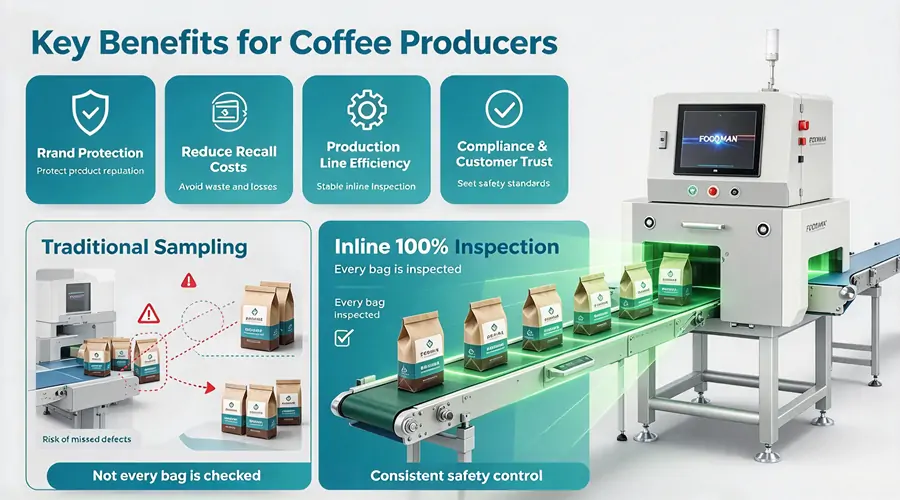
X-ray inspection enables the evaluation of 100% of the industrial output, in contrast to manual inspection or sampling. It requires no human intervention, causes no damage to the product, and does not necessitate opening the packaging. This makes it particularly valuable for industries such as coffee, where packaging is typically opaque, sealed, and designed to preserve freshness.
What Does “Zero-Unpacking” Mean in Coffee Inspection?
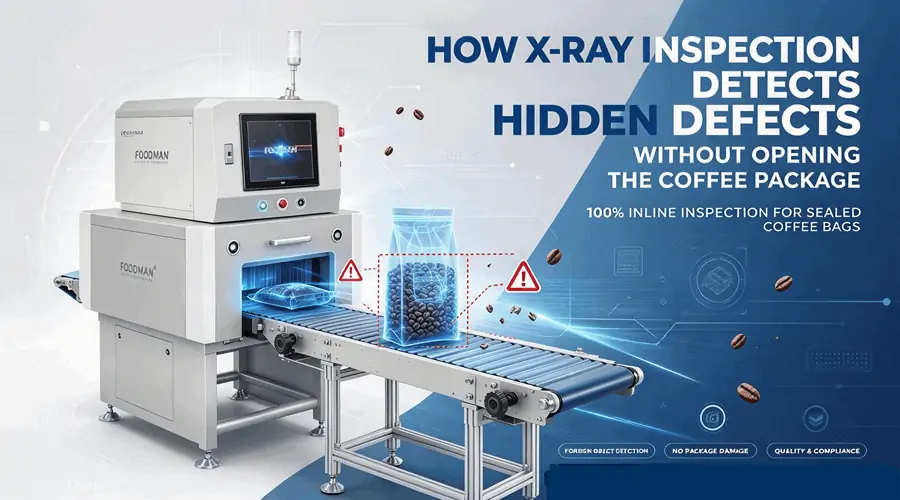
“Zero-unpacking” means inspecting coffee products without opening, modifying, or damaging their packaging. X-ray inspection can analyze the product inside sealed packaging while preserving vacuum seals and protecting the outer package.
Aluminum foil. Composite films. Cardboard. Plastic bags. Metallized packaging. X-rays cut through all of them. That matters for coffee, where vacuum-sealed bricks, foil bags, and capsules must keep oxygen and moisture out. The packaging stays intact. The inspection still works.
Detection capability depends on the setup. High-resolution detectors can catch foreign objects as small as roughly 0.3–0.5 mm—product, packaging, and inspection conditions all shape that number. Density is what drives contrast. A stone, a shard of glass, a bit of metal—each absorbs X-rays differently than a coffee bean does. Size alone doesn’t decide whether it gets caught. Density does.
Modern inspection software can further improve detection accuracy and reduce false rejects. AI and machine learning technologies can analyze the normal characteristics of the product and identify abnormal density or shape patterns. This is particularly useful for ground coffee, where the product itself has no fixed shape.
The entire inspection process can also operate inline. Sealed packages pass through the X-ray inspection system at production speed, and products that fail the defined inspection criteria are automatically rejected. No manual unpacking or product rework is required.
This combination of non-destructive inspection, high-resolution imaging, intelligent analysis, and automatic rejection makes X-ray inspection a practical solution for maintaining food safety and quality control throughout coffee production.
What can a coffee X-ray system actually catch?
Metal detectors still have their place on the line. But their reach is narrow—conductive or magnetic metals, and little else. X-ray inspection covers far more ground. It responds to density, not conductivity. That opens the door to a broader set of physical hazards.
Stones and gravel. Beans dry on patios or open ground after harvest. Small stones mix in easily. Color and size often match the beans. The eye misses them.
Glass fragments. A broken light. A shattered plant window. Worn processing equipment. Any of these can shed glass into the product stream.
High-density plastics and rubber. Conveyor belts wear down. Gaskets degrade. Packaging sealants break apart. Fragments enter the flow.
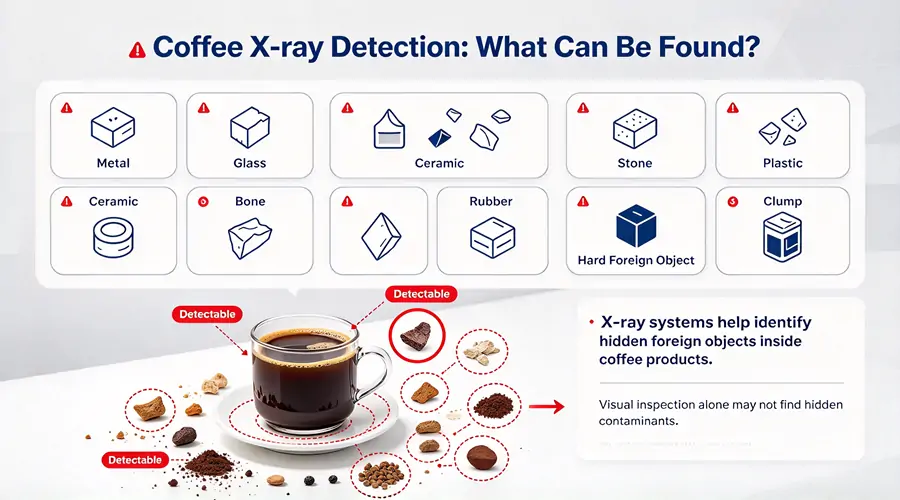
Metals of all kinds. Ferrous. Non-ferrous. Stainless steel. The last one gives traditional metal detectors trouble—”product effect” interference can mask the signal. X-ray imaging sidesteps that problem.
Clumping and fill issues: Beyond foreign object detection, these systems can also identify problems such as underweight packaging, compromised seals, or product clumping.
Why does X-ray inspection matter so much for coffee safety?
The core payoff is simple: contaminated product gets caught before it leaves the facility. Recalls drop. Injury risk drops. Regulatory penalties drop. The benefits stack up from there.
Brand protection and compliance. A recall costs money—often millions. It also costs trust, which is harder to win back. X-ray systems help producers meet HACCP, IFS, and BRC requirements. Global standards demand proof. X-ray inspection provides it.
Zero waste. X-ray inspection destroys nothing. Lines run at full speed. Not a single gram of coffee is lost. Packaging stays intact.
Operational efficiency. Modern systems bolt onto existing conveyors. Automatic rejection mechanisms kick out non-compliant packages the moment they’re flagged. No manual intervention. No bottleneck.
Data traceability. Advanced software logs every scanned package. Audit trails build themselves. Process improvements follow.
Placement matters too. X-ray inspection creates a final checkpoint after packaging. Sealed products get checked without being opened. Hygiene holds. Contaminated product never leaks downstream.
For many producers, the strongest setup pairs upstream controls with a final packaged-product inspection. Two layers. One comprehensive safeguard.
How to Select an In-Line X-Ray Inspection System for Your Production Line
Start with the product and the packaging. Coffee takes many forms—whole beans, ground coffee, capsules, instant powder. Each brings its own density profile. Each arrives in different packaging materials. A small single-serve capsule. A 250g foil bag. A 50kg sack. The system must match the job. Aperture size matters. Conveyor speed matters. Get either wrong, and the line slows down or the inspection misses things.
Second, evaluate inspection sensitivity. The system should be capable of detecting the smallest foreign objects that pose a risk to the product. It is advisable to request test data from suppliers based on actual product samples and real-world contaminants.
Speed and throughput come next. The system has to keep pace with the line. Fall behind, and it becomes the bottleneck. High-speed conveying matters. So does rapid image processing.
Then look at software. Automatic rejection. Image storage. Trend analysis. A clean, intuitive interface. AI can help here—it cuts the false rejection rate significantly.
Hygiene demands attention too. Coffee processing is a wash-down environment. Equipment needs high IP ratings—IP66 or IP69K. Anything less risks failing hygiene standards.
Don’t overlook the user experience and support. Intuitive touchscreens. Multilingual interfaces. Self-learning algorithms that shorten setup for new blends or packaging formats. And behind the machine, a supplier who handles installation, training, calibration, and ongoing technical support.
Finally, verify compliance. The system must meet food safety and radiation safety standards. No shortcuts here.
Foodman: X-ray and Metal Detection Solutions for the Coffee Industry
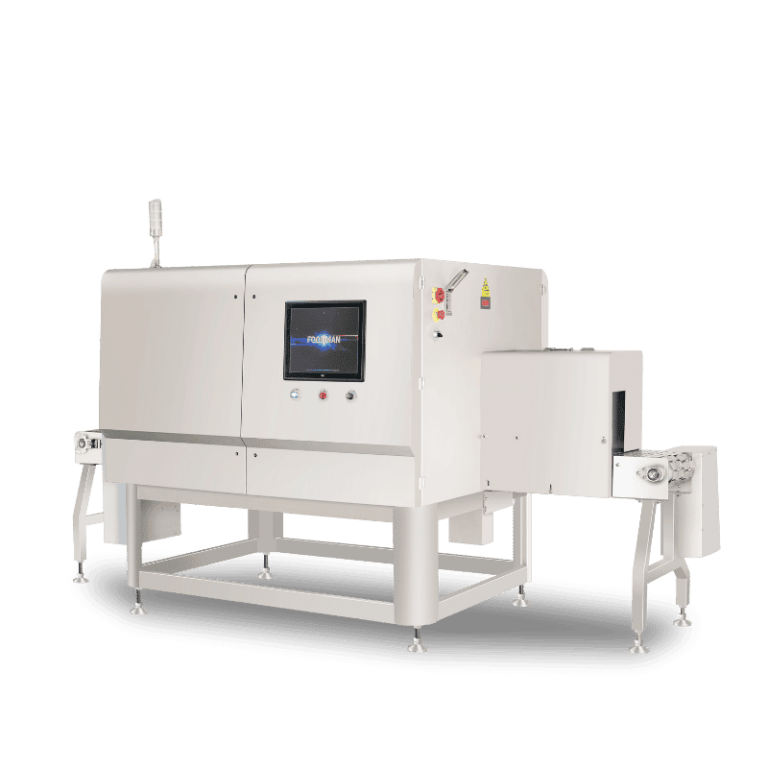
Foodman builds inspection equipment. That’s the focus—nothing broader. Automatic checkweighers. Metal detectors. X-ray systems. Sorting systems. The company develops and manufactures all of them, and it tailors technical solutions for food and beverage producers worldwide.
Foodman’s X-ray line runs on three strengths: sensitivity, speed, and easy integration. Sealed coffee products get inspected without being opened. Metal, glass, stones, high-density plastics—all detectable inside the package. Whole beans. Ground coffee. Capsules. Instant coffee. The systems cover the full range, holding food safety steady throughout production.
X-ray isn’t the only tool in the lineup. Foodman also supplies metal detection systems that catch ferrous metals, non-ferrous metals, and stainless steel. Vision inspection systems handle a different job: packaging integrity, label placement, product appearance. Quality control at multiple stages.
Stack the three technologies together—X-ray, metal detection, vision—and you get multi-layered in-line inspection. Foreign object detection at one point. Packaging and appearance checks at another. Manufacturers get stronger quality. Stronger food safety.
Foodman’s aim is straightforward: comprehensive in-line inspection and quality control for coffee production. The equipment balances durability, precision, and usability. Specialized software sits behind it. After-sales support stands behind that. Existing lines absorb the systems without disruption. The integration holds. The reliability holds.
Conclusion
Foreign object contamination ranks among the worst risks in coffee production. Consumers get hurt. Recalls follow. Brand reputation takes the hit. Traditional inspection methods can’t keep up—they can’t see through sealed packaging. The contents stay hidden. X-ray inspection solves this. Non-destructive. In-line. High-precision. Hidden contaminants get caught.

With X-ray equipment, producers inspect 100% of product without opening a single package. Metal. Glass. Stones. Plastic. All detectable. Food safety improves. Brand reputation holds. Industry demands for quality and transparency keep climbing. In-line X-ray inspection is shifting from optional to standard—especially for producers thinking ahead.
Foodman backs the coffee industry with X-ray, metal detection, and vision inspection solutions. Integrate them into the line, and producers get safer products, tighter operational efficiency, and stronger consumer trust.
FAQS
Yes. X-ray systems are specifically designed to penetrate aluminum foil, composite films, and other opaque packaging materials. This is a key advantage of X-ray inspection equipment for coffee.
Depending on the specific application, coffee X-ray inspection systems can detect a variety of high-density foreign objects, including metal fragments, glass, stones, mineral materials, and certain types of high-density plastic or rubber.
Yes. X-ray inspection systems can be designed to accommodate various packaging formats, including flexible bags, cartons, cans, glass jars, and other sealed packages.