
Introduction
Flour and grains underpin much of daily food production. Wheat flour, corn flour, rice flour, oats—these are staples. So too are breakfast cereals, baking mixes, and pasta ingredients. Their journey to market is rarely simple. Milling, conveying, mixing, packaging: each step adds risk.
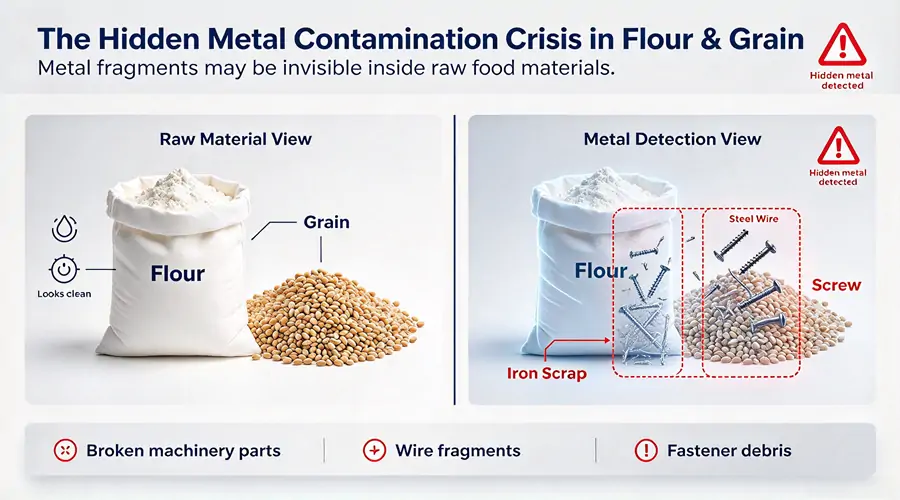
Metal fragments can enter at nearly any point. Worn machinery sheds particles. Screens tear. Blades break. Even raw grains arrive already contaminated—picked up during harvest, transport, or storage. Once inside the final product, the damage is done. Recalls. Regulatory fines. Reputation loss. At worst, consumer injury. No wonder food-grade metal detectors have become standard equipment in this industry.
Today’s food production relies on layered defenses: preventive maintenance, Good Manufacturing Practices (GMP), process controls, automated inspection. Metal detectors for food quality screen for ferrous, non-ferrous, and stainless steel contaminants—inline, without opening packages or halting production. For bulk flour and grains, gravity-fed (free-fall) systems add one more check before packaging.
Install detection equipment at critical points. Catch metal foreign objects earlier. Cut the risk of non-compliant product reaching downstream operations or the supply chain. The result: tighter, more reliable food quality control.
Common Metal Contaminants in Flour and Grain Processing
Controlling metal contamination starts with one question: where do these fragments come from? In flour and grain processing, several stages stand out.
1.Equipment Wear and Tear
Roller mills, sifters, conveyors, screw conveyors. Run them long enough, and parts begin to fail. Screens degrade. Sieve plates wear. Blades lose their edge—or break off entirely. Once metal particles or fragments break off, they can enter subsequent processing stages along with the material.
2. Loose or Damaged Components
Continuous equipment vibration can cause components—such as bolts, nuts, washers, and clips—to loosen or even detach. In the event of upstream equipment failure, broken parts may also enter the product flow.
3. Contamination from Raw Materials
During harvesting, transportation, and storage, grain may come into contact with harvesting machinery, metal fencing, or transport containers, thereby picking up metal impurities. Consequently, the raw material intake and pre-processing stages are critical points for metal detection in flour and grain processing.
4. Foreign objects generated during maintenance
If cleaning and lockout/tagout procedures are not properly executed during equipment maintenance, welding, or modification, welding slag, drilling debris, or fragments of tools may fall into the production line.
5. Packaging and handling stages
Packaging brings its own hazards. Staples. Metal clips. Fragments shed by worn machinery. These events are rare, yes. But they belong in any serious food safety inspection system.
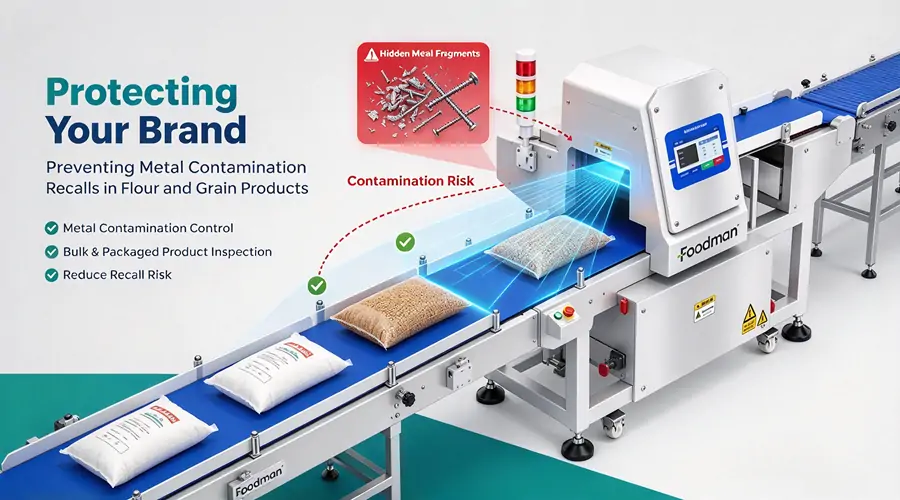
Metal contaminants differ widely—size, shape, material. No single inspection method catches everything. The answer lies in combination. Preventive maintenance. Process control. Metal detection systems. Place food-grade detectors at critical points. Together, these build a more complete control system for metal foreign objects in flour and grain production.
Food Metal Detectors and Their Operating Principles
A food metal detector identifies metal contaminants. It then rejects them. That is the core function. Simple enough in principle.
Flour and grain processing, though, complicates things. Fine dust gets everywhere. Product density fluctuates. Throughput runs high. And hygienic design is non-negotiable. Each factor shapes how these systems must perform.
Most industrial systems utilize an electromagnetic field generated within the detection aperture or sensing zone. When a conductive metal object passes through this field, it alters the system’s electromagnetic response. The detector’s electronics analyze these changes to determine whether the signal corresponds to a potential metal contaminant. Upon detecting a contaminant, the system triggers an automatic rejection mechanism.
Common methods include:
Air blast rejection: Using compressed air to rapidly blow contaminated products off the production line.
Pusher: Using a pneumatic mechanism to push non-conforming products into a rejection zone.
Retracting conveyor: Retracting the conveyor belt to allow non-conforming products to drop into a collection area.
Swing arm rejection: Using a arm to alter the product’s direction of travel.
Divider system: Guiding non-conforming products into a separate channel.
Stop-and-alarm: Suitable for production lines requiring manual verification or intervention.
The specific rejection method should be selected based on product characteristics, production speed, packaging dimensions, and conveyor line configuration.
Detection of Ferrous Metals, Non-ferrous Metals, and Stainless Steel
Food industry metal detectors face a mixed threat. Ferrous metals. Non-ferrous metals. Stainless steel. Each behaves differently.
Ferrous metals are the easy case. Detection comes readily. Non-ferrous metals—aluminum, copper—tell a different story. Their electromagnetic properties set them apart. Stainless steel poses the hardest problem. Some alloys respond weakly to electromagnetic fields. Sensitivity, then, cannot be judged by metal type alone.
Product Characteristics Also Affect Detection Performance.
The metal itself is only part of the picture. Product and environment matter too. Moisture content. Salt content. Temperature. Electrical conductivity. Add packaging materials, product orientation, and where the contaminant sits. All of these shift the detection signal.
So how should detection capability be judged? Not in the abstract. Consider the specific product. The production environment. The detection aperture. The equipment configuration. Real-world sensitivity emerges from product testing and on-site validation. It is not a fixed value. No single number applies across all products.
Metal Detection in Food Processing: Deployment Points Along the Production Line
One detector at the end of the line is not enough. Metal contamination control demands more.
In flour and grain processing, map the contamination risk across each stage. Then install detectors accordingly. Do this, and foreign metal objects get caught sooner. Isolated faster. Downstream risk drops.
1. Raw Material Intake
Incoming grain may contain metal contaminants introduced during harvesting, transport, or storage. Inspecting raw materials before they enter storage silos or processing equipment reduces the risk of contamination carrying over into subsequent stages and protects downstream machinery. For bulk materials, gravity-fed metal detector food processing can typically be installed directly within the material flow path.
2. Post-Pulverization and Grinding
Equipment such as roller mills and hammer mills is susceptible to wear and tear during prolonged operation. Installing a metal detection system after the pulverization or grinding stage allows for the timely detection of metal fragments generated by the equipment, preventing contamination from proceeding to the next stage of processing.
3. Sifting and Grading
Components such as screens and sieve plates can also generate metal foreign objects due to wear or breakage. Conducting inspections before and after sifting helps identify anomalies promptly and limits the spread of contamination.
4. Prior to Packaging or Bulk Loading
The last stage before packaging deserves special attention. Bagged flour. Bulk tankers. Premix production. Whatever the destination, run a metal check before the product leaves the facility. This ensures compliance with quality control standards.
For bulk flour and grains, gravity-fed detectors often work best. They handle high-volume flows. They need minimal product handling. They slot directly into gravity-fed systems.
Where you place inspection points matters. Raw materials. Processing. Rework. Finished products. Cover all four, and the result is a comprehensive food safety control system.
Metal Detectors for Flour and Grain Producers
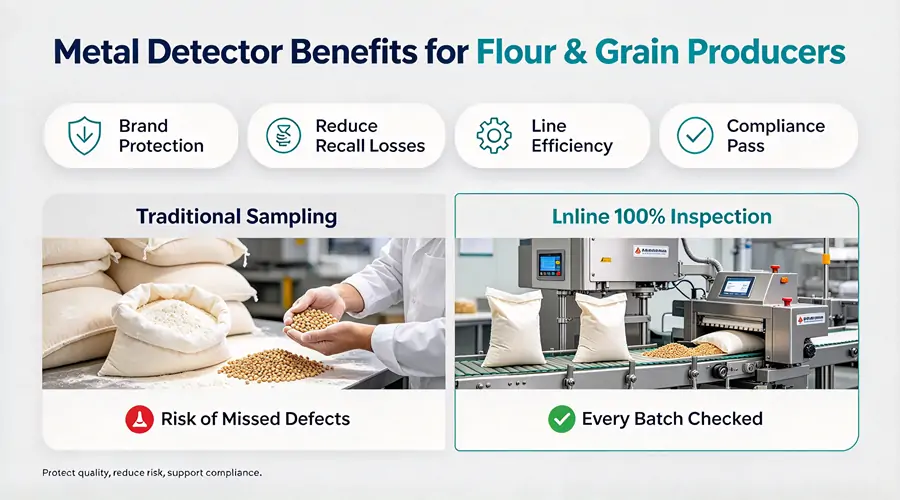
Investing in advanced metal detection technology creates measurable value across multiple dimensions:
Brand Protection
A single product recall can destroy years of accumulated brand equity. Metal detection systems significantly reduce the risk of contaminated products reaching consumers, thereby safeguarding brand reputation and customer loyalty.
Regulatory Compliance
Global food safety regulations—including FSMA, HACCP, and ISO 22000—increasingly mandate record-keeping for foreign object control. Metal detectors provide auditable evidence of due diligence.
Operational Efficiency
Modern systems feature automatic calibration, self-diagnostics, and real-time data logging, thereby reducing downtime and the need for manual intervention.
Reduced Waste
Compared to manual inspection or overly conservative rejection thresholds, precise detection and rejection mechanisms minimize product waste.
Customer Confidence
Retailers want documentation. Industrial buyers want it too. Metal detection protocols must be clear, complete, and verifiable. Prove your controls are robust—and that becomes a competitive edge. For producers of flour, semolina, cornmeal, oats, and specialty grains, the payoff is direct. Lower risk. Greater customer trust.
Defense-in-Depth: Pairing Metal Detection with X-ray Inspection
Metal detectors have limits. They catch metal—nothing more. Stones. Glass. Bone. High-density plastic. These slip through. X-ray inspection fills the gap. It reads density variations inside the product.
The two technologies work as partners.
Metal detectors bring high sensitivity and speed. Cost-effective, too. Ferrous, non-ferrous, stainless steel—all covered.
X-ray systems see more. Stones. Glass fragments. Hard plastics. They also inspect packaging itself—seal leaks, product trapped in the seal.
In flour and grain processing, X-ray earns its place twice over. Packaged products. Bulk applications, where density stays uniform enough for reliable imaging.
Stack the two together. Multiple lines of defense. Contaminated product leaving the facility becomes far less likely.
This integrated approach is increasingly regarded as best practice in the food processing industry—particularly regarding metal detection—because no single technology can address every potential risk.
How to Choose the Right Food Metal Detector
When selecting the optimal system, carefully consider the following factors:
1. Product Characteristics
Flour and grain products vary in density, moisture content, and flow characteristics. For gravity-fed metal detection systems, the unit must be calibrated for the specific product to maintain sensitivity while avoiding false rejects.
2. Detection Sensitivity Requirements
Define the minimum contaminant size to be detected. Generally, higher sensitivity requirements necessitate smaller aperture sizes and more advanced signal processing technology.
3. Throughput and Aperture Size
Select a detector appropriate for your production speed. An aperture that is too small can impede material flow, while one that is too large reduces detection sensitivity.
4. Rejection Mechanism
Choose a rejection system suited to your product and process—such as a swing arm, pusher, or air-blast rejection system.
5. Hygienic Standards and Structural Design
Flour and grain processing environments generate dust, making equipment design and cleaning protocols critical. Inspection equipment must comply with the facility’s hygiene standards and suit the production environment. Easy access to key components also simplifies routine maintenance and validation tasks.
6. Data and Traceability Considerations
Modern inspection systems offer capabilities that go far beyond simple alarms. Depending on the configuration, manufacturers can monitor data such as the number of rejected products, product recipes, inspection status, alarm details, and operating parameters. This information supports quality management and helps identify recurring process issues.
7. Supplier Support and Validation Services
Select a partner capable of providing installation support, validation documentation, and ongoing after-sales service.
Metal detection equipment in the food industry represents a long-term investment. Selecting the right system requires a comprehensive evaluation of technical performance, operational practicality, and total cost of ownership.
Foodman Vision: Inspection Solutions for the Flour and Grain Industry
Foodman understands the unique challenges faced by flour and grain processing enterprises. Our inspection systems are engineered for demanding environments and reliable performance, combining advanced inspection technology, hygienic design, and an intuitive user experience.
Foodman core product portfolio includes:
Automatic checkweighers for precise weight control and compliance management
Metal detectors for bulk and packaged products (including gravity-fed and conveyor-based systems)
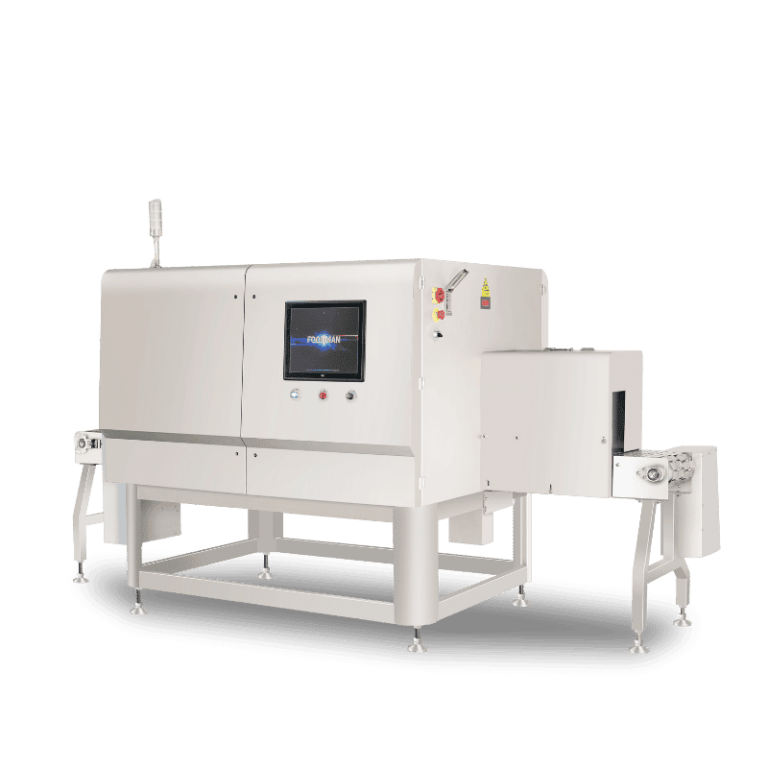
X-ray inspection systems for comprehensive foreign object detection and quality verification
Sorters for classification based on color, shape, and defects
Vision inspection systems for surface defect detection and quality assurance

Foodman’s X-ray and metal inspection platforms are widely used in flour mills, grain processing plants, and dry goods production facilities around the world. Whether you require a standalone metal detector machine for food industry or a fully integrated inspection line, Foodman delivers tailored solutions backed by technical expertise and responsive service.
Conclusion
Metal contamination in flour and grain is persistent. It threatens consumer safety. It threatens regulatory compliance. It threatens brand reputation. The problem is real—and it does not go away on its own.
But it can be managed. Systematically. Through technology. Through operational discipline. Through partnerships.
The path forward is clear. Deploy food-grade metal detection at critical control points. Add gravity-fed systems for bulk products. Supplement both with X-ray inspection. Together, these build a robust defense against contamination.
The payoff? Safer products. A stronger brand. Greater confidence in production integrity.
In this industry, trust is everything. Inspection technology is not just a cost. It is a competitive advantage.
FAQs
Gravity-fed (gravity-drop) metal detection systems are typically the best choice for bulk flour and grains; they efficiently handle free-flowing powders and granules, offer high sensitivity, and are easily integrated into gravity-fed production lines.
Food metal detectors primarily detect metal contaminants by sensing electromagnetic changes, whereas X-ray inspection systems identify density differences within the product or packaging. As they utilize different technologies and offer distinct advantages, they serve as complementary inspection strategies.
Yes. Foodman provides customized solutions—including metal detection, X-ray inspection, automatic checkweighing, sorting, and vision inspection—tailored to the specific needs of flour and grain producers.