Introduction
The chicken company is dealing with an ongoing dilemma: as customer demand for convenient, ready-to-cook, and boneless products grows, so does the risk of remaining bone pieces in processed meat. Traditional detection technologies are excellent at detecting high-density metallic contamination, but they frequently fail to detect low-density, well-hidden poultry bone pieces.
This technological limitation poses significant challenges to brand reputation and consumer safety. Foodman recognizes that ensuring supply chain safety requires going beyond conventional foreign object detection methods. This article examines at how advanced dual-energy X-ray detection devices are altering food safety standards for poultry products.
Why Advanced Bone Detection Technology Is Important to the Poultry Industry
Modern poultry processing aims to produce high-quality, safe, and convenient products. However, even with advanced mechanical deboning techniques, the presence of tiny, brittle, or splinter-like bone pieces can often be unavoidable. These fragments range in size, ranging from small micron-sized particles to thin, translucent slivers of cartilage, and blend almost perfectly into the surrounding tissue matrix, making them difficult to detect by eye.
The physical characteristics of fowl tissue worsen this issue. When evaluated with standard single-energy X-ray machines, the average densities of bone and muscle are strikingly similar. The density difference between a chicken rib fragment and dense breast meat might be minimal, especially if the moisture content fluctuates or the product has been frozen. Traditional approaches that rely solely on density criteria fail to detect these minor differences.
This limitation leads to a dangerous operational blind space. Processors using standard X-ray equipment for bone fragment detection frequently face a difficult decision: set the detection threshold too low, resulting in acceptable product being incorrectly rejected and causing significant yield loss, or set it too high to maintain throughput, allowing hazardous fragments to pass undetected. In an industry where consumer safety goes precedence, neither option is acceptable.
Furthermore, regulatory pressure is growing. Global food safety agencies are increasingly identifying bone fragments as a physical threat that needs preventive action. The USDA Food Safety and Inspection Service (FSIS) and its international counterparts have intensified their scrutiny of poultry processors, demanding verifiable evidence that X-ray bone detection systems meet established standards. Generic inspection systems simply cannot provide the documentation and reliability required to satisfy modern audit demands.
Why Traditional X-ray Systems Struggle to Detect Bone Fragments in Poultry
Standard X-ray equipment operates on the principle of attenuation—measuring the X-ray energy absorbed by an object to determine its density. Foreign objects appear as dark areas in the generated image, marking them as potential contaminants and triggering an alarm and rejection system to remove the affected product.
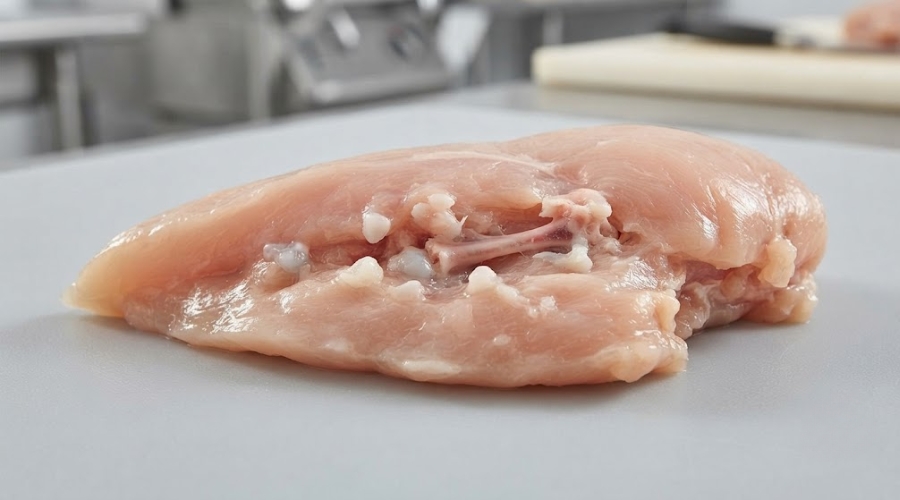
This method is highly effective for detecting high-density foreign objects such as metal, glass, or dense stones. However, it fails completely when it comes to detecting bone fragments in poultry because the densities of bone fragments and meat overlap significantly. The signal produced by a small bone fragment can be virtually indistinguishable from natural density variations within chicken breast or leg meat—particularly around joints, cartilage attachment points, and areas with varying levels of fat infiltration.
Bone fragments from poultry—especially young birds—have low mineral density. In transmission images, the density of small bone fragments often closely matches that of the surrounding dense muscle tissue. Consequently, traditional X-ray foreign object detection systems struggle to distinguish between the two; natural calcifications, joint remnants, and even variations in muscle density can trigger false alarms. This renders traditional X-ray detection methods unreliable, as systems either fail to detect bone fragments or generate excessive false rejections, leading to unnecessary production line stoppages.
Key Advantages of Dual-Energy X-Ray Detection for Bone Fragments in Poultry
To overcome these physical limitations, the industry has shifted toward dual-energy X-ray detection systems. This technology has revolutionized food safety inspection for poultry products.
Principles of Dual-Energy X-Ray Imaging
The fundamental breakthrough of dual-energy X-ray detection systems lies in their ability to analyze material composition rather than merely detecting density. Instead of using a single X-ray beam, dual-energy technology employs two distinct energy spectra—typically a low-energy beam and a high-energy beam—to capture images of the product. Because bone fragments and meat absorb these two energy levels differently, the system can use mathematical algorithms to remove the “shadow” of the meat from the image, thereby isolating the bone structures. This method yields high-contrast images in which even the smallest bone fragments are clearly visible.
Specialized Bone Fragment Detection Algorithms for Poultry
Foodman incorporates proprietary algorithms specifically trained to recognize the structural characteristics of poultry bone fragments. Calibrated to distinguish between the soft texture of muscle tissue and the distinct mineral composition of poultry bone, these algorithms ensure accurate detection even when fragments are obscured by overlapping meat tissue.
Technological Differentiation: Beyond Standard Detection
While standard X-ray systems for poultry bone detection typically flag any object with “above-average density,” Foodman’s dual-energy system is deeply optimized for the unique challenges of detecting bone fragments and cartilage. It filters out non-critical density variations to focus specifically on the structural integrity of bone fragments. This makes it particularly well-suited for high-speed poultry processing environments, where product thickness and shape often vary.
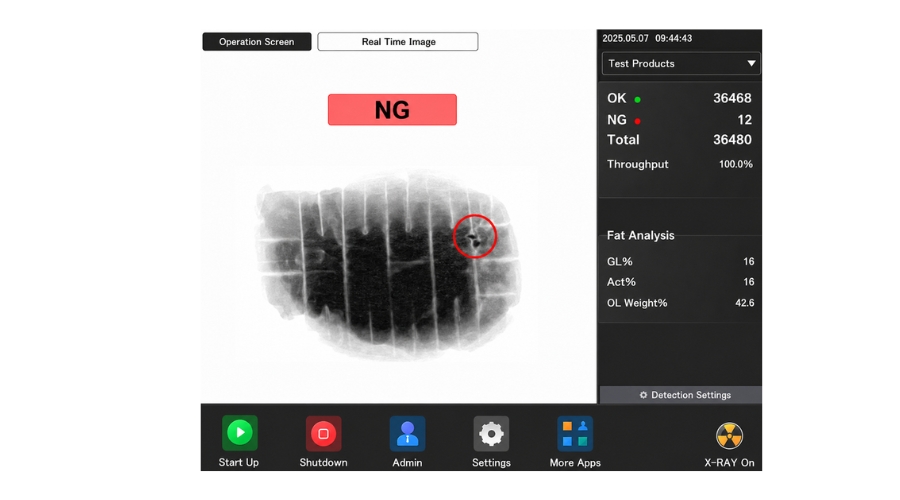
Intelligent Automation: From Detection to Rejection
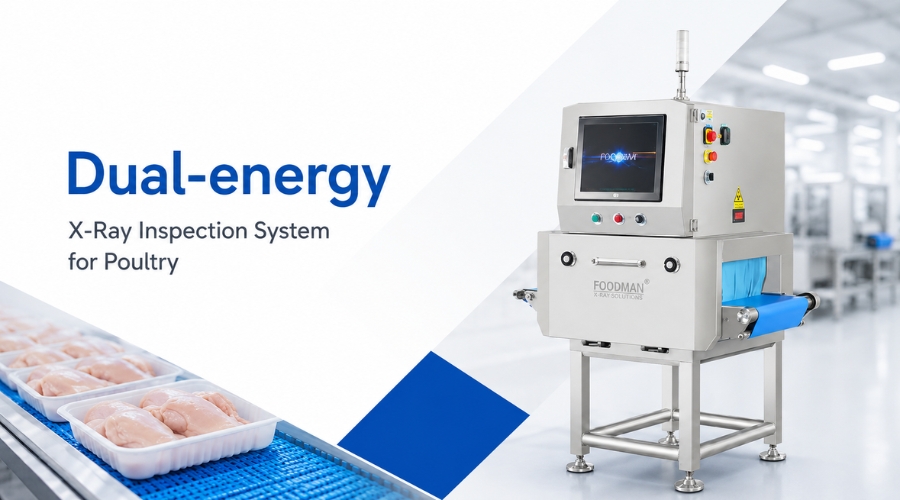
The efficiency of the dual-energy X-ray inspection system lies in its highly integrated design. Our system does more than just flag issues; it provides real-time, automated feedback. Upon detecting a bone fragment, the system triggers a precise rejection mechanism—such as an air blast or pusher arm—to remove the non-compliant product from the line without interrupting the production flow.
How Dual-Energy X-Ray Technology Is Reshaping Poultry Food Safety Systems
Adopting dual-energy X-ray technology for bone fragment detection in poultry is not merely an incremental improvement; it is fundamentally reshaping how poultry processors manage food safety.
This technology offers the following advantages
Reduced product waste: Higher detection accuracy means fewer false rejects, thereby enhancing both safety and yield.
Enhanced data capabilities
Traceability: Every scan is recorded, providing processors with data that meets audit requirements for poultry food safety standards.
Optimized compliance: Meeting the rigorous demands of food safety regulations (such as FSIS or HACCP) becomes automated and reliable.
Foodman Dual-Energy Poultry Bone Fragment Detection Solution
Foodman Technologies is an innovative company renowned in the field of inspection and weighing equipment. The Foodman team has developed a comprehensive dual-energy X-ray inspection solution specifically designed to address the challenges of poultry processing. Our system combines high-resolution dual-energy imaging technology with proprietary bone fragment detection algorithms—trained on extensive, poultry-specific datasets—to achieve industry-leading sensitivity in detecting bone fragments and cartilage.
Whether processing chicken breast, leg meat, or deboned fillets, Foodman equipment leverages the power of dual-energy X-ray inspection to deliver exceptional detection accuracy. By focusing on X-ray-based detection of bone fragments, we ensure that processors can confidently fulfill their “bone-free” promises to customers.

Conclusion
In the poultry processing sector, the era of relying solely on conventional X-ray inspection to mitigate the risks posed by physical foreign objects is drawing to a close. Consumer expectations, regulatory standards, and competitive pressures are driving a demand for higher levels of protection than traditional technologies can offer. Dual-energy X-ray inspection systems, specifically engineered to detect bone fragments in poultry, have emerged as the ideal solution to bridge this critical gap in food safety.
Going beyond simple density-based detection, dual-energy technology leverages material-specific identification capabilities to achieve results unattainable by conventional systems—reliably and consistently detecting bone fragments and cartilage, even in complex inspection scenarios. The resulting economic benefits and enhancements to brand reputation are significant, including reduced product recalls, lower liability risks, improved product yields, and a demonstrated commitment to due diligence in food safety management.
Foodman offers more than just equipment; we provide the expertise, training, and ongoing technical support necessary to ensure our dual-energy X-ray inspection systems deliver lasting value. Let us work together to build a safer, more reliable poultry supply chain through every precise inspection.
Frequently Asked Questions
Standard X-ray systems measure total density, making it difficult to distinguish between dense meat and softer bone fragments. Dual-energy X-ray inspection systems utilize two energy levels to simultaneously analyze chemical composition and density, allowing them to “see through” the meat and identify bone fragments that standard systems might miss.
Foodman’s advanced X-ray algorithms for bone fragment detection in meat and poultry are optimized to maximize the detection of residual bone material, significantly reducing risks associated with cartilage compared to traditional equipment.
These versatile systems are suitable for a wide range of products, including meat slices, chicken tenders, ground meat/poultry, and complex-shaped cuts. In these applications, X-ray inspection for bone fragments ensures consistent quality and food safety across your entire meat and poultry product line.