Introduction
Today, food safety means much more than regulatory compliance. It also protects brand reputation, improves customer satisfaction, and supports long-term business stability. The problem of completely eliminating various contaminants prior to market release is becoming increasingly difficult for makers of sauces, soups, dairy drinks, jams, and edible oils. Metallic foreign objects are the most common danger factor among these threats, which might be caused by broken machinery components, worn pump bodies, loose screws, or burst filter screens.
Metal contaminants in liquid and semi-liquid foods are often invisible to the human eye. However, if consumers ingest contaminated products, the consequences can be severe and permanent. This represents a severe public relations issue for the brand—one that is sometimes hard to reverse in the face of negative exposure and one that could ultimately push the firm into insolvency. As a result, you need reliable detection technology: not just a luxury but a fundamental necessity.
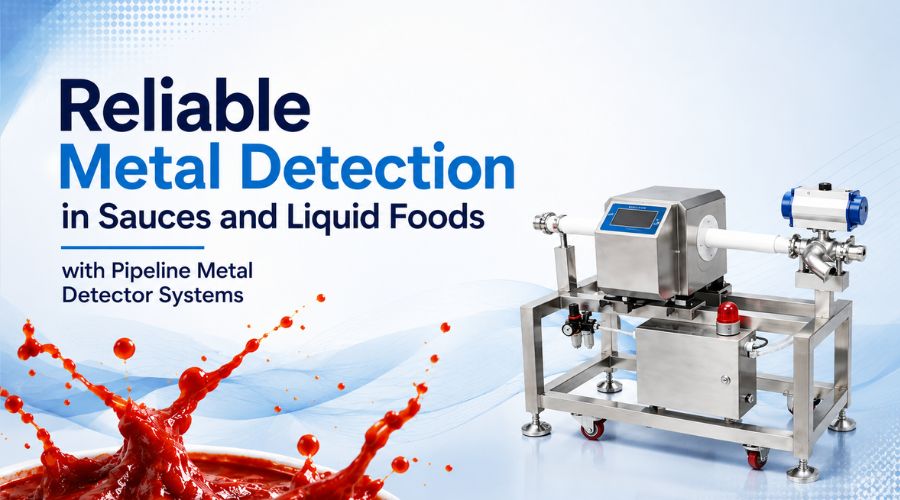
Pipeline metal detectors become essential tools in this particular situation. Engineers specifically design these systems for liquid and semi-liquid products transported through pumps, provide extremely sensitive, dependable detection while preserving production efficiency. Modern pipeline metal detectors provide continuous and automatic contamination control. They inspect products such as beverages, yogurt, syrup, cheese sauce, ketchup, and chili sauce without interrupting production flow.
As international food safety regulations evolve, the need of ensuring the security of liquid and semi-liquid meals, as well as condiments, has increased dramatically. Even a little metal particle on a stainless steel detection line can cause product recalls, consumer complaints, and serious food safety issues.
In the competitive food sector, a single contamination incidence can result in significant financial losses, legal challenges, and lasting damage to reputation. Therefore, investing in advanced pipeline metal detection technology is more than a technical upgrade. It is also a strategic decision that supports sustainable growth and strengthens consumer trust.
Challenges in Metal Detection for Sauces and Liquid Foods
Detecting metal fragments in sauces and liquid foods presents a series of obstacles rarely encountered on production lines for dry or solid products.
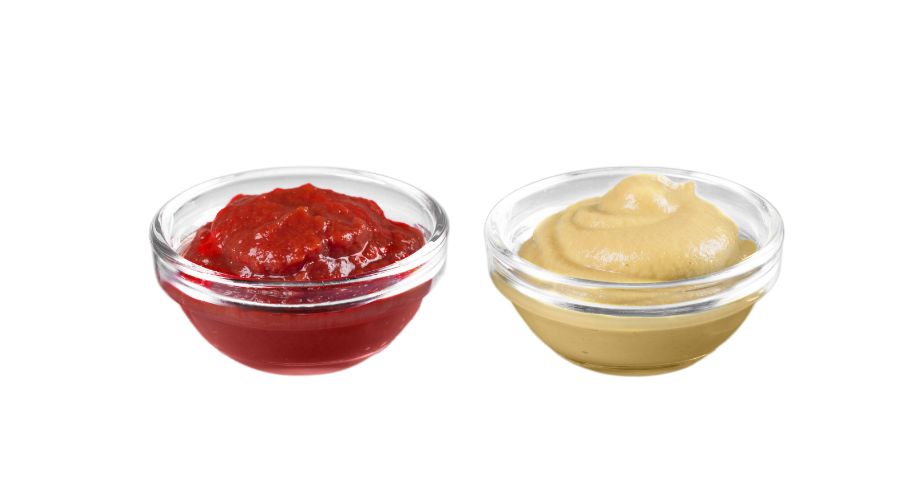
First, the physical characteristics of these products, in particular their high viscosity, variable density, and usually heterogeneous composition, might interfere with the electromagnetic fields generated through traditional metal detectors. For example, chunky tomato sauce with herbs or vegetable pieces may generate signals that resemble metal contamination. As a result, the system may trigger false rejects and increase product waste.
Second, temperature is critical in detection: hot liquid sauces and chilly dairy liquids may vary in electrical conductivity and signal response.
Third, the presence of salts, organic acids, or metal ions, which are usual ingredients in many recipes, causes inherent electrical conductivity, reducing detection sensitivity and complicates liquid food inspection.
Fourth, the pipe system itself presents a unique set of issues, such as pressure fluctuations, flow rate variations, and the potential for cavitation (bubble formation); all of these elements can cause false alarms.
Finally, the geometry of metal parts—such as thin stainless steel flakes from worn pump impellers or tiny wire-like shards from mesh screens—is often extremely light, and these fragments tend to position themselves within the circulating product stream in a way that prevents detection.
Standard pipeline metal detectors must overcome these challenges while maintaining high production throughput. As a consequence, identifying procedures particularly designed for wet product examination—such as multi-frequency operation and self-learning algorithms—are essential to ensuring reliable metal detection in sauces while preserving production efficiency.
What is a Pipeline Metal Detection System?
A pipeline metal detector is specialized detection equipment designed to detect liquid, paste, slurry, and semi-liquid products that travel through pressured pipes during food processing. Pipeline metal detectors, as opposed to typical gravity-fed or conveyor-based detection systems, are installed directly in the production line, prior to filling or packaging operations.
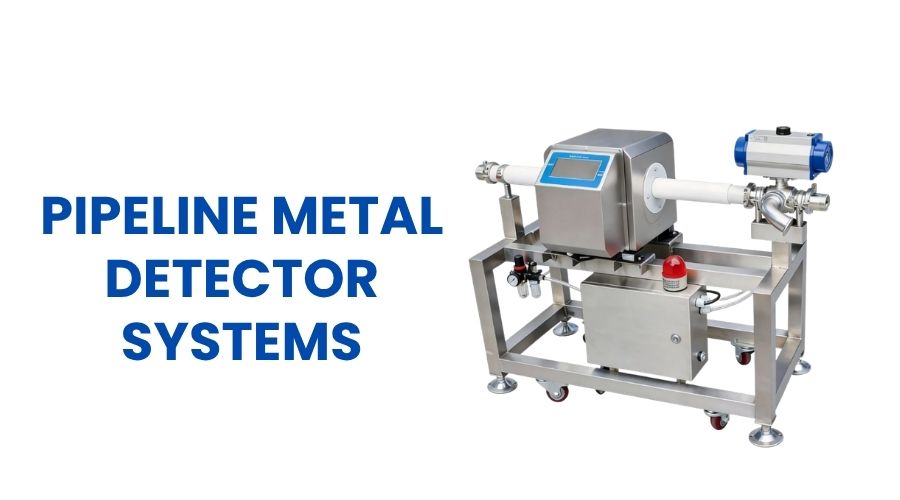
The product flows continuously from the stainless steel inlet pipe through the detection zone to the discharge outlet. Upon passing the detection point, If the system detects no contaminants, the product exits through the normal pass channel, it exits through the “pass” channel. However, If the system detects metallic contaminants, it immediately activates the rejection mechanism, diverting the contaminated product to exit through the dedicated rejection port.
Modern multi-frequency detectors distinguish contaminant signals from normal product signals more effectively. This technology improves detection accuracy and reduces false alarms. This enables the system to detect ferromagnetic metals, non-ferromagnetic metals, and stainless steel contaminants with exceptionally high sensitivity.
Typical systems include the following:
Detection head
Stainless steel piping assembly
Automatic reject valve
Control interface
Product compensation software
Sanitary fittings
Data logging and traceability functions
The rejection mechanism is one of the most important roles in the field of liquid food safety. When a contamination is discovered, the system properly sends the contaminated component of the product to a designated rejection path, guaranteeing food safety while reducing waste. Hygienic safety is critical in applications such as detecting metallic foreign particles in sauces. All Foodman systems are made of food-grade stainless steel, have an IP69K protection certification, and have quick-release fittings for simple cleaning and maintenance.
Today’s intelligent pipeline metal detection systems also support digital integration with factory automation platforms. Features such as real-time monitoring, remote diagnostics, production data logging, and compliance reporting are increasingly becoming standard requirements in advanced food processing facilities.
How to Choose the Right Pipeline Metal Detector
Choosing a pipeline metal detector requires more than reviewing technical specifications. Manufacturers must also evaluate real production conditions and operational requirements.
Manufacturers must first get extensive knowledge of their product’s properties—such as conductivity, viscosity, temperature, density, and composition. This is critical because certain products, such as sauces and liquid food, particularly those that are rich in salt content, may generate unstable signals.

Sauces, soups, dairy products… each exhibits distinct flow characteristics within a pipeline. Some have high salt content, others are acidic, and some remain highly unstable while flowing at high speeds. Since conductive products generate a strong “product effect,” accurately distinguishing between the product itself and potential contaminants presents a significant challenge.
These product characteristics (i.e., the “product effect”) can easily interfere with detection signals. Consequently, manufacturers should select a pipeline metal detection system equipped with multi-frequency technology. Such a system is better able to differentiate between signals generated by contaminants and those generated by the product itself, thereby helping to minimize product waste during the rejection process—a capability that is particularly critical in sauce production lines or high-speed manufacturing environments.
Of course, beyond system functioning, the safety and cleanliness of the equipment itself are essential since pipeline detectors come into close proximity with the product; they must be built for easy disassembly and cleaning and made of food-safe stainless steel.
Foodman manufactures its systems with food-grade stainless steel and IP69K protection certification. Working with an experienced supplier, such as Foodman, guarantees durable equipment and long-term operational reliability.
Typical Applications for Pipeline Metal Detection
Tomato Paste Processing
During the production of high-viscosity tomato paste, minute stainless steel particles may erroneously enter the product stream due to wear and strain on pumps and processing equipment. Pipeline metal detectors utilizing multi-frequency technology help identify these tiny, non-magnetic stainless steel atoms prior to filling, reducing the risk of product recalls and minimizing product waste.
Dairy Custard and Liquid Dessert Production
Due to their high moisture and dairy content, refrigerated custard-based products often generate strong “product effect” signals during inspection. Advanced pipeline metal detectors equipped with digital signal processing and temperature compensation capabilities can maintain stable detection performance throughout the production process while significantly reducing false reject rates.
Sauce and Marinade Manufacturing
Sweet chili sauces, marinades, and other conductive liquid food products containing spices or particulate elements often pose a challenge to standard magnetic separation methods. Pipeline metal detectors provide a reliable in-line inspection solution for detecting stainless steel fragments, broken screen wires, and other metallic contaminants that may have gotten in acidic or high-sugar products.
Employing specialized pipeline metal detection systems may enhance product safety, minimize false rejects, safeguard a brand reputation, and meet modern food safety standards.
Pipeline metal detectors VS traditional metal detectors
Traditional conveyor-based metal detectors are still useful when handling packaging dry items, but they are not ideal for liquid or semi-liquid products.
Historically, detectors inspect finished, packed products as they pass down a conveyor belt. However, this approach has drawbacks for liquid products since contaminants might settle unevenly or remain buried inside thick product matrices. Pipeline metal detectors, on the other side, examine products prior to when they are filled and packaged, ensuring that contamination is detected earlier in the production process.
Key differences include the following:
Detection Method: In-line flow detection versus conveyor-based package inspection
Application Type: Liquids and slurries versus dry, packaged products
Sensitivity: Highly optimized for the inspection of wet products
Hygiene: Features a sanitary piping system specifically designed for food processing environments.
Efficiency: Enables continuous production workflows without the need to handle packaged products
Waste Reduction: Precise rejection of non-conforming products minimizes product loss.
For manufacturers specializing in sauces, beverages, dairy products, and liquid foods, dedicated pipeline metal detectors offer superior performance compared to general-purpose inspection equipment.
Future Trends in Liquid Food Inspection
Liquid food inspection is evolving toward production systems that are more intelligent, highly automated, and efficient.
AI-Enhanced Detection: Artificial intelligence enables inline metal detectors to more accurately distinguish between “product effect” and actual contaminants, thereby reducing false rejections.
Smart Factory Integration: Modern inspection systems can interconnect with factory monitoring platforms to facilitate real-time tracking and predictive maintenance.
Increased Detection Sensitivity: Increasingly stringent global food safety standards are driving market demand for high-sensitivity inspection systems for wet products.
Optimized Hygienic Design: Advanced hygienic engineering designs help reduce cleaning times and minimize the risk of contamination.
Focus on Sustainability: New metal detection technologies for sauces help minimize unnecessary product waste, thereby contributing to sustainable production.
Remote Monitoring: Cloud-based systems enable remote diagnostics, maintenance, and faster technical support services.
These technological advancements continue to elevate food safety standards, operational efficiency, and product quality within the liquid food manufacturing sector.
Conclusion
In today’s highly regulated and quality-conscious food industry, robust contaminant control mechanisms are paramount for safeguarding consumer interests, ensuring regulatory compliance, and preserving brand reputation.

The inspection of liquid and semi-liquid products presents unique challenges, driven by factors such as conductivity, viscosity, temperature fluctuations, and complex ingredient compositions. Traditional inspection systems often struggle to deliver stable and reliable performance under these demanding operating conditions.
Dedicated pipeline metal detectors offer an ideal solution for modern inspection applications involving liquid foods and wet products. From various sauces and dairy products to beverages and soups, these systems provide high-sensitivity detection capabilities, hygienic operating environments, significant waste reduction, and seamless integration into production workflows.
As global expectations regarding food safety continue to rise, manufacturers who proactively invest in advanced metal detection technology for sauces and similar products will gain a distinct competitive advantage in terms of operational reliability, regulatory compliance, and earning consumer trust.
Ultimately, a high-performance pipeline metal detector is more than just an inspection device; it serves as a critical safeguard for ensuring product quality, protecting commercial reputation, and achieving long-term success within the highly competitive food and beverage industry.
FAQ
A1: Depending on the conductivity and viscosity of the product, the device is capable of detecting ferromagnetic, non-ferromagnetic, and non-magnetic stainless steel fragments down to sub-millimeter sizes.
A2: Yes. The system is specifically designed for wet product inspection—including high-viscosity sauces—and is equipped with an adjustable reject valve and frequency tuning capabilities to prevent false rejections.
A3: The system utilizes multi-frequency operation technology and self-learning algorithms to automatically compensate for the effects of product conductivity, temperature drift, and air bubble interference.