Industry Context: Quality Requirements in Bottled Condiment Production
Filling a bottle is only one step in production. Next, manufacturers must complete labeling, capping, sealing, coding, and packing. However, problems can occur at every stage. For example, misaligned labels, loose caps, and faulty seals may reach consumers if the production line lacks effective inspection. Compromised seals reach the shelf. For food manufacturers, these defects are not cosmetic. A wrong label can carry wrong allergen information. A faulty seal invites microbial contamination and shortens shelf life.
However, each type of condiment has different packaging and inspection needs. For example, soy sauce, oyster sauce, chili sauce, vinegar, and hot pot base may require different inspection settings. Quality control must cover product appearance, label accuracy, packaging integrity, and production consistency. However, manual inspection becomes less reliable when a production line runs at high speed or handles several products. In addition, workers may apply different standards across shifts. As a result, some defective bottles may reach the market.
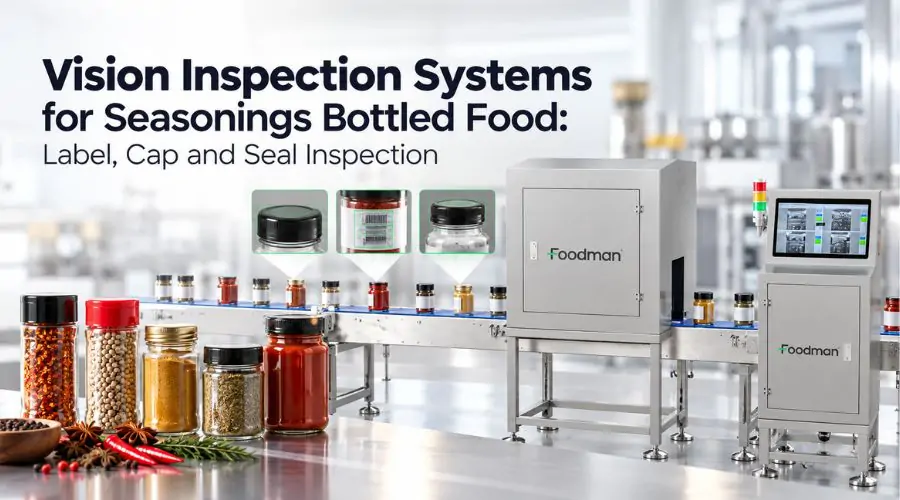
A vision system for bottled condiments runs on industrial cameras, specialized lighting, and image processing algorithms. It inspects bottles in-line. Depending on configuration, it catches missing or misaligned labels, absent or malformed date codes, missing or misplaced caps, and some visible seal defects.
Vision is not a universal solution. Cameras see external anomalies. They cannot measure cap torque. A single image cannot prove a bottle opening is perfectly sealed. Manufacturers must divide labor between vision and other test methods. Packaging structure, defect types, quality control requirements—these decide the split.
Why Do Bottled Condiments Require Automated Visual Inspection?
1. Label Defects Go Beyond Just Aesthetics
Bottle shape, label material, adhesive condition, conveyor stability—each introduces variation. Common problems: missing labels, skewed labels, wrinkles, peeling edges, wrong labels, misplaced front or back labels. One line running multiple flavors or specifications adds another risk. Changeovers can put the wrong label on the wrong bottle.
However, not all label defects carry the same level of risk. A slightly misaligned label may mainly affect product appearance. By contrast, errors in product names, ingredient lists, or allergen information can create serious quality and compliance concerns.
Automated vision systems evaluate products against predefined criteria: label position, visual characteristics, text information. This reduces the risk of defects going unnoticed—a common failure of manual inspection. The system’s detection ability depends on several factors. These include the camera’s viewing area, image quality, inspection software, and product standards. Therefore, manufacturers should test the system with actual labels before using it on the production line.
2. Defects in Caps and Bottle Mouths
Cap defects need real-time detection on the line. Capping—whether by screwing or pressing—brings its own failure modes. Missing caps. Tilted caps. Deformed caps. Wrong colors. Irregularities in the tamper-evident ring. For packaging with visible tamper-evident features such as breakaway rings, vision systems can flag obvious omissions or anomalies in these structures.
However, a cap may look normal even when the capping process has a problem. For example, the threads may not engage correctly, although the cap appears secure. As a result, the bottle may not have a reliable seal. From certain viewing angles, the two states look nearly identical. Visual imagery alone struggles to tell them apart.
Cap inspection cannot stand alone. It must integrate with process control on the capping equipment. Torque testing supplements it. Other seal integrity assessments complete the picture. A satisfactory appearance does not equal a reliable seal. That distinction must be clear.
3. Date and Batch Coding: Presence and Legibility
Production dates, expiration dates, batch numbers, traceability information—these go on via inkjet or laser marking. On a real line, coding errors have many causes. Clogged printheads. Poor ink adhesion. Container vibration. Overlapping characters. Misaligned print positions.
What does vision monitor? Code presence. Correct placement. Character legibility against predefined standards. With OCR, the system can also compare recognized text against expected data. A missing date on a batch of bottled chili sauce gets caught. A printed product code that does not match the current production order gets caught.
OCR reads and recognizes printed characters. However, recognizing text does not confirm that the information is correct. Therefore, manufacturers must verify dates, batch numbers, and product codes against production orders, recipe specifications, or other approved reference data. This additional step helps identify incorrect information before products leave the production line. Reading is not checking. The two are different tasks.
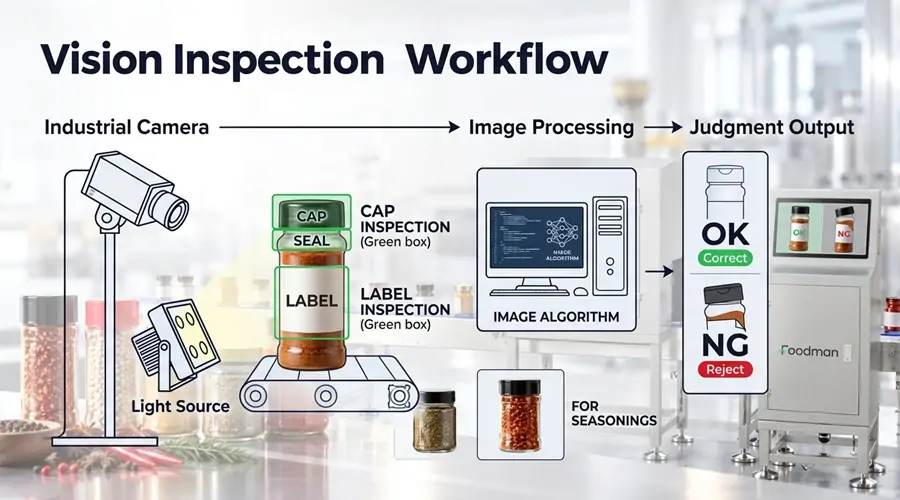
Products enter the inspection zone. Cameras capture images. Software analyzes them against preset standards. Results go to a control system. The control system triggers an actuating mechanism. Non-conforming products get handled. That is the basic workflow.
A trigger signal fires. Cameras capture the moving bottles. Label inspection usually needs multiple cameras—front, back, sometimes full circumference—to cover the whole label area. Cap inspection generally runs from directly above. It verifies position, alignment, presence. Seal inspection targets the sealing area: aluminum foil seals, shrink-wrap films, tamper-evident rings. Light source choice shapes image quality. Reflections from glass bottles. Low-contrast dark labels. Glare from transparent films. These demand specialized lighting—diffuse lighting, low-angle dark-field illumination, coaxial lighting.
The software compares captured images with preset standards. For label inspection, it uses template matching, OCR/OCV, and image comparison to identify potential defects. It looks for misalignment, creases, air bubbles, missing characters, wrong label versions. Cap inspection targets three things: center position, tilt angle, tamper-evident ring integrity. Seal inspection extracts features from the sealing area. Is the aluminum foil intact? Free of creases? Properly aligned? The system outputs a pass/fail signal. That signal triggers a rejection mechanism—air blast, pusher, diverter flap. Defective items leave the line.
Synchronization and traceability. Higher production line speeds demand greater precision in trigger timing and exposure duration. Most systems record the inspection results and images for each bottle, facilitating future traceability and parameter optimization. The value of this data for quality control is often underestimated; it enables the identification of the specific batch, time frame, and equipment associated with any given issue.
It is important to emphasize that visual inspection is a technology based on “consistency verification” rather than “product understanding.” While it excels at determining whether a specific bottle matches the established standard, the system cannot independently judge whether that standard is reasonable or whether the defined defects adequately cover all actual risks. This distinction defines the operational boundaries of inspection, which will be discussed further on.
What types of defects need to be detected during the production of bottled condiments?
Label Inspection: Presence Does Not Equal Correctness
The primary question in label inspection is not “Is there a label?” but rather “Is it the correct one?” Simply applying a label is merely the starting point. Any deviation—whether in position, integrity, or version—can compromise product quality.
There are numerous criteria to check. Missing labels must be detected, as should extra or duplicate labels. If a label’s height, tilt angle, or offset relative to the bottle’s reference point falls outside the permitted range, it is flagged as a defect. Visual flaws—such as tears, creases, peeling edges, contamination, or printing errors—must also be identified. Version control is equally critical: product names, packaging graphics, color specifications, and required text must all be verified. This is often where errors occur during product changeovers. Furthermore, barcodes and QR codes must be monitored—ensuring they are present and, provided the equipment configuration allows, that they are readable.
Take this example: on a soy sauce production line, the bottle size is changed during a single production run. If the labeling machine’s settings aren’t updated accordingly, it will still apply labels—but they will be in the wrong position for the current bottle size. Checking that a label is present catches nothing here. Specific inspection templates for each product specification are needed. Then the system can identify them while the line runs.
Templates only work under one condition: the label versions must differ in some discernible way. Overall color is unreliable when designs are highly similar. Focus instead on key text, barcodes, or designated identification zones. Configure the system to monitor the specific areas where differences occur.
Missing, misplaced and abnormal appearance of bottle caps
Bottle cap inspection can cover the following visual defects:
The cover is missing or the cover is not properly seated;
The bottle cap is obviously tilted or has an abnormal height;
The cover is damaged, crushed or has obvious cracks;
The cap color, shape or designated logo does not match the current product;
The tamper-evident ring can be missing, broken, or out of position. For screw caps, inspection usually covers the cap top, the cap body sides, and how the cap sits relative to the bottle mouth. Threads or anti-slip textures on the cap side matter. They change how light hits the surface. That shifts the imaging angle and lighting conditions—and defect recognition along with them.
Some condiment packaging adds internal plugs, dispensing tips, or other specialized features. The packaging design decides which areas need inspection.
Issue types must be separated. Cap presence and noticeable misalignment are appearance matters. Verifying torque, or whether threads are securely engaged, is not. That calls for torque measurement or specialized mechanical testing.
Some bottled condiments use aluminum foil induction seals, plastic inner liners, or other bottle-mouth sealing structures. Depending on configuration, a vision system can verify sealing film presence and positioning. It can also detect significant wrinkles, damage, or residue in the sealed area. Transparent or translucent materials usually need specialized lighting and imaging.
Visual inspection cannot replace seal integrity testing. For example, a smooth-looking film may still allow tiny leaks between the film and bottle rim. However, an uneven film edge does not always mean the seal has failed. Therefore, manufacturers should use suitable leak or seal strength tests when packaging integrity is critical. When quality control involves leakage risks or shelf life, use appropriate methods: leak testing, seal strength testing, or other validated seal integrity verification. Select them by packaging material, product characteristics, and process requirements.
Date Coding and Batch Traceability
The focus of code inspection lies in combining visual appearance checks with information verification.
The system catches missing characters. Significant blurring or overlap. Print placement outside the designated area. Batch codes that break predefined rules. Take dark-colored soy sauce bottles. Lighting and image contrast can be tuned for the lighter printed areas. Take transparent glass bottles. Background variation affects character recognition and must be accounted for. Now suppose a company needs to confirm that a production date matches the current task. Checking for text in the coding area is not enough. The OCR results must be cross-referenced with actual production data.
Glass bottles may develop cracks, chips, or breaks during production and handling. Plastic bottles can also develop dents, scratches, or other visible damage. A vision inspection system can detect these defects when they fall within the camera’s field of view and remain visible under the selected lighting conditions.
However, detection performance depends on defect size, location, surface reflections, and image quality. For example, fine cracks in clear glass may blend into reflections, while a front-facing camera may miss damage hidden behind a label. Manufacturers should therefore define the inspection areas and test the system with representative defect samples before deployment.
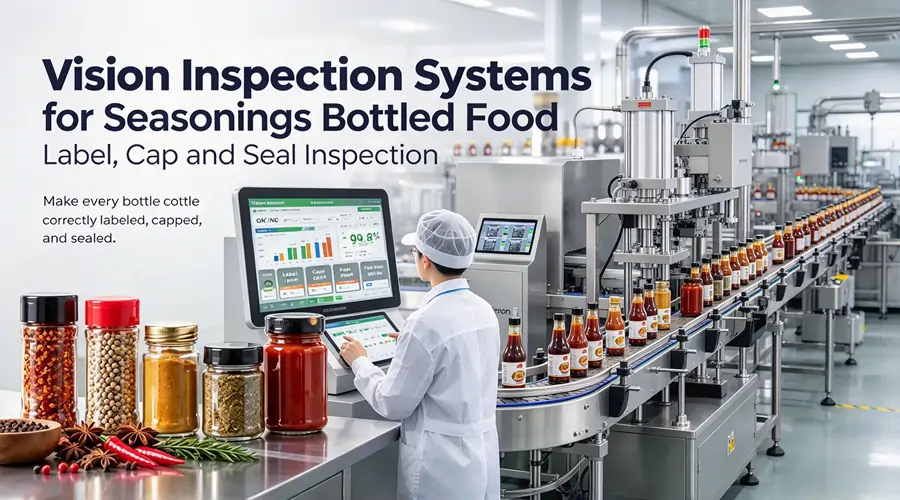
Differences in vision solutions across bottled condiments
Soy sauce and vinegar: reflections, ink-jet coding, caps
Soy sauce and vinegar usually come in glass or plastic bottles. During production, manufacturers should focus on three main inspection areas: bottle reflections, inkjet code readability, and label and cap defects. For transparent glass bottles, reflections and background interference can make inspection more difficult. Therefore, the camera position and lighting setup should match the bottle material and product characteristics. Transparent glass bottles need extra measures. Refraction and background interference inside the camera’s field of view must be addressed.
A dark product is not automatically a hard inspection. The bottle’s dark color is not the core problem. What matters is image contrast between target and background. And how well lighting and imaging techniques match the target’s specific characteristics.
Oyster sauce and thick sauces: residue interferes with identification
Filling oyster sauce, chili sauce, or bean paste leaves residue behind. It clings to the bottle opening. It clings to the container body. Residue on label edges, cap surfaces, or the printed code area does damage. At best it hurts appearance. At worst it blocks text or code legibility.
Vision systems can detect visible stains and label anomalies. But residue appearance varies. Color matters. Viscosity matters. Surface reflectivity matters. The detectable contamination range must be established by testing with the actual product. Residue over critical characters can defeat OCR. Stain color close to the packaging color calls for adjusted lighting, imaging angle, or detection strategy.
Multiple specifications and flavors: preventing changeover errors comes first
Many manufacturers produce several brands, bottle sizes, and flavors on the same line. As a result, product changeover errors can pose a greater risk than isolated visual defects. To reduce this risk, the inspection system should load the correct settings for each production task, including label templates, cap color standards, and printed code requirements. During every changeover, operators should confirm that the selected inspection recipe matches the current production order.Product appearance benchmarks.
When operators switch products, they must confirm the inspection recipe matches the current production order. Similar packaging needs multiple distinctive features for verification. Cap color alone will not do. Label primary color alone will not do. If the production system has data interfaces, link inspection results to batch information, production orders, and quality records. Defect analysis and product traceability get easier.
Inspection Capabilities and Limitations
In practice, an inspection system may perform differently on a real production line than it does during a demonstration. Several factors explain this difference. The five main considerations are product and packaging characteristics, defect definitions, production speed, product changeovers, and environmental conditions.
Product and packaging variables: The complexity of a bottle’s shape, whether it is made of glass or plastic, the reflective properties of its labels, and the color of its contents—all of these affect imaging contrast. For example, a clear bottle containing a dark sauce may need a special lighting setup. In addition, square, flat, or ribbed bottles can create areas that a camera cannot see clearly from certain angles. Manufacturers should test different camera positions to find a suitable setup.
Quantifiability of defect definitions: A “crooked label” can be quantified as an angular deviation, making it straightforward to assess. Conversely, the severity of “label wrinkles” is inherently subjective; therefore, during the acceptance phase, it is essential to work with the supplier to define specific sample cases and establish clear, objective thresholds for judgment. The more ambiguous these definitions are, the more likely they are to lead to disputes once the system is in operation.
The trade-off between speed and image quality: Higher speeds result in shorter exposure times per bottle, which degrades the signal-to-noise ratio. High-speed production lines require more powerful light sources and more sensitive cameras, leading to higher costs. Acceptance criteria should specify that the system must be able to detect the minimum defect size even at maximum operating speed—relying solely on static demonstrations is insufficient.
Frequency of product changeovers: For factories handling a wide variety of products in small batches, the time required for line changeovers can have a greater impact on overall efficiency than the inspection process itself. The ease of switching between product configurations—and whether manual re-teaching is required—directly determines the actual user experience.
Environmental factors: In a filling plant, elements such as water mist from wash-down processes, steam, and condensation on the bottles can interfere with imaging. It is essential to verify the system’s ingress protection (IP) rating and lens-cleaning mechanisms during the selection phase.
Defining these boundaries is not intended to discredit visual inspection; rather, it ensures that acceptance criteria and operational expectations are grounded in real-world conditions. A system that performs well on a demonstration line may see its performance drop significantly when faced with bottle types or lighting conditions that were not previously accounted for.
How should you select vision inspection equipment for a bottled condiment production line?
Start by identifying the quality problems that your production line needs to solve. Then decide which cameras, lighting options, and inspection functions the system requires. This approach helps manufacturers choose equipment based on actual needs rather than technical specifications alone.
Step 1: Identify the Main Inspection Requirements
First, list the most common packaging defects and rank them by risk. For example, frequent label errors may require label-position inspection, while incorrect dates call for OCR and text verification. Keep cap appearance, capping performance, and seal integrity as separate inspection tasks.
Step 2: Check Bottle and Packaging Requirements
Next, provide the bottle dimensions, material, label type, cap design, and production line layout. A label covering most of the bottle may require multiple cameras. Likewise, complex caps may need both top and side views. For transparent glass bottles and reflective metal caps, test the imaging setup with actual samples.
Step 3: Confirm Line Speed and Rejection Requirements
Then, confirm the maximum line speed, bottle spacing, and conveyor conditions. Check whether bottles rotate during transport and whether the rejection mechanism suits the container type. If the line runs at different speeds, test inspection performance under each operating condition.
Step 4: Test with Actual Defect Samples
Before purchasing the equipment, prepare samples of acceptable and defective packaging. Include missing, misaligned, or wrinkled labels; missing, crooked, or damaged caps; incorrect or unreadable date codes; and representative visible seal defects.
Record the detection results for each defect type, along with false rejection rates and operating conditions. If the application requires leak detection or other tests beyond visual inspection, assess those requirements separately.
Step 5: Review Integration and Maintenance
Finally, check how the system will connect to conveyors, coding equipment, labeling machines, and production control systems. Confirm how operators will change inspection recipes, review defect records, respond to alarms, and verify product rejection.
Also, review cleaning and maintenance needs. Food processing plants often involve moisture, oil, and frequent wash-down. Therefore, confirm that the equipment’s IP rating, protective components, and installation method suit the actual production environment.
Foodman vision inspection for bottled condiments

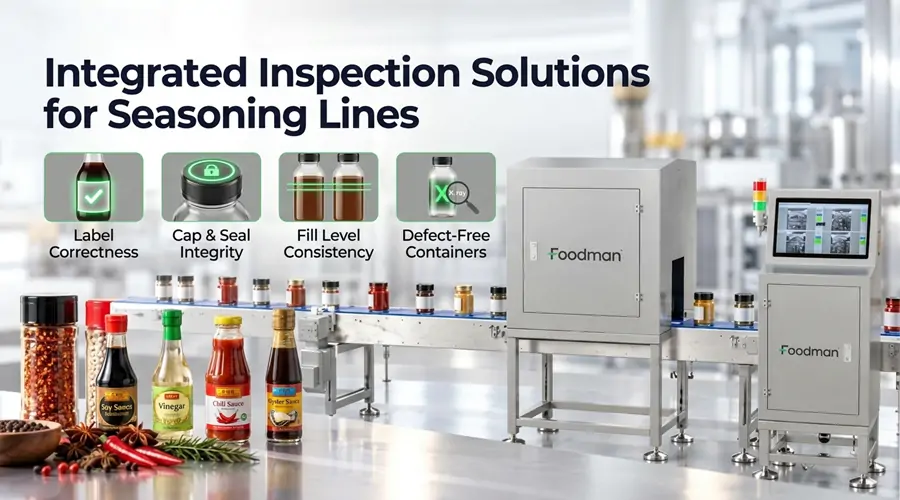
Foodman supplies vision inspection equipment for food packaging Labels, Codes, Seal integrity, Packaging damage. Industrial cameras and image analysis drive the Foodman Vision Inspection System. Manufacturers can configure the system to inspect labels, barcodes, printed codes, and visible seal defects. Food and beverage plants are the target environment.
How does a bottled condiment manufacturer configure it? The setup follows the packaging format and the quality control objective. No rigid template.
Labels and codes. Soy sauce, vinegar, oyster sauce, other bottled condiments. The system detects missing or misaligned labels, anomalies in specific graphic elements, and printed code presence or absence. Need to verify production dates, batch numbers, or product codes? Confirm the system supports OCR, standard text comparison, and data integration interfaces.
Caps and seals. Screw caps, press-on caps, visible tamper-evident structures. Feasibility of detecting missing caps, significant misalignment, or visible seal anomalies depends on cap geometry, viewing angles, and defect types. Torque verification, seal integrity, micro-leak detection? These need a broader solution with additional testing methods.
Packaging appearance and line integration. Bottle scratches, noticeable deformation, surface contamination. Suitability is judged case by case. Before deployment, Foodman and the manufacturer should test the system with actual bottles, labels, and representative defective samples. Confirm camera positioning, imaging quality, line speed, and rejection mechanisms.
Want an assessment? Provide bottle shape and material, photographs of labels and caps, line speed, defect types, and current equipment layout. Foodman will evaluate the fit.
Conclusion: making vision inspection serve packaging quality control
A vision system for bottled condiments is not just a camera on the line. Its value lies elsewhere. Labels, caps, coding, visible packaging defects—these become definable, verifiable, recordable inspection items.
Soy sauce, vinegar, oyster sauce, bottled sauce. A suitable solution weighs several things at once. Packaging structure. Lighting conditions. Production speed. Defect types. Post-processing rejection logic. Torque and seal integrity cannot be confirmed by vision alone. They need independent inspection methods.
Foodman can help evaluate vision equipment against specific packaging and inspection needs. Testing actual samples and defining clear acceptance criteria help manufacturers make informed decisions. They can then assess whether automated inspection suits their production lines and identify practical ways to improve packaging quality control.
FAQ
Depending on the configuration of cameras, lighting, and software, the system can detect missing or misaligned labels, significant wrinkles, missing or malformed print codes, missing or crooked caps, and visible seal defects. Specific capabilities must be verified using actual product samples; it should not be assumed that all systems offer the same detection range.
I am item content. Click edit buttoTypically, specific inspection “recipes” must be created for each combination of bottle type, label version, cap style, and print code requirement. During product changeovers, operators should ensure the active recipe matches the current production order and verify the inspection performance for the new specification. For products with similar appearances, it is advisable to incorporate additional identification criteria, such as specific text, barcodes, or other distinct features.n to change this text. Lorem ipsum dolor sit amet, consectetur adipiscing elit. Ut elit tellus, luctus nec ullamcorper mattis, pulvinar dapibus leo.
Yes, but there are trade-offs. Higher line speeds result in shorter exposure times per bottle, which can degrade the signal-to-noise ratio of the captured images. High-speed lines generally require more powerful lighting and more sensitive cameras, leading to higher costs. When selecting equipment, the acceptance criteria should be based on the system’s ability to detect the smallest target defect at the maximum line speed—rather than relying solely on demonstrations conducted under static or low-speed conditions.