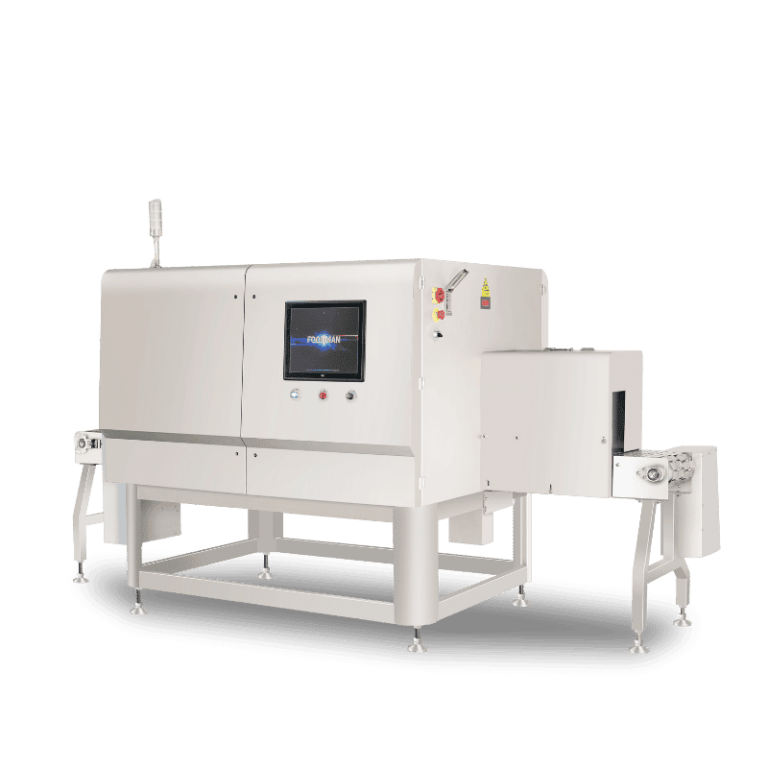

Introduction: The Rising Challenge of Metal in Food Production
In food processing, even tiny metal fragments—often imperceptible to the naked eye—can cause immediate bodily harm to consumers if they infect packaging and make it to market. Such instances can set off a chain response of problems, including product recalls, legal action, reputational damage, and a drop in stock prices. While these food safety incidents are common, the vast majority of them can be prevented with the use of expert, high-sensitivity metal detection devices.
Modern food production operates at extremely high speeds.Assembly lines process thousands of packages every hour.Even a minor mistake can lead to serious consequences.
Traditional manual inspection is slow and prone to human error. It cannot meet today’s strict food safety requirements. As a result, metal contaminant detection has progressed from a mere compliance formality to a key lifeline for food firms looking to maintain safety standards and defend their brand image.
Stricter regulations and higher retail standards have increased quality control requirements. Consumers also expect safer food than ever before. As a result, manufacturers face greater pressure to maintain product quality. Investing in advanced inspection systems is now a strategic decision. Reliable metal detection protects consumers. It also helps manufacturers remain competitive.
What is a high-sensitivity food metal detector?
A high-sensitivity metal detector’s basic principle of operation is straightforward: it relies on electromagnetic fields and the disturbances they experience. Three balanced coils are used in a typical arrangement. While the other two coils serve as receivers and continuously monitor for any changes, one coil emits an electromagnetic field.
Manufacturers use high-sensitivity food metal detectors as precision inspection systems for food production. Their primary function is to accurately identify and automatically reject various metal contaminants mixed into products before they leave the factory, thereby preventing foreign metal objects from entering the market at the source.
Compared to traditional inspection methods, this modern food inspection equipment overcomes the limitations of both efficiency and accuracy. It is compatible with high-speed production lines, allowing for the precise detection of minute metal impurities without compromising productivity. It effectively addresses the shortcomings of manual inspection and traditional equipment—namely, significant margins of error and high rates of missed detections.
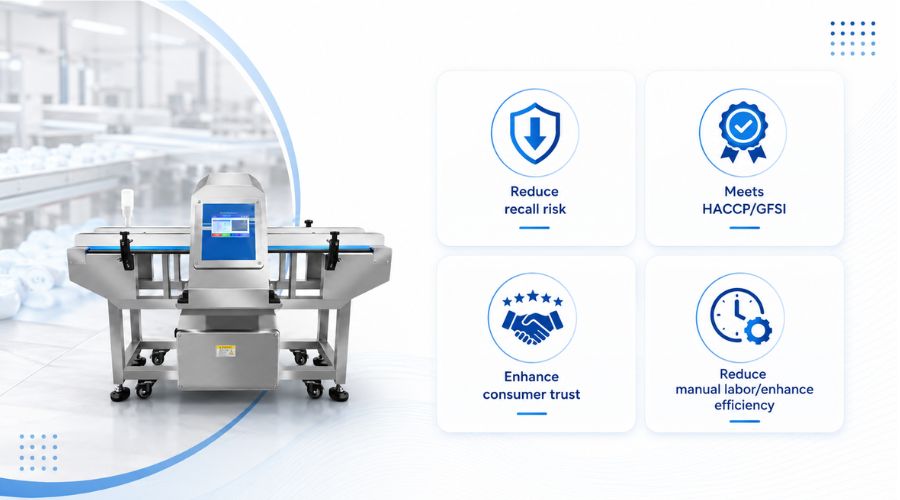
Operating Principle
The equipment utilizes stable electromagnetic field detection technology. During production, the system continuously monitors changes in electromagnetic signals as products move through the inspection zone in real time as packaged or unpackaged goods pass through the inspection zone during production.
Whenever ferrous, non-ferrous, or stainless-steel contaminants enter the detection area, the system instantly identifies the disturbance and activates the rejection device.
With advanced digital signal processing and multi-frequency technology, it maintains excellent detection accuracy even when inspecting moist, salty, or high-density foods. It can effectively inspect complicated food materials—like those that are very moist, salty, or unevenly dense—while reducing interference from these challenging environments to maintain steady and accurate detection.
The Core Value of High Sensitivity
“High sensitivity” refers to the detector’s ability to identify extremely small metal contaminants. In general, greater sensitivity allows manufacturers to detect smaller metal fragments. As a result, companies reduce recall risks, improve food safety, and better protect their brand reputation.
Why Modern Food Manufacturing Requires High-Sensitivity Metal Detectors
1. Reduce high-cost recall risks and operational losses
Recalls due to foreign item contamination are among the most expensive and devastating situations for food producers. A single tainted batch entering the market can set off a chain reaction of losses, including product withdrawals, channel fines, regulatory audits, legal issues, and significant damage to the brand name.
Equipping production lines with high-performance metal detection for food packaging systems enables the detection of metal contaminants before they enter warehousing, distribution, or retail channels, moving risk management to an earlier stage.
This enables companies to move from reactive remediation to proactive prevention. As a result, professional metal detecting equipment is no longer just a quality control tool; it is a vital investment in managing operational risks and reducing hidden losses.
2. Align with Authoritative International Standards for Seamless Compliance Audits
As global food safety standards evolve, major international certification systems, like HACCP, GFSI, BRCGS, SQF, FSSC 22000, and IFS, prioritize foreign object management and explicitly designate metal detection as a critical management point.
High-sensitivity automated detection systems allow for continuous online monitoring, rapid rejection of non-conforming products, extensive data logging, and verifiable compliance records.
These systems fully meet the requirements of various audit standards, significantly increasing the likelihood of passing facility audits and mitigating compliance risks, thereby helping companies successfully access high-end markets and major client channels both domestically and internationally.
3. Solidify brand reputation and strengthen consumer trust
Consumers care more about food safety than ever before.
News spreads rapidly through social media.
Even one contamination incident can seriously damage a brand’s reputation and customer trust.
Automated, high-precision metal detection adds a solid layer of safety to the production process, ensuring product purity and safety across the board. It is particularly well-suited for high-stakes industries such as infant food, dairy goods, snack foods, frozen foods, seafood, and meat processing. It fosters long-term consumer loyalty by effectively stabilizing product quality and preserving brand image.
4. Replace manual inspection to reduce errors and cut costs
Traditional manual visual inspection has inherent limitations; it is susceptible to human factors such as fatigue, lapses in attention, and subjective judgment variations. This leads to high rates of missed or false detections, alongside consistently high labor costs for inspections.
Automated metal detection equipment enables stable, round-the-clock operation with consistent standards and performance. Features such as automatic rejection and real-time monitoring completely eliminate human error. Quality control teams spend less time on repetitive visual inspection. They can focus on process optimization and production improvement instead.
5. Accelerate production and boost overall profitability
Modern food production demands both high safety standards and high efficiency. High-sensitivity metal detection for food packaging systems is designed for high-speed assembly lines, allowing for continuous, high-volume product inspection without downtime or interruptions, precisely matching the pace of industrial mass production.
The system effectively lowers production line downtime and waste from defective items and improves total production turnover. While adhering to food safety regulations, it increases operational effectiveness, lowers costs, and increases overall profitability.
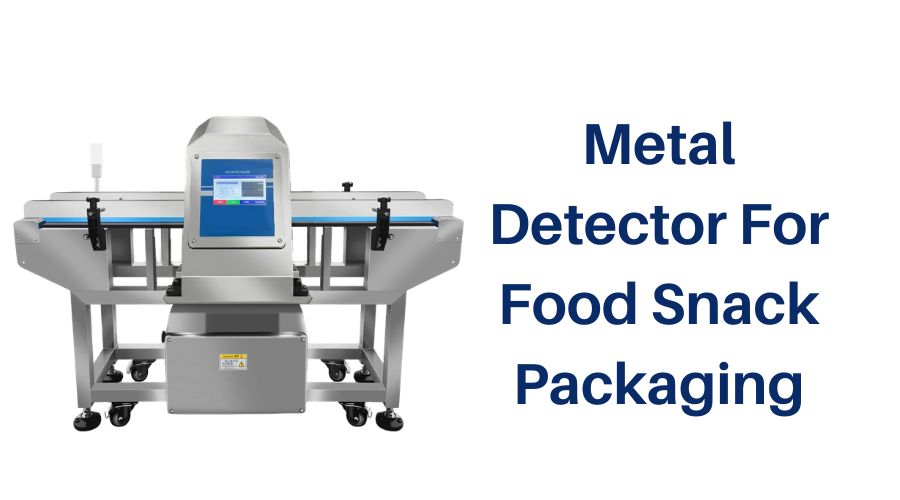
Where do metal pollutants usually originate?
To establish a solid food safety system and precisely limit the risk of foreign metal objects, first identify the sources of metal contamination throughout the manufacturing process.
Metal contamination in food does not occur at a single stage but rather across the entire production chain—including raw materials, processing, maintenance, the environment, and packaging. The primary sources of contamination are classified into five categories:
1. Contamination of source materials
Agricultural products and other manufacturing inputs may get contaminated with metal pieces, which are frequently left behind by equipment during stages such as field harvesting, preliminary processing, storage, and shipping. Mechanized production greatly increases the likelihood that raw materials have concealed metal impurities, making it a major source of upstream contamination.
2. Contamination from equipment wear and tear
This is the most common cause of metal contamination in food manufacturing. Cutting blades, conveyor parts, grinding discs, sieves, and mixing equipment all wear and age over time while in use. Parts may even shatter or detach, resulting in small metal particles that mix directly with the product.
3. Contamination due to maintenance and operational activities
Tools, loose fasteners (such as screws), and metal debris left over from servicing may accidentally fall into the manufacturing line during equipment inspection, maintenance, or calibration. Inadequate cleanup leads to metal pollution caused by human activity.
4. Cross-contamination from the production environment
Metal contaminants can be supplied indirectly via factors such as old production workshop infrastructure, airborne metal particulates, and cross-contact between materials at various processing steps. These offer concealed contamination dangers that are difficult to detect with manual inspection alone.
5. Contamination during the packaging process
Equipment wear, metal clips, loose fasteners, and metal debris inherent in packaging containers or accessories can cause secondary metal contamination during the final packaging stage, compromising the safety of the finished product.
Risks of metal contamination exist throughout the entire food production process; relying on single-point controls is insufficient to completely eliminate these risks. Therefore, deploying metal detection equipment at multiple points along the production line and utilizing high-sensitivity detection systems for final verification before products leave the factory are critical steps in intercepting metal foreign objects and upholding food safety standards.
Which Food Sectors Need High-Sensitivity Metal Detection Most?
While the risk of metal contamination exists across the entire food processing industry, certain product categories—due to factors such as product characteristics, regulatory standards, target demographics, and production models—demand higher levels of detection sensitivity, stability, and comprehensive coverage. These sectors represent the core market for high-sensitivity metal detection equipment.
1. Snack food and confectionery industry
Products in this category are often mass-produced in small, high-speed packaging, carry premium prices and brand value, and are sold directly to end users. Issues related to contamination of metals can easily lead to public relations catastrophes and large-scale recalls; the resulting brand risk is huge, demanding rigorous detection accuracy standards and a zero-tolerance policy for missed detection.
2. Meat and Poultry Processing Industry
Meat products are inherently dense and present significant signal interference, making detection challenging. Foreign substances, such as metal shavings from equipment wear or processing pieces, can easily contaminate the product during manufacturing. Conventional equipment frequently struggles to identify these effectively; thus, high-sensitivity detection technology is required to reduce the danger of missed detections.
3. Bakery and Cereal Products Industry
Products such as flour-based goods and baked items feature stable matrices and minimal signal interference, enabling ultra-high-precision detection. Large-scale assembly lines, and these are characterized by high production capacity and shipment volumes, place tremendous demands on equipment efficiency and operational stability since they require 100% inspection of completed goods.
4. Ready-to-Eat and Pre-prepared Food Industries
Pre-prepared foods involve complex formulations and diverse ingredients; significant variations in product matrices can easily interfere with standard detection equipment. As these products are ready to consume without further processing, any foreign object contamination directly impacts the consumer, creating significant pressure regarding safety control and risk prevention.
5. Infant Food and Formula Milk Powder Industry
This sector is subject to the strictest food safety regulations, adhering to a “zero-tolerance” standard and attracting intense public scrutiny. Even minor safety hazards can lead to severe negative consequences, making high-sensitivity metal detection an essential requirement.
6. Pet Food Industry
The pet food industry is characterized by high production volumes, complex ingredient compositions, and significant batch-to-batch variation, all while facing increasingly rigorous regulatory oversight. With growing public concern regarding pet food safety, the ability to precisely detect metal contaminants and implement comprehensive, compliant inspection processes has become a standard industry requirement.
How to Choose the Right Food Metal Detector
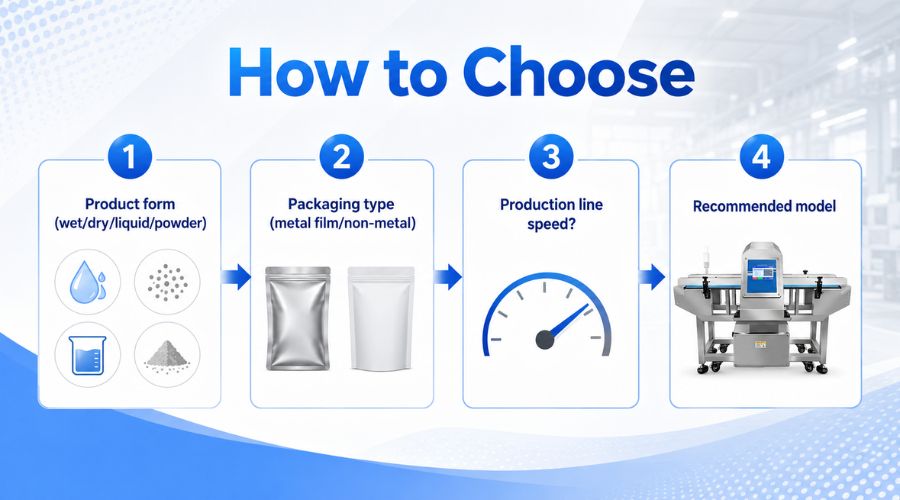
Selecting the appropriate food metal detection equipment for packaging requires careful consideration of the following factors:
Understand Your Product
Product characteristics significantly impact detection performance. Moist, salty, or mineral-rich products can generate a “product effect” that masks metal signals. Understanding the product’s conductivity and composition is crucial.
Define Contaminant Requirements
What types of metal are most likely to be present? What size of metal particles must be detected? The answers to these questions determine the required sensitivity specifications.
Consider Operational Factors
Production speed, environmental conditions, and integration requirements all influence equipment selection. If used in a wet environment, the system must be capable of withstanding washdown procedures.
Plan for Compliance
Does the system provide comprehensive data logging for audits? Can it verify compliance with HACCP and GFSI requirements?
Testing and Validation
Always conduct tests using actual product samples before purchasing. Challenge testing with representative contaminants verifies that the system operates as expected.
How Foodman Helps Manufacturers Detect Foreign Objects Better
As an expert in food inspection technology, Foodman offers advanced solutions designed to support modern food manufacturing environments.

Foodman’s product portfolio includes a wide range of inspection solutions:
* Conveyor-based metal detectors
* Combined checkweigher and metal detector systems
* X-ray inspection systems
* Bulk product X-ray inspection systems
* Pipeline inspection systems
* Intelligent sorting solutions
Designed for modern production lines, these systems deliver reliable metal detection while maintaining production efficiency and regulatory compliance.
Together, intelligent signal processing and high detection sensitivity help manufacturers improve food safety and reduce contamination risks.
Conclusion
Metal contamination remains one of the most critical food safety challenges facing modern manufacturers.
Amid rising consumer expectations and increasingly stringent regulations, high-sensitivity metal detectors play a vital role in protecting products, brands, and consumers.
From mitigating recall risks and supporting HACCP compliance to boosting production efficiency and strengthening customer trust, the value of Foodman’s applications is evident.
Today, advanced metal detection technology tailored for the food industry has become an essential investment for food manufacturers worldwide.
Reliable metal detection benefits every food category.
It supports snacks, dairy products, seafood, meat, and frozen foods.
Manufacturers improve food safety while achieving long-term operational success.
FAQ
A1: Yes. Modern metal detection equipment for food packaging is designed for easy integration, working seamlessly with existing conveyor systems, packaging machinery, and rejection mechanisms.
A2: Metal detection at the packaging stage helps prevent contaminated products from reaching consumers, thereby reducing the risk of recalls and enhancing food safety compliance.
A3: We provide comprehensive support services, including operator training, performance verification, technical support, spare parts supply, and ongoing application assistance.