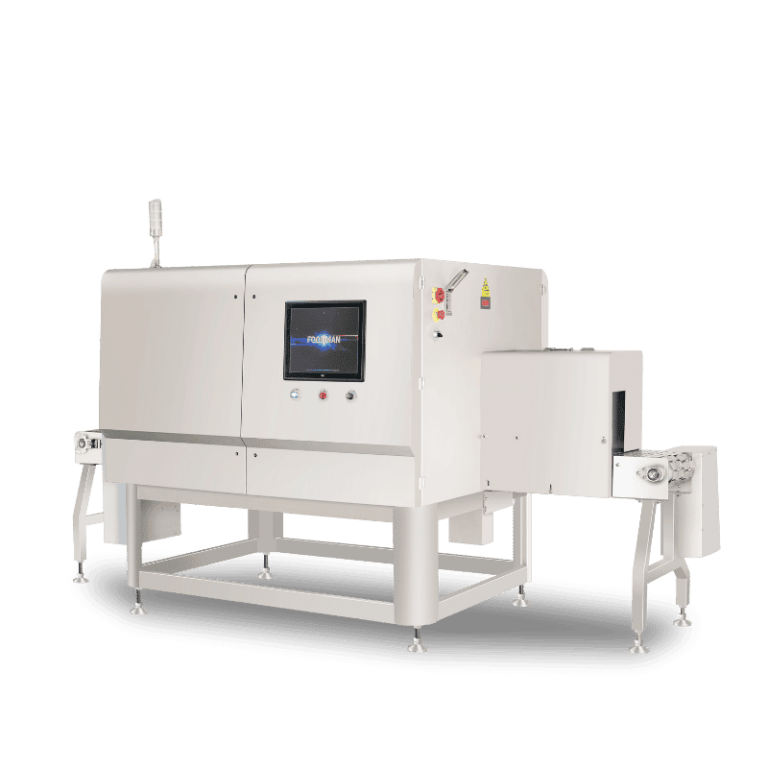

Introduction: Hidden Food Safety Risks in Bulk Date Processing
Dates are among the most widely traded dried fruits in the global food supply chain, particularly in the Middle East, North Africa, and export-oriented agribusiness markets. However, the existence of hidden foreign objects that could become embedded during harvesting, shipment, or first sorting is a problem that is often overlooked but crucial to the handling of bulk dates.
For food safety managers, omitting even a single piece of metal from harvesting equipment, a twig, a stone, or a pit fragment may result in costly product recalls or even cargo rejection at the border. Today, the challenge is not simply if contaminants exist but also how to reliably eliminate them without compromising the quality of the end result.
Why is it simpler to identify foreign objects in dates than in other fruits?
Raisins and cranberries may look like dates at first. However, there are three distinct issues with dates that make foreign object detection in dates especially difficult:
Non-uniform density: Dates have a variety of textures, from hard and dry to moist, soft, and heavy in sugar. Low-density contaminants might get hidden by these density changes.
Non-uniform density: Dates have a variety of textures, from hard and dry to moist, soft, and heavy in sugar. Low-density contaminants might get hidden by these density changes.

Differentiating natural pits from foreign objects: Traditional sensors experience “false positives” due to the enormous density of natural pits. Detection devices must distinguish almond-shaped pits from stones of comparable size.
Characteristics of bulk material flow: Dates have a capacity to cling together. Overlapping dates can mask contaminants in a bulk product stream, rendering it difficult for traditional optical sorters to detect them.
Bulk processing: Rather than being inspected one at a time, dates are processed constantly on high-throughput production lines.
Since there are these characteristics, it is considerably harder to recognize foreign objects in dates than in apples, citrus fruits, or packaged food. Traditional detection methods often fail in this context.
Limitations of Traditional Methods in Bulk Food Inspection
Most date-packaging facilities still rely on a combination of manual sorting stations and metal detectors—the most traditional approach to bulk food inspection.
Manual sorting: While humans excel at identifying color variations, they struggle to detect high-density foreign objects embedded deep within the fruit flesh. Additionally, after just 20 minutes of time, manual sorters are prone to fatigue.
Standard metal detectors can only identify ferrous metals, non-ferrous metals, and stainless steel. Glass, stones, high-density polymers, and pieces of calcified bone are examples of foreign materials that they are useless against. Optical sorters (cameras): The main objective of these vision systems is to assess surface conditions. As a result, embedded pits or pieces of glass that are the same color as the fruit flesh usually pass undiscovered.
When inspecting bulk food, these detection blind spots can translate into compliance risks. This implies not only the failure to detect contaminants but also a failure to meet regulatory compliance standards.
How X-ray inspection systems work in bulk date processing
Modern X-ray inspection systems for bulk products are based on a simple yet powerful principle: differential absorption of X-ray energy.
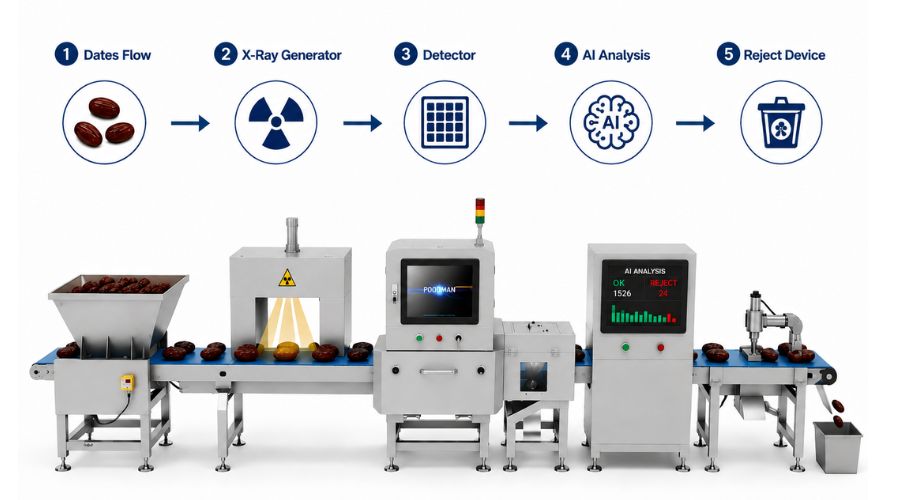
When dates pass through the detection channel:
X-ray generators emit low doses of radiation.
Products absorb radiation based on their density and atomic composition.
High-resolution sensor captures transmission signal
Software reconstructs internal density images in real time.
Identify foreign objects based on abnormal density patterns.
Unlike surface-based inspection, X-ray technology is able to visualize internal structures, making it ideal for detecting hidden contaminants in bulk food streams.
Key Advantages of X-ray Inspection in Date Processing
Why are leading date exporters replacing traditional equipment with X-ray inspection systems? The answer lies in four major technical advantages:
Density-independent inspection: X-rays can penetrate moisture, sugar crystals, and dense date flesh to perform inspections, but metal detectors usually misfire when items are moist.
Wide range of contaminant detection: Further to the foreign items identified by metal detectors, these systems can detect stones, ceramics, Teflon (PTFE), tempered glass, and even bits of oyster shell, a common contaminant in organic farming.
Simultaneous quality inspection: In conjunction with detecting pollutants, modern techniques have the ability to measure mass, identify interior voids (like insect damage), and verify the precision of the pitting.
Hygienic design: These systems endure high-pressure washdowns thanks to the IP69K rating, which is essential for managing the sticky, sugary residues generated during date preparation.
How can bulk-product X-ray inspection systems identify foreign items in dates?
The power of X-ray imaging allows for detection of a variety of contaminants, including:
Metal fragments (aluminum, steel, and wear-associated particles)
Soil waste and stones were placed while harvesting.
Glass fragments from damaged containers
High-density plastic or rubber materials
Bone fragments (in mixed processing environments)
Organic foreign matter having a high density (such as hardened or decaying substance clumps)
In addition, advanced technologies are able to identify internal flaws that can indicate contamination or deterioration by identifying density irregularities.
Food Safety and Export Compliance Requirements
For exporters—particularly those targeting the EU, US, and GCC markets—compliance is strictly regulated under frameworks such as the following:
HACCP (Hazard Analysis and Critical Control Points)
BRCGS Global Standard for Food Safety
ISO 22000 Food Safety Management System
FDA requirements for imported food safety
EU Regulation (EC) No 178/2002 on food safety

A Critical Control Point (CCP) in these systems is the detection of alien objects in dates. Product recalls, certification loss, or shipment rejection are all possible outcomes of compliance.
X-ray inspection systems provide traceable records, which are increasingly becoming a necessary condition for passing audits and obtaining export approvals.
Why Enterprises Invest in X-ray Inspection Systems
Three key drivers are accelerating the adoption of X-ray inspection systems in the bulk product sector:
1. Costs of Quality Failure
A single contamination incident can lead to massive recall costs and export bans.
2. Production Efficiency
Automation technology reduces reliance on manual labor while enhancing output consistency.
3. Brand and Market Protection
Food safety reputations have grown more crucial in the competition among exporters than price, simply.
Food safety reputations have grown more crucial in the competition among exporters than price, simply.
Conclusion: Building a Safer, Smarter Date Processing Ecosystem
As the global market for dates continues to expand, requirements regarding food safety, product consistency, and export quality control are becoming increasingly stringent. Faced with complex production environments and rigorous regulatory standards, traditional manual spot-checks or single-method inspection techniques are no longer sufficient to meet the risk control needs of modern processing enterprises.
The application of X-ray inspection systems for bulk products not only enables the effective detection and rejection of foreign objects—such as date pits, stones, metal, and glass—but also helps enterprises establish more stable and traceable quality control systems. Through recognizing and fixing potential production-related problems early on, automated inspection may reduce food safety concerns and lower the probability of customer complaints.
Reliable inspection capabilities enhance the consistency of passing inspections and audits and render it simpler for export-oriented companies to comply with international market norms. These processes protect consumer interests and maintain brand reputation for owners of brands. For production and quality management teams, data-driven inspection results provide robust support for process optimization and continuous improvement.
Amid the growing emphasis on food safety and quality management, X-ray inspection technology is increasingly becoming a vital tool for date-processing enterprises seeking to elevate their quality control standards and meet the demands of international trade.
FAQ
X-ray systems can detect most high-density contaminants, such as metal, glass, stones, and high-density plastics. Detection capability depends on the size and density of the foreign object, as well as the system’s resolution.
Yes. AI algorithms can enhance detection precision, reduce false rejects, and adaptively learn based on product variations and production conditions.
Yes. Most systems feature a modular design, allowing for easy integration into existing sorting or packaging lines with minimal modification.