
Introduction
Facility managers face major challenges when processing agricultural products. One key task is ensuring that finished products remain completely free of contaminants. During nut harvesting, products may pick up stones, soil clumps, glass shards, metal fragments, and shell remnants from the orchard floor. Even tiny imperfections hidden in bulk nuts have the potential to lead to major product recalls, harm a brand’s reputation, and pose serious health hazards.
X-ray inspection devices for bulk materials have become important due to these issues. Modern X-ray technology detects contaminants hidden inside dense and overlapping nut streams. At the same time, it maintains continuous production flow, in contrast to previous systems that frequently struggle to handle the irregular shapes and changing densities of nuts.
To accomplish accurate contamination detection while also guaranteeing product quality, many producers now rely on specialized bulk X-ray inspection technologies. The proper X-ray inspection technology can greatly improve operational dependability and customer trust, whether processing coated nut snacks, roasted peanuts, mixed nuts, or raw almonds.
Bulk Nut Processing's Complicated Challenges
Nuts grow in natural environments and are harvested using mechanical tree-shakers and ground-collection methods. As a result, after initial cleaning, field debris like shell fragments, twigs, and leaves frequently remains mixed in with the nuts. It presents an array of special challenges for bulk nut processing.

Foreign body detection becomes more difficult because nuts within the same batch vary greatly in size, shape, and density. Additionally, their low moisture content makes them vulnerable to the electrostatic attraction of foreign objects.
Concurrently, the sheer volume of bulk nut production (typically reaching several tons per hour) demands a detection system that combines both high speed and high precision. Moreover, common contaminants found in nuts—such as fruit pits, minute glass shards, and various metal fragments—are extremely difficult to identify due to their specific density or volumetric characteristics.
Therefore, bulk nut production lines require integrated inspection systems that can handle natural product variations while maintaining high processing speeds. Such a solution must accurately distinguish between the nut tissue itself and various foreign objects (including low-density, lightweight impurities), thereby enabling non-destructive and highly efficient in-line inspection.
Bulk Product X-Ray Inspection Systems: How Nut Inspection Works
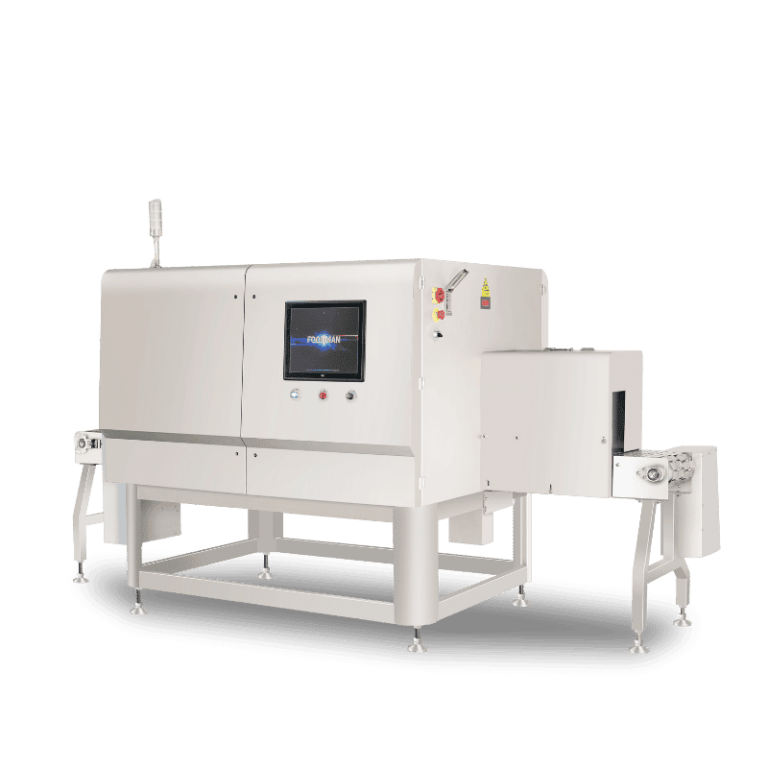
Advanced X-ray inspection systems for bulk products use X-ray imaging technology to look at moving bulk goods in real time.
X-ray inspection relies on density differences. As bulk nuts travel into the scanner via a conveyor belt, the system captures high-resolution grayscale images based on variations in material density. Foreign objects such as glass, stone, and metal have higher densities than nuts. As a result, they absorb more X-rays during inspection.
The software immediately analyzes grayscale images. If it detects a darker area that indicates a dense foreign object, the system activates the reject mechanism and removes the contaminated product.
A core breakthrough of this system lies in its adaptive learning capabilities. The Foodman bulk X-ray manufacturer is equipped with AI machine learning algorithms that enable it to precisely construct characteristic density models for various types of nuts. Furthermore, it offers an optional visual inspection module that—through “dual-energy recognition”—can simultaneously reject nuts exhibiting density anomalies as well as those with visual defects such as black spots, breakage, or deformation.
For instance, almonds possess a relatively uniform density, whereas a walnut half contains air pockets and ridged structures. The system automatically adjusts its sensitivity levels. This improves contaminant detection while reducing false rejects. Some advanced units can even detect low-density contaminants—such as calcified bone fragments or certain plastics—a feat that traditional metal detectors are unable to achieve.
X-Ray Inspection vs. Metal Detection in Nut Processing
For a long time, metal detectors have served as a foundational safety measure in the nut industry, largely due to their cost-effectiveness and operational simplicity; however, the scope of their detection capabilities has reached its physical limits. Traditional electromagnetic induction technology is not only incapable of identifying non-conductive foreign objects—such as glass, stones, hard bone fragments, and high-density plastics—but is also highly susceptible to “product effect” interference.

The inherent moisture content and conductivity of nuts frequently trigger false alarms, leading to production line stoppages for recalibration. In contrast, bulk-flow X-ray inspection systems have successfully overcome these physical limitations. These systems detect metals, non-magnetic stainless steel, glass, stones, calcified bone, and some high-density plastics. Furthermore, X-ray systems remain unaffected by product temperature or moisture levels, making them a more reliable solution when accommodating the seasonal variations inherent in nut crops.
However, metal detectors still provide strong value during certain production stages comprehensive safety assurance capabilities in the processing of bulk nuts, metal detectors continue to hold significant value in specific stages of production. Rather than being mutually exclusive, these two technologies are complementary: metal detectors—thanks to their high cost-efficiency and ease of operation—remain the ideal choice for the final inspection of packaged finished goods, as the primary safety risk at this stage typically centers on metallic foreign objects.
Conversely, X-ray inspection systems of bulk—distinguished by their immunity to product effects (such as temperature, moisture, and conductivity)—hold a distinct advantage during the pre-packaging stage involving bulk raw materials, where they can simultaneously and precisely identify a wide spectrum of potential hazards, including metals, glass, stones, hard bone fragments, and high-density plastics.
Customized Inspection Solutions for Diverse Nut Varieties and Specific Contaminants
Not all nuts share the same characteristics, and the contaminant risks they face vary significantly. Intelligent X-ray inspection systems designed specifically for bulk products allow processors to fine-tune inspection parameters for each individual nut variety.
Walnuts / Pecans: The shells of these nuts are exceptionally hard and thick. Their internal structure is irregular and lobed, often creating internal voids that the system may incorrectly identify internal voids as defects or contaminants. When the shells are cracked open, sharp shell fragments frequently become intermingled with the valuable nutmeat. Detecting density-based contaminants within walnuts is critical to prevent consumers from sustaining dental injuries caused by inadvertently biting down on shell fragments. When precisely calibrated for walnuts, bulk-flow X-ray inspection systems can accurately distinguish density differences between walnut halves and anomalous shell fragments, thereby ensuring the final product is of superior quality and completely safe.

Coffee Beans: Coffee beans are typically cultivated in regions where traditional harvesting methods involve frequent contact with the ground. The primary challenge facing importers is identifying stones and glass fragments within bulk shipments of coffee beans. Since coffee beans often undergo roasting or coating processes during the later stages of processing, utilizing a bulk-flow X-ray foreign body detection in bulk nuts to remove these contaminants during the early bulk stage serves a dual purpose: it prevents damage to downstream processing equipment while simultaneously safeguarding consumer safety.
Almonds / Hazelnuts: These nuts possess a relatively uniform density, which allows for the achievement of exceptionally high detection sensitivity. The primary sources of risk for these nuts include stones (which are often similar in size to the nuts themselves) and metal fragments originating from shelling equipment. For these specific nut varieties, the sensitivity of bulk-flow X-ray inspection systems operators can configure the system to detect stainless steel spheres as small as 0.3 mm.
Industry Insight: Combining X-ray inspection with visual inspection often yields the most optimal detection results. Visual inspection is responsible for identifying and removing discolored nuts and insects, while the X-ray inspection system focuses specifically on detecting high-density physical contaminants. Working in tandem, these two technologies ensure that the food safety of nuts standards reach a near-perfect level.
Optimizing Speed and Throughput: High-Throughput Solutions
Many processing plants attempt to boost production capacity by increasing conveyor belt speeds; however, this often results in a skyrocketing rate of missed detections. This occurs because traditional inspection systems simply cannot keep pace with the data stream. Breaking this impasse requires the synergistic upgrading of both hardware and software. Yet, the true bottleneck is not speed itself, but rather data processing capability.
Lorem ipsum dolor sit amet, consectetur adipiscing elit. Ut elit tellus, luctus nec ullamcorper mattis, pulvinar dapibus leo.
High-Speed Data Processing Technology
Modern X-ray systems use high-performance image acquisition boards and FPGA pre-processing chips. These technologies enable ultra-fast data processing speeds.—processing tens of thousands of frames per second—thereby ensuring data integrity and accuracy even at high velocities.
Intelligent Sensitivity Adjustment
Coupled with a zone-based ROI (Region of Interest) detection strategy, these systems can intelligently distinguish between the edges and the center of the conveyor belt, dynamically adjusting sensitivity to eliminate irrelevant background interference. This capability lies at the very core of the price disparity observed across different equipment models. To effectively handle extremely high production line speeds, manufacturers equip top-tier models with high-performance processing chips possessing superior computational power; this investment in “hardware muscle” constitutes the true source of their value.
Future Trends in X-Ray Inspection for Bulk Nuts
The Integration of Artificial Intelligence (AI)
Technologies powered by AI algorithms are continuously optimizing key functions—including pattern recognition, false reject rate reduction, adaptive sensitivity control, and autonomous learning capabilities. These technological advancements will further enhance the ability to detect foreign objects within bulk nuts.
Multispectral Imaging Technology
In the future, emerging technologies may enable even more precise contaminant identification —particularly those foreign objects whose density characteristics closely resemble those of the nuts themselves.
As technological innovation continues to deepen, establishing close collaborative partnerships with trusted manufacturers of bulk X-ray inspection equipment will become increasingly vital for nut processing enterprises committed to maintaining long-term market competitiveness.

Foodman is redefining inspection standards through the power of AI. Leveraging our proprietary AI cloud platform, we have optimized the entire visual inspection workflow and mastered AI-centric X-ray technology. This system not only performs real-time analysis, engages in autonomous learning, and makes intelligent decisions, but it also elevates the safety, quality, and operational efficiency of nut processing to an entirely new dimension—leaving traditional inspection methods far behind.
Conclusion
Ensuring the food safety of bulk nuts is no longer an optional choice; it is an imperative step for enhancing market competitiveness and meeting regulatory requirements. X-ray inspection systems specifically designed of bulk products offer the most comprehensive solution for detecting foreign objects in bulk nuts, enabling processing facilities to identify various contaminants that traditional inspection technologies might otherwise miss.
Whether dealing with almonds, cashews, pistachios, or various mixed nut products, advanced X-ray inspection systems serve to simultaneously boost operational efficiency and comprehensively strengthen the food safety assurance of nut products.
By establishing strategic partnerships with experienced manufacturers of bulk X-ray inspection equipment, processing facilities can deploy highly customized, high-throughput inspection solutions. This ensures that production processes remain compliant with regulatory standards, safeguards brand reputation, and ultimately delivers safer, more trustworthy nut products to consumers worldwide.
FAQ
A: Yes. Advanced systems utilize intelligent image processing technology capable of detecting products with varying shapes and densities, making them highly suitable for mixed nut products.
A: No. High-speed systems provided by specialized manufacturers of bulk X-ray inspection equipment are specifically designed for continuous, high-throughput production environments.
A: No. The X-ray dose generated by the system is extremely low—far below the dosage levels found in medical X-ray equipment. The nutritional value, taste, and texture of the nuts remain completely unaffected. It is a completely non-destructive inspection technology.