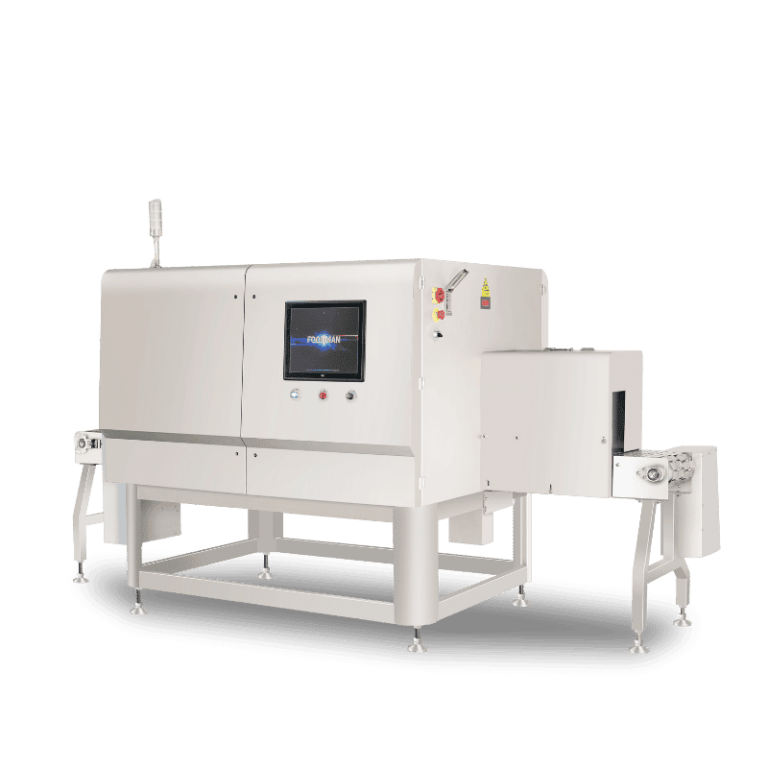
Introduction
Cheese may appear easy on the surface. Whether it’s a block of Cheddar, a stack of slices, or a package of shredded mozzarella, the product appears consistent and easy to scrutinize. However, in modern dairy processing plants, the manufacturing process includes cutting, pressing, molding, slicing, shredding, transporting, packaging, and handling. Each of these steps presents a danger of foreign object contamination.
This is why X-ray inspection equipment has become essential. Unlike metal detection, which is based on conductivity, X-ray technology identifies pollutants based on density variations; it can accurately identify foreign particles such as metal, glass, stone, bone, high-density plastic, and rubber.
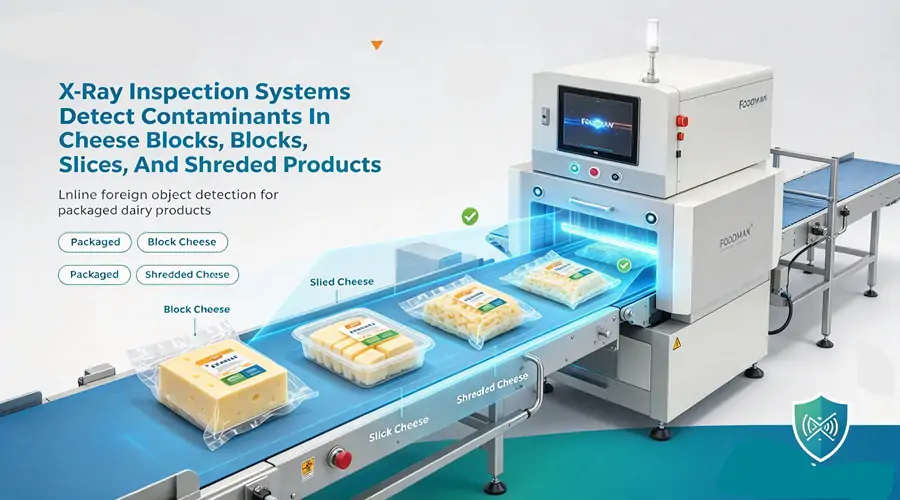
Food X-ray inspection systems offer a non-destructive inspection phase for manufacturers of cheese blocks, slices, shreds, snacks, filled cheese products, and other dairy goods before they reach distributors, merchants, restaurants, or consumers.
The challenge is more than simply detecting foreign items. An efficient inspection method must consider a variety of criteria, such product density, cheese shape, packaging format, conveyor speed, contaminant kind, product temperature, packaging materials, and the potential placement of contaminants.
This article looks at how modern X-ray inspection equipment handles different cheese product formats, the sorts of impurities that can be identified, relevant safety considerations, and how manufacturers can choose the best inspection solution.
What is X-ray inspection equipment?
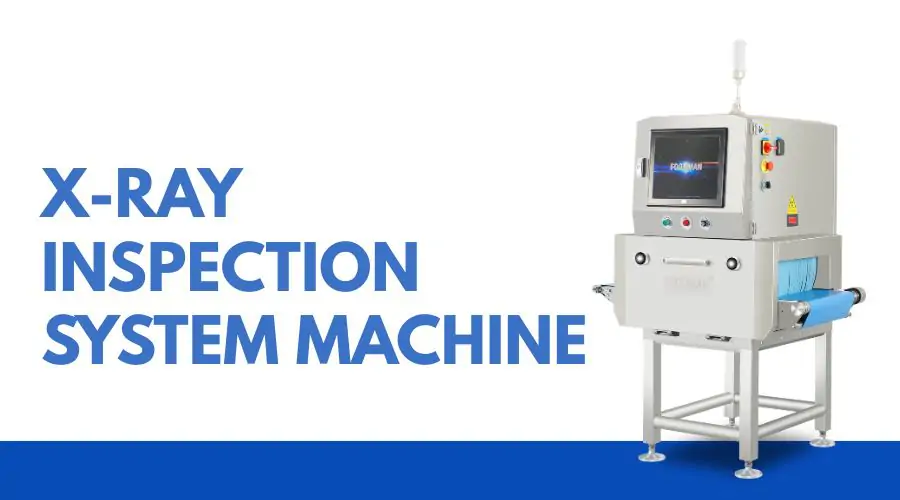
X-ray inspection equipment uses controlled X-ray radiation to create images of a product’s internal structure, acting as a type of non-destructive testing.
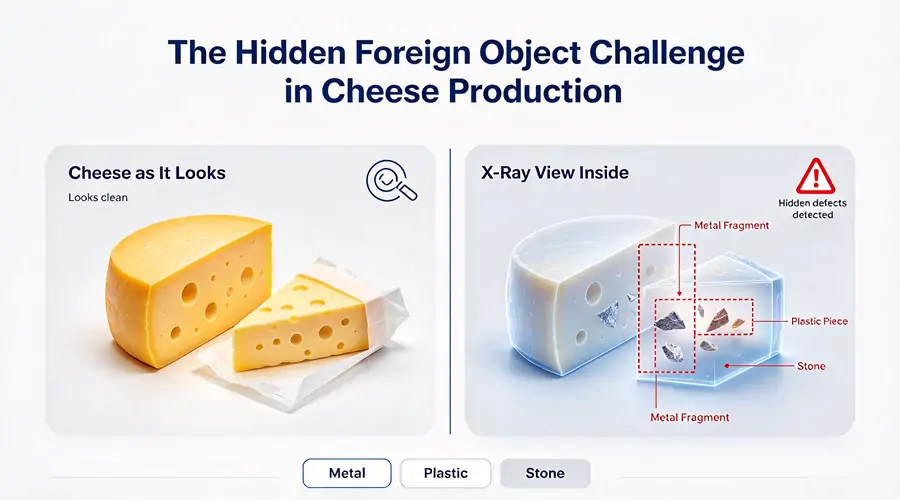
As cheese products pass through the food system’s x-ray inspection, X-rays penetrate both the product and the packaging. Materials absorb X-rays at different rates. A detector transforms these variations into a picture, allowing inspection software to spot areas of aberrant density.
This technique is particularly helpful for food inspection because many foreign things differ in density from the surrounding food product.
For example, a little piece of metal inside a block of cheese may be invisible from the outside, whereas a shard of glass just beneath the surface of sealed packaging may easily evade traditional visual inspection. The created images from X-ray inspection show the product’s interior in great detail.
One significant advantage is that the inspection method does not require opening the packaging. This makes X-ray technology ideal for sealed cheese products, allowing manufacturers to inspect finished, packed goods without disrupting the production line with human checks.
Inspection Challenges and X-ray Strategies for Various Cheese Formats
Cheese is not uniform. It is not homogeneous. Block, sliced, shredded—each format brings its own inspection problems. Each shapes system configuration, sensitivity settings, and where the equipment sits on the line.
Block Cheese
Block cheese runs dense and thick. One kilogram. Twenty kilograms. Sometimes more. Density and thickness attenuate X-rays. Contrast drops. Small contaminants fade from view. Add packaging—plastic, vacuum-sealed film—and imaging gets harder still.
The fix? High-power X-ray generators. Optimized detector configurations. Multi-angle or dual-energy systems help further. They capture images from different orientations. Contaminants get caught even at awkward angles.
Sliced Cheese
Sliced cheese is thin. Individually packaged, or stacked. Two challenges dominate. Speed. Resolution. Slices move fast along cutting and packaging lines. The system must spot minute contaminants—metal fragments from cutting blades, for instance—without triggering false rejects.
High-resolution detectors are standard here. So are advanced software algorithms. Their job: separate real contaminants from product features. Air bubbles. Voids. Seasonings. The thin profile helps. Lower X-ray power often suffices. That improves contrast. And sensitivity.
Shredded Cheese
Shredded cheese presents perhaps the most difficult inspection scenario. The product has a loose, irregular structure and often contains anti-caking agents such as cellulose or potato starch. Clumping can lead to uneven density, complicating image analysis, while contaminants may be extremely small and randomly distributed.
X-ray inspection systems for shredded cheese require advanced software to handle the product’s dynamic state during inspection. Some systems employ a spreading or single-lane diversion mechanism prior to inspection to ensure uniform product thickness, while others utilize multi-channel inspection equipped with independent rejection zones. Since shredded cheese is typically sold in bags, x ray inspection of food is usually performed after the bagging and sealing stages, allowing for the inspection of the final packaged product.
What types of contaminants can food X-ray inspection systems detect in cheese?
Food X-ray systems catch what cheese production throws at them. The list is long.
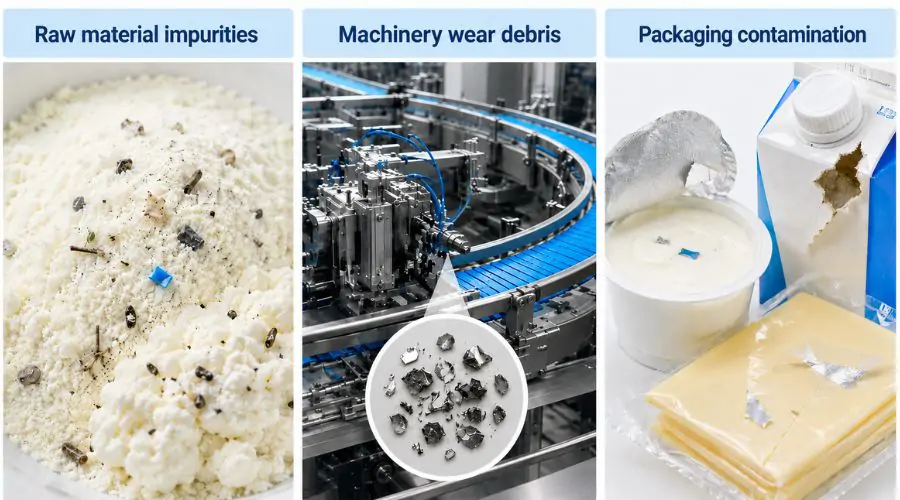
Ferrous and non-ferrous metals. Cutting wires. Blades. Shredders. Worn mechanical parts. Stainless steel. Carbon steel. Aluminum. Copper. Brass.
Glass and ceramics. Broken gauges. Lighting fixtures. Equipment components. All fair game.
Stones and bones: Foreign objects that are either naturally occurring or introduced during raw material handling.
High-density plastics and rubber. Gaskets. Seals. Conveyor belts. Packaging materials. Fragments from any of these can end up in the product.
Calcified deposits. Product clumps. These matter too. They may signal deviations in the production process.
Sensitivity is not fixed. It depends on three things. The density of the contaminant relative to the cheese matrix. The size of the contaminant. Its location within the product.
So choose carefully. Match the system to the specific product format. Know the minimum contaminant size you need to detect.
X-ray and Metal Detection for Cheese
X-ray inspection and metal detection do different jobs. Neither replaces the other.
Metal detectors target conductive or magnetic contaminants. Under optimal conditions, they catch ferrous, non-ferrous, and stainless steel reliably.
X-ray works on a different principle. It reads density variations. That lets it find what metal detectors cannot—glass, stone, certain high-density plastics.
So what should cheese manufacturers do? Match the technology to the actual contamination risk. Some lines run a sequence: metal detector, then X-ray, then checkweigher. Others use an integrated configuration built around the production process.
One common setup: a metal detector before packaging, aimed squarely at metal. Then X-ray on the sealed, finished product, catching a wider range of high-density foreign objects.
Layer the inspection. Do not bet everything on one technology. Overall capability goes up.
Key Focus: How safe is X-ray inspection for cheese?
Is X-ray Inspection of Cheese Safe? Manufacturers ask this. Consumers ask it too. The answer is straightforward: yes. Safe for the product. Safe for the people running the equipment.
Start with the process itself. X-ray inspection is non-contact. Non-destructive. Energy levels used in food inspection are low. The product does not become radioactive. This is not irradiation. Irradiation uses high doses of ionizing radiation to kill bacteria. X-ray inspection uses extremely low doses. The rays pass through. They do not alter chemical composition, nutritional value, taste, or texture. No residual radiation. None.
Then there is the equipment. Multiple safety features are built in. The housing is lined with lead or stainless steel. That blocks radiation leakage. Interlock mechanisms shut the generator down automatically if the housing opens. Outside the machine, radiation levels are typically indistinguishable from natural background. Most jurisdictions classify these systems as radiation-emitting equipment. Strict standards apply—US FDA, EU, and other regulatory bodies.
From the consumer’s side, the math is simple. The dose from eating X-ray inspected cheese is negligible. Far lower than natural background radiation encountered daily. This technology has been used in food production for decades. No evidence suggests any health risk.
How to Select the Right Food X-ray Inspection System for Cheese
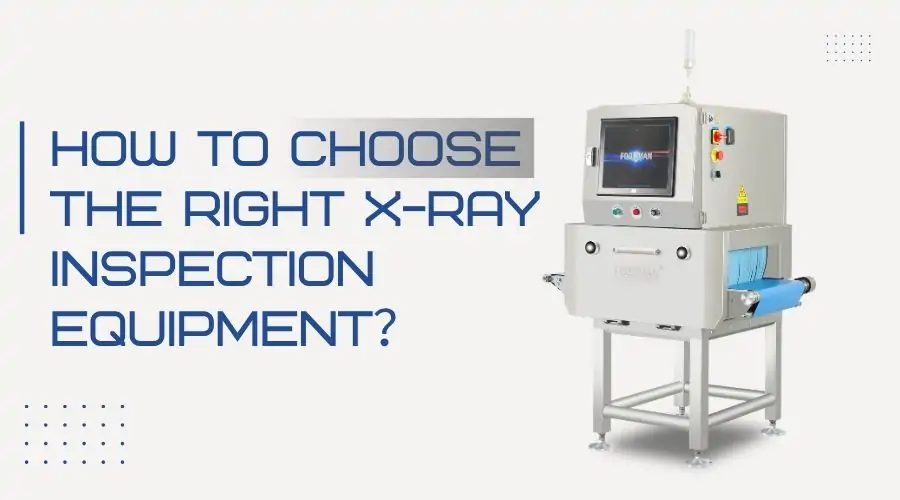
To select the appropriate food X-ray inspection system, it is essential to first understand your production requirements, product characteristics, and quality goals. Here are several key considerations:
1. Product Form and Dimensions
System configurations must vary according to the cheese format. Whole cheese blocks typically require high-power generators and wide conveyor belts; shredded cheese is better suited for multi-lane or single-lane conveyance; and sliced cheese requires high-speed imaging capabilities while minimizing false rejection rates.
2. Required Detection Sensitivity
The size of the smallest contaminant that must be detected determines the required system resolution and power. Manufacturers are advised to collaborate with suppliers to conduct feasibility tests using actual product samples and target contaminants.
3. Production Line Speed and Throughput
The system speed must keep pace with the production line to avoid creating a bottleneck. High-speed lines may require multiple inspection lanes or enhanced image processing capabilities.
4. Rejection Mechanism
The rejection method must match the product form. Air-blast systems are suitable for small, lightweight products, whereas pusher or retracting-belt mechanisms are better suited for larger blocks or packaged products.
5. Software and Data Management
Modern X-ray systems typically feature automatic contaminant identification, real-time monitoring, trend analysis, and compliance reporting. These features enable manufacturers to maintain audit-ready records and continuously improve quality control.
6. Hygienic Design
Cheese production environments require equipment that is easy to clean and resistant to moisture and cleaning chemicals. Key considerations include stainless steel construction, an IP66 (or higher) protection rating, and tool-free conveyor belt removal.
7. Compliance and Certification
The system must comply with relevant food safety regulations and industry standards, including HACCP, ISO 22000, and FDA requirements.
Foodman: X-ray and Metal Detection Solutions for the Dairy Industry
Foodman supplies inspection and sorting equipment to the food industry. Automatic checkweighers. Metal detectors. X-ray inspection systems. Sorting machinery. That is the core portfolio. X-ray, metal detection, vision inspection—each engineered for dairy processing and its rigorous demands.
Cheese manufacturers get tailored solutions. Block. Sliced. Shredded. Whatever the format.
X-ray systems from Foodman deliver high sensitivity. High speed. Reliable performance. Hygienic designs built for tough dairy environments. Detecting metal fragments in 20 kg cheese blocks? Inspecting individually wrapped slices at high speed? Both are covered. Integration into your production line is seamless.
Metal detection systems complement the X-ray technology. They add a layer of safety where metal contamination is the primary concern.
Vision inspection systems handle a different job. Packaging integrity. Label placement. Product appearance. Every cheese product meets your quality standards—or it does not leave the line.
Conclusion
Cheese production has evolved from relatively simple cutting and packaging operations into highly automated processes encompassing forming, slicing, shredding, filling, packaging, conveying, and distribution.
As production speeds increase and packaging becomes more complex, foreign object detection must go beyond mere surface inspection.

X-ray inspection offers manufacturers a non-destructive method to examine the internal structure of packaged products. For cheese blocks, the technology helps identify dense foreign objects hidden deep within the product. For sliced cheese, it can inspect products whether they are stacked or individually wrapped. For shredded cheese, advanced image processing techniques help manage the challenges posed by the product’s naturally uneven distribution.
For manufacturers looking to enhance their inspection capabilities, partnering with an experienced supplier like Foodman yields significant benefits. With a comprehensive product portfolio covering X-ray, metal detection, and vision inspection systems, Foodman is dedicated to helping dairy processors deliver safe, high-quality cheese to consumers worldwide.
FAQs
A: Metal detection finds conductive materials. Mostly metals. X-ray works on density. That difference matters. X-ray catches metal, glass, stone, bone, high-density plastics. Many manufacturers run both. Comprehensive quality assurance demands it.
A: Yes. Metal is dense. It produces strong contrast in X-ray images. But performance is not guaranteed by default. It depends on the metal type. Size. Orientation. Product thickness. Packaging. System configuration.
A: It depends on the type of plastic. Low-density plastics may offer limited contrast against the cheese, whereas higher-density plastic materials can often be detected. Manufacturers should test specific contaminant materials rather than assuming that all plastics have the same detectability.