Introduction
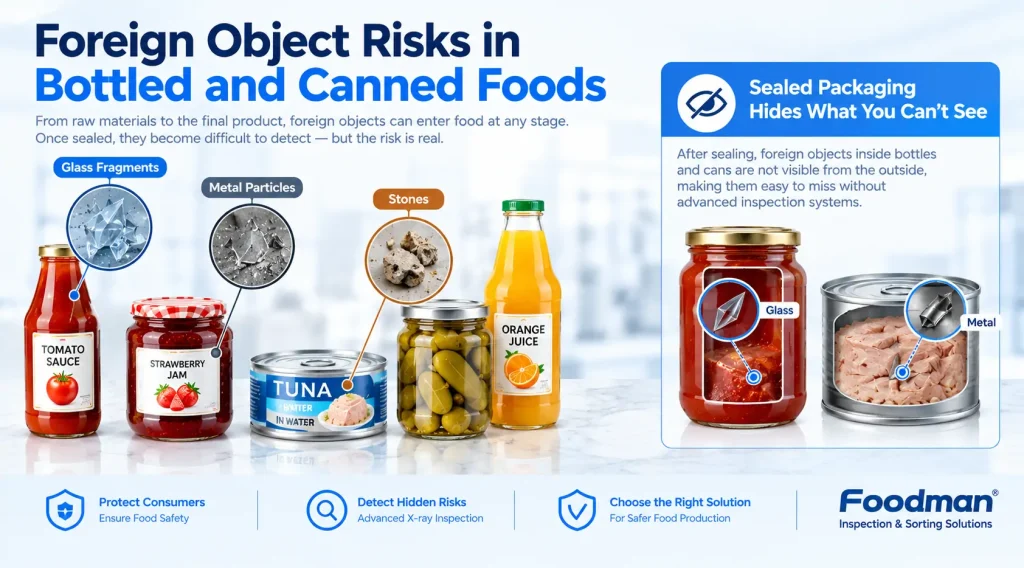
While glass bottles and jars safeguard food products during storage and shipping, they render it difficult to identify unrelated objects. Glass particles can enter the product during handling, filling, or capping, whereas high-density contaminants—such as metal shards or stones—can come from raw materials or processing equipment. When a container is sealed, inspecting its contents becomes much more difficult; this is especially true when the product is opaque or believed that chemicals collect near the bottom of the container.
X-ray inspection solves this: it scans sealed glass packs non-destructively. The technology relies on contrast. Target food and unwanted debris absorb X-rays at different rates. This contrast lets processors spot dense inclusions, such as metal chips and some mineral stones. With properly configured hardware, the same system can flag selected packaging faults too.
Bottles and jars are usually inspected standing upright. Their curved geometry and uneven product distribution complicate imaging. Side scan X-ray units built around dual-beam side scanning add extra viewing planes. More angles cut down blind zones at the base and along sidewalls—areas standard single-view setups often miss.
Why is X-ray inspection required for food stored in glass jars and bottles?
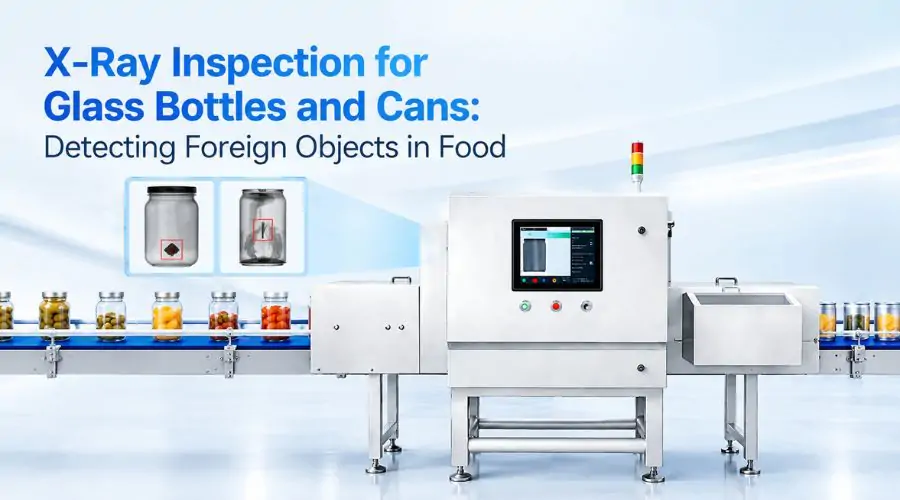
Glass shards can enter food at many points in production. Filling is not the only risk. Hazards arise throughout the workflow. Empty bottle transit, washing, filling, capping, and final shipment all carry risk.
Impact damage can crack or chip glass at the base, shoulder, or rim. Some dislodged fragments drop into the food at later steps. Others stay trapped inside the vessel. Empty-container washing and on-line pre-checks do not rule out glass contamination entirely. Finished goods can still hold hidden shards.
After filling, liquids, fruit pulp or solid food can obscure foreign particles. Shards that sink to jar bottoms or stick to inner surfaces evade visual manual checks almost entirely.
Clear packaging does not ensure that the entire contents are visible. Clear glass lets operators see portions of the product. It cannot, however, make every region visible. Ketchup, chili sauce, and jams, for example, are often highly viscous. Glass fragments may be trapped in suspended particles or concealed in dense regions of the product.
Fruit juices and pickled foods pose even greater difficulty for visual assessment. They may contain pulp, vegetable pieces, or sediment. Moreover, once a product is capped, manufacturers are generally reluctant to open containers for spot checks. X-ray inspection offers an alternative. It examines the contents without compromising package integrity. This makes it well suited to integration into continuous production lines.
X-ray inspection cannot stand alone. It works as a screening tool. It does not remove the need to control glass breakage at the source. Companies must manage container quality. They should inspect equipment regularly. Clear protocols for handling glass breakage are also essential. When breakage occurs, established procedures should guide the response. Affected products must be isolated. The production line must be cleaned. The scope of impact must be defined.
An X-ray inspection station at a critical point can catch contaminants that earlier controls may have missed. The best position is after filling and capping. The exact installation point depends on the production process, risk analysis, and validation results.
How do X-rays detect foreign objects in glass bottles?
X-ray inspection of bottled products rests on attenuation contrast. Materials differ in how strongly they weaken X-rays. Four main parts make up the system: an X-ray source, a conveyor, a detector, and image-processing software. X-rays pass through the bottle and its contents. Their attenuation depends on material composition, density, thickness, and X-ray energy. The detector captures the transmitted X-rays. It converts them into image signals. Software then reads grayscale fluctuations and local features. From these it judges whether anomalous regions exist.
Why are glass fragments sometimes harder to detect than certain metal objects?
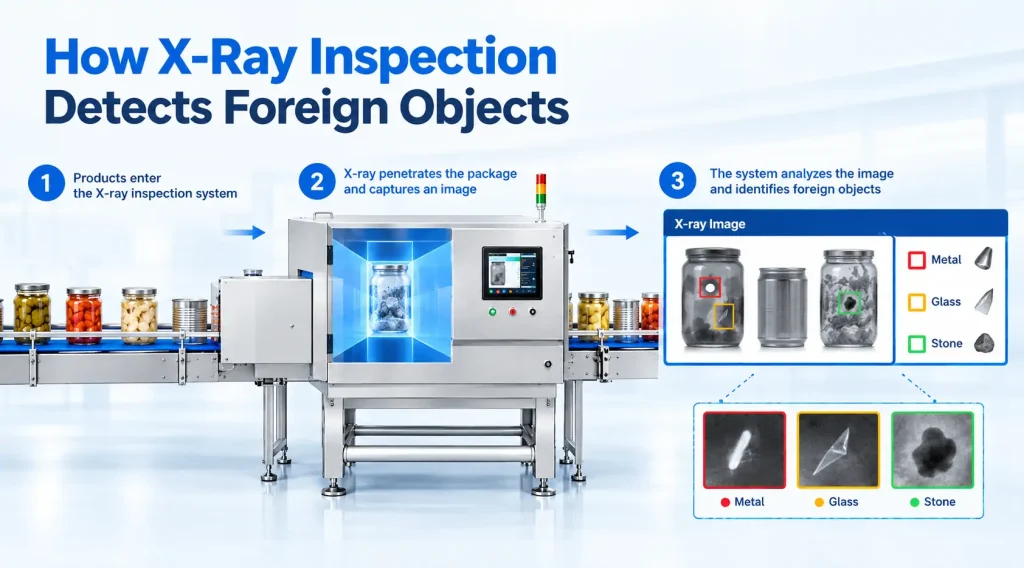
The bottle itself is glass. Its walls, its base, and any glass fragments inside can share similar material properties. Image analysis must therefore separate container structure from actual contaminants.
Fragment shape and orientation also matter. Thick fragments may produce clear local variation. Thin, flake-like fragments may yield insufficient contrast at certain viewing angles.
Position is just as critical. Fragments near the base or side walls of a thick glass bottle may overlap with container structure in the projected image. The equipment may detect similar fragments elsewhere yet fail in these zones.
Assessing glass-fragment detection calls for attention to five factors: fragment size, thickness, shape, orientation, and position. Testing should ideally use the actual food product and packaging.
How does dual beam side scanning x-ray improve inspection coverage?
For upright glass bottles and jars inspection with x-ray, source and detector geometry shapes the imaging result. A single viewpoint gives projection data from one direction only. A fragment may overlap with the bottle wall, the base, or dense food structures. Its image features can then be obscured or weakened.
Dual beam side scanning captures images from two independent directions. When the two viewpoints sit nearly perpendicular to each other, the projection overlap of foreign objects shifts. A fragment hard to identify from one angle may become clearly visible from the other. The Foodman FXR-C180-2 dual-beam side-scan X-ray inspection system uses two X-ray sources set at roughly 90 degrees. It is designed specifically for upright bottles, jars, and similar packages.
Dual beam side scanning x-ray adds complementary imaging data. It cannot eliminate inspection blind spots entirely. Final performance depends on container specifications, bottle-base thickness, product distribution, foreign-object characteristics, and equipment parameters. Suitability for a given line must be tested with the actual products.
Application of X-ray inspection in different glass bottles and canned foods
The X-ray inspection performance of glass bottled food cannot be inferred by food category. The texture, density, and internal structure are different, and the results of the same equipment facing different formulas may vary greatly. The evaluation must revolve around the actual product.
Sauces and thickeners pose a harder imaging problem. Tomato sauce, chili sauce, salad dressing, and marinades often carry suspended particles or unevenly distributed ingredients. The image background becomes more complex. Glass fragments may sit under food or close to the bottle bottom. The system must then find local anomalies against a cluttered background. Tests must use actual recipes. They should cover different bottle types, filling volumes, and production conditions. For particle-bearing sauces, normal ingredients and real foreign matter must be told apart. Spice particles permitted in food should not be flagged as contaminants. Detection parameters should balance the ability to identify target foreign objects against a reasonable false-rejection level.
Juices, jams, and pulpy foods vary in imaging difficulty. The background depends on the formulation. Clarified juices are relatively homogeneous. Products with pulp, peel, or pellets show more local variation. Whether glass fragments can be told apart from natural ingredients such as pulp and seeds must be confirmed by actual testing. For products that settle or stratify, normal changes in storage state and production process also matter. When a line runs multiple formulations, the equipment should recall verified test parameters by product specification. After replacing the product, the performance of the new formula must be confirmed, and unverified settings cannot be used directly.
Pickled vegetables and granular products are hard to image. Pickles, olives, and mushrooms have irregular shapes and complex internal structures. Solid pieces may overlap or pile up at the container bottom. The challenge is telling the product’s own structure apart from unintended foreign objects. Glass shards, stones, or ceramic fragments are often detectable when image contrast is sufficient. Naturally hard structures such as fruit pits or seeds complicate the assessment. Test samples must reflect the natural variation of the actual product. They must also cover the target contaminants identified through risk analysis. Only then can the system’s detection performance be judged fairly under real production conditions.
Baby food and fruit purées demand strict control of physical contamination. Detection protocols must be built on product-specific risks, applicable regulations, and internal quality standards. These foods may have a uniform texture or contain small particles. Imaging characteristics vary widely with formulation. Manufacturers should define clearly which foreign objects are to be controlled. Testing targets should follow from risk levels. X-ray inspection can form one part of foreign-object control for finished goods. The presence of such equipment alone does not prove food safety. Effective detection, reliable rejection mechanisms, complete production records, and routine verification must all be folded into the quality management system.
Inherent Challenges in X-ray Inspection of Food in Glass Containers
Inspecting food in glass containers has long been limited by the packaging itself. Glass, metal, and thick plastic containers attenuate X-rays strongly and unevenly. The contents—often liquid or semi-solid—frequently show non-uniform density, suspended air bubbles, or mixed solid and liquid phases. Any of these can mask signals from defects. Grayscale contrast between foreign objects and food contents is low. Small glass shards, hard plastic fragments, and low-density bone fragments are therefore especially hard to detect. Bottle caps, labels, and bases vary in thickness. This creates structural noise and pronounced artifacts, particularly in edge regions.
General-purpose X-ray systems usually fire the beam from top to bottom. They were designed first for flat, bagged products. With glass containers, the beam must cross several interfaces: the bottle opening, the cap, the liquid surface, and the base. This sharply limits the effective inspection area. In an upright container, a foreign object in the sidewall lies parallel to the beam direction. The overlapping projections make such objects nearly invisible. Debris settled at the bottom is easily confused with the glass base’s own texture. False positives run high.
Side scan X-ray inspection systems designed for bottled or canned products utilize a horizontal X-ray beam that passes through the side of the container. By avoiding the thicker structures of the cap and base, this approach improves imaging below the liquid level. However, single-sided inspection has inherent blind spots: the unidirectional beam means that the projected area of a thin, sheet-like foreign object becomes nearly zero if it happens to be oriented parallel to the beam. Furthermore, the curvature of the container wall causes refraction and scattering, leading to edge distortion that hinders the detection of defects located near the sidewalls, while shadows on the side opposite the X-ray source can result in the loss of detail in certain areas.
Dual-source Side scan X-ray systems employ two beams—positioned at an angle or orthogonally—that emit simultaneously, providing complementary inspection paths. It is highly unlikely for a sheet-like foreign object to be oriented parallel to both beams, ensuring that it remains detectable from at least one perspective. These dual projections enable approximate three-dimensional localization, preserving depth information. The blind spots of one beam are covered by the other, and distortions caused by the container’s curvature are corrected through cross-referencing the two views. Because the structural “noise” of the container manifests differently in each projection, it can be more easily distinguished from the signals of foreign objects, thereby enhancing grayscale contrast.
Non-uniform attenuation within the liquid is averaged across both directions, which amplifies the differences between air bubbles and actual defects, allowing for more reliable differentiation. Consequently, both sensitivity and spatial resolution are improved, and the false-alarm rate is reduced—enabling online inspection of bottles and cans that matches or even surpasses the performance achieved for flat, pouched products.
How to Choose an X-ray Inspection System
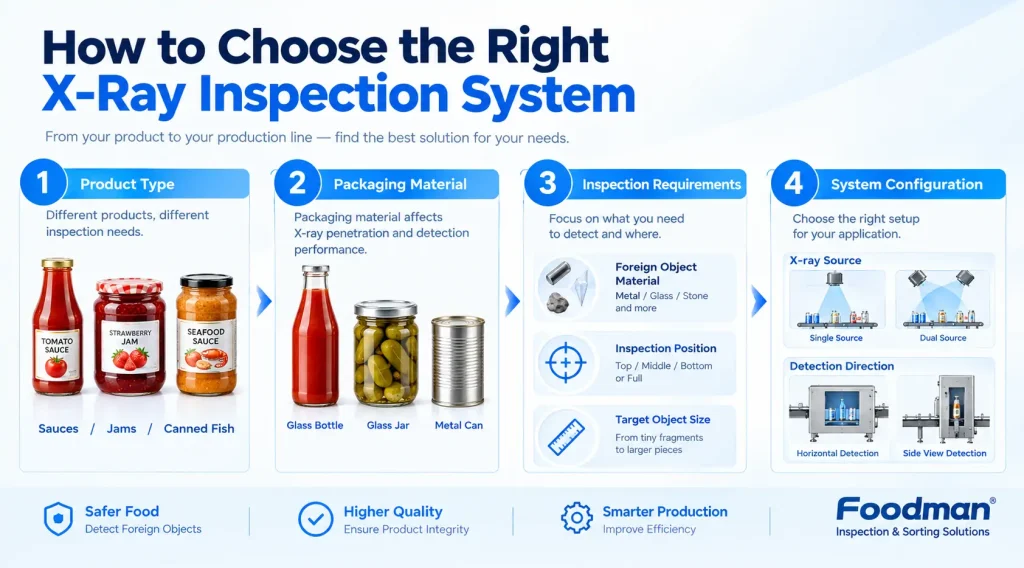
Selection should be based on packaging format and the type of contaminants, rather than the sophistication or “tier” of the equipment.
For flat, bagged products, X-rays penetrate from top to bottom. Since there are no thick structural elements obstructing the path, there is minimal overlap in the projection. A standard (general-purpose) X-ray system is sufficient; no Side scaning capability is required.
For upright canned or bottled products, the thick structures of the lid and base consistently obstruct the X-ray path, effectively shrinking the usable inspection zone when using a top-down approach. A Side scaning system, however, directs the beam laterally through the container, bypassing the lid and base and providing better imaging below the liquid level. In this case, choose a Side scaning system over a standard one.
In meat and poultry products, bone fragments and brittle bones have a density similar to that of soft tissue, making them difficult to distinguish via conventional grayscale projection due to insufficient contrast. Dual-energy X-ray systems use both high and low energy levels to create images, analyzing differences in material attenuation to separate the signals of bone from meat. Dual-energy technology is the right choice for detecting bone fragments and brittle bones.
Fish bones are thin, curved, and low-density—often with a density that overlaps with the surrounding fish flesh—making them easy to miss with standard projection. Specialized X-ray systems for fish bones feature optimized optical paths and algorithms tailored to the specific shape and attenuation characteristics of these fine bones. For fish bone detection, opt for a specialized system rather than relying on a general-purpose machine.
In short: use standard systems for flat, bagged products; Side scaning systems for upright, canned/bottled products; dual-energy systems for bone fragments and brittle bones; and specialized systems for fish bones. The selection criteria should be based on the nature of the hazards and how the packaging obstructs the view—not on the length of a feature list.
Foodman X-ray Inspection Solutions for Food in Glass Bottles and Cans
Foodman specializes in foreign object detection and quality control for food processing and packaging. Our product portfolio includes X-ray inspection systems, metal detectors, checkweighers, and vision inspection equipment.
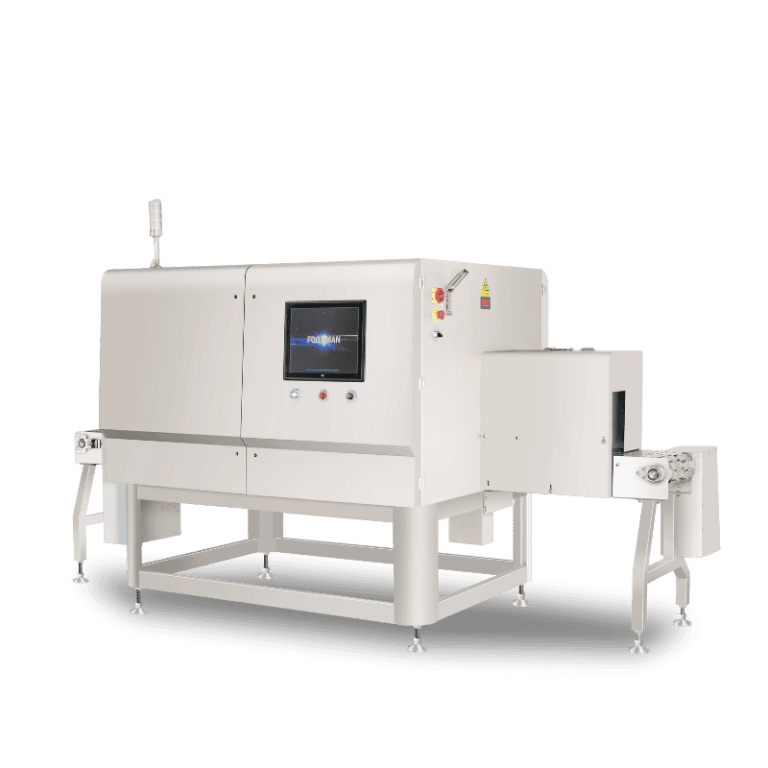
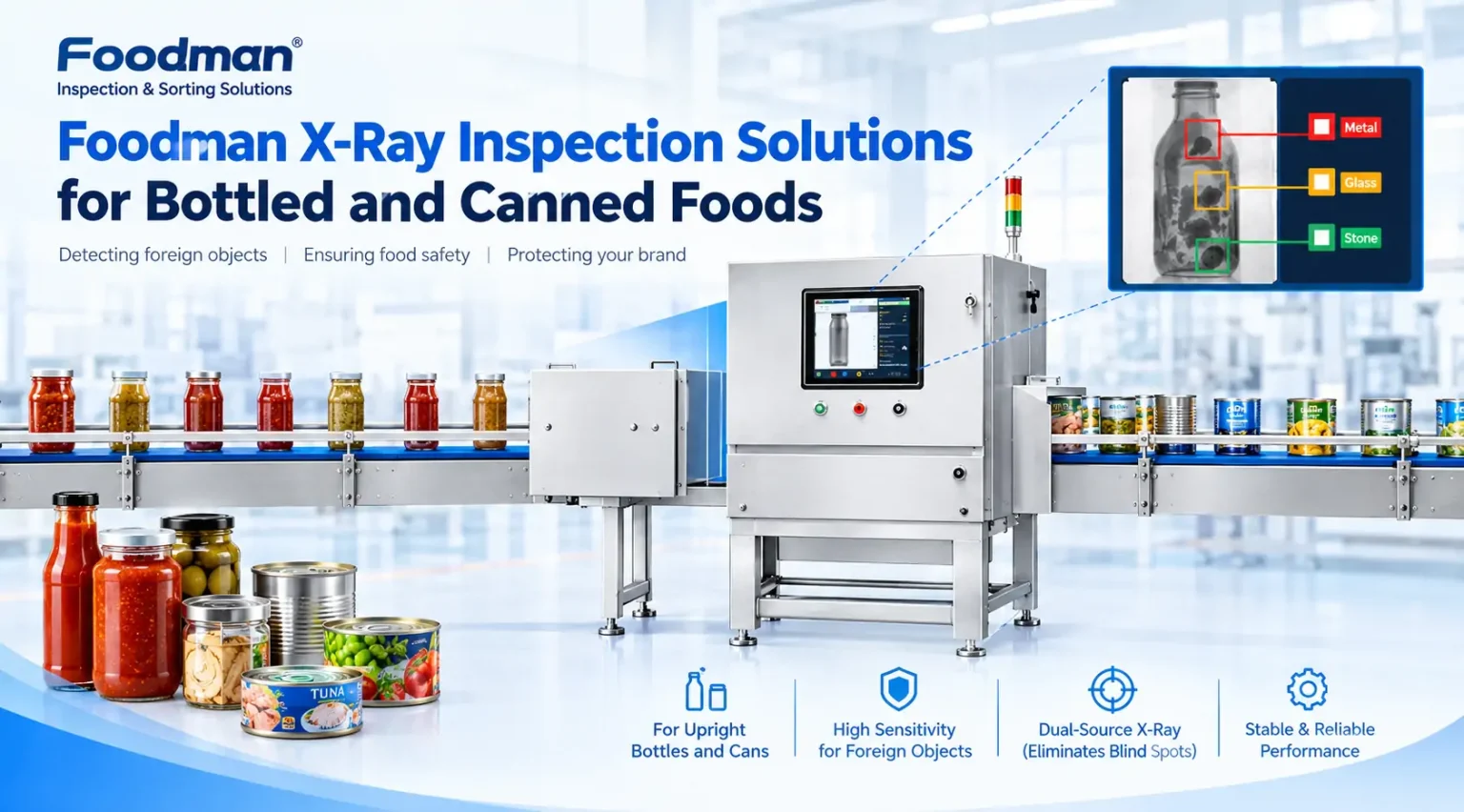
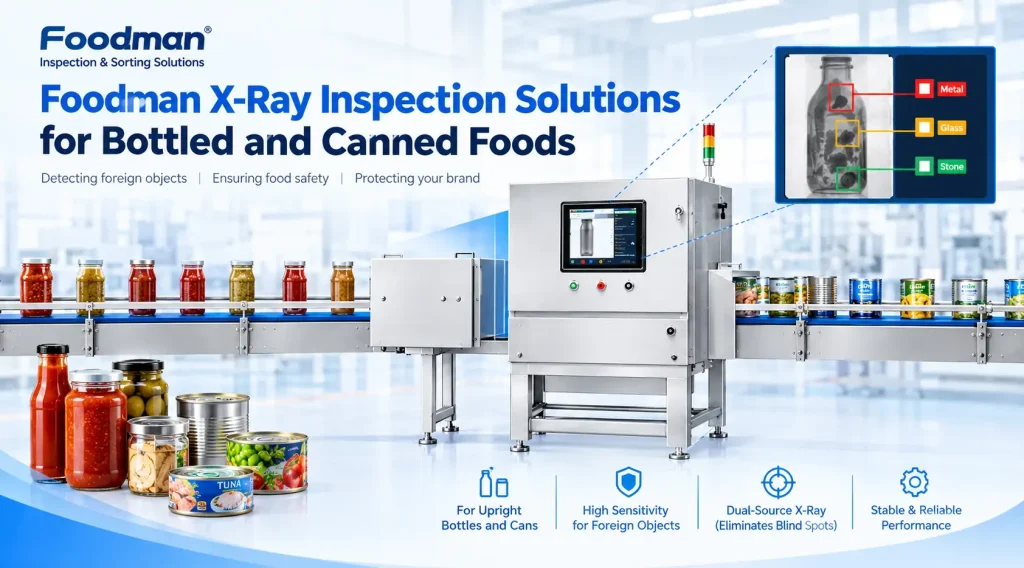
To address the inspection requirements for upright bottled or canned products, the Foodman FXR-C180-2—a dual-beam side scan x-ray inspection system, utilizes two X-ray sources positioned at an angle of approximately 90 degrees to one another, capturing complementary images from different perspectives.
For food products such as sauces, juices, and jams packaged in glass, this configuration enables the detection of foreign objects at the base, sidewalls, and other critical areas of the container. The feasibility of detecting specific glass fragments should be verified by considering factors such as the food formulation, container dimensions, characteristics of the potential fragments, and production line speed. Foodman also offers X-ray inspection solutions for various other types of packaging.
Each solution is tailored to the specific packaging structure, product density, target foreign objects, and production line layout, rather than relying on a one-size-fits-all configuration.
If a manufacturer also needs to verify net content, labels, or date codes, the system can be integrated with checkweighers or vision inspection systems. Each piece of equipment serves a distinct purpose, and the overall configuration should be determined based on a thorough risk analysis and specific quality control requirements.
Before evaluating equipment, we recommend preparing actual product samples, specifications for the glass containers, details regarding potential foreign objects, and production line parameters. Foodman can use this information to conduct application testing, helping you determine the most suitable inspection layout and system configuration.
Conclusion
Controlling foreign objects in glass-bottled food products is not as simple as purchasing the most sensitive piece of equipment available on the market. Success hinges on deploying the right equipment at the optimal location along the production line, configuring its performance based on the specific product and bottle type, and maintaining a clear understanding of its physical limitations—such as challenges posed by the sealing area, fragments adhering to the bottle walls, or small contaminants concealed within dense products.
X-ray inspection plays a vital role in these production lines; it can penetrate sealed glass bottles, distinguish dense contaminants from the product, and generate records suitable for verification. However, it cannot replace upstream controls—such as container integrity checks, monitoring of the capping area, strict supplier specifications, and hygienic design—all of which work to reduce the burden of potential contaminants reaching the inspection station. Together, these measures form a comprehensive control strategy that can withstand rigorous audits while meeting market requirements.
For manufacturers using glass bottles, the most practical next step is testing: validate the system using your actual bottles, products, and potential contaminants, all while operating at your production line’s specific speed. These empirical test results—rather than marketing brochures—are the only true indicator of whether a system is up to the task.
FAQ
It is possible to detect some glass fragments, but the results depend on factors such as the fragment’s size, thickness, shape, orientation, and position, as well as the imaging characteristics of both the food and the container. Fragments located near the thick base or side walls of a bottle may be more difficult to identify. Testing with actual products is recommended to confirm specific detection capabilities.
Glass fragments may have X-ray attenuation properties similar to those of the container itself. When a fragment overlaps with the bottle wall or base in a projection image, the resulting signal may not be sufficiently distinct. Additionally, the density of the food product and the presence of internal particles can complicate image interpretation.
A dual-beam side scan, Side scan system captures images from two different angles, providing complementary information for identifying foreign objects. If a fragment is obscured by the container’s structure from one perspective, it may be more clearly visible from the other. However, actual detection performance must always be verified through practical testing.