Introduction
Foreign substances get into food and pharmaceutical products. Not occasionally—anywhere along the line, receiving, processing, filling, tableting, packaging, shipping. None of these steps is fully safe. Stones, glass fragments, metal chips: non-metallic and metallic impurities alike, and product quality pays for it. Then come the complaints. Recalls happen. Production stalls. For pharmaceutical manufacturers the exposure is worse. Patients are at risk. Quality control is compromised the moment contamination gets through.
On the production floor, checking for foreign objects mostly relies on two tools: X-ray inspection and metal detection. They cover different risks. Their operating principles are nothing alike. Metal contaminants create unique electromagnetic signals, and that’s what a metal detector catches. X-ray gear operates on another principle entirely. It gauges how much the product weakens radiation as it travels through. Whether a contaminant becomes visible boils down to a single factor: contrast in the resulting image.
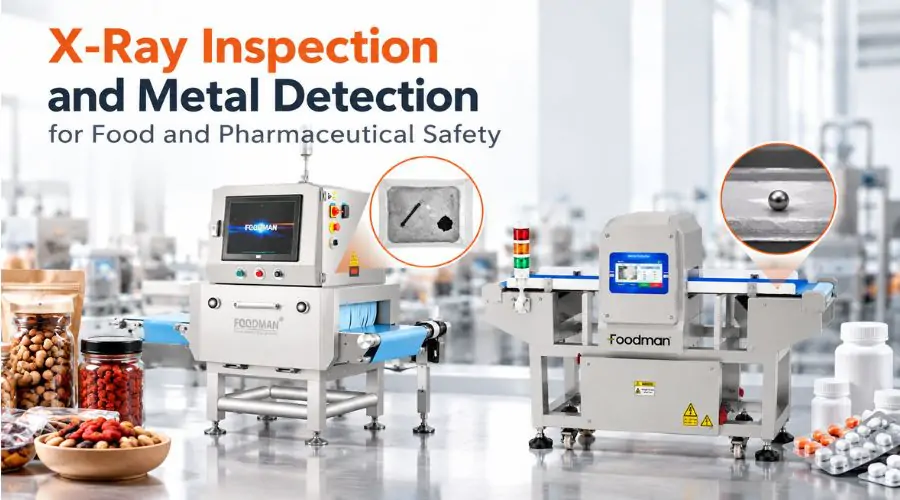
Food facilities may use just one of these systems, or run them side by side. The choice hinges on the product itself, packaging design, and the site’s risk assessment. Pharmaceutical manufacturing carries separate inspection requirements. Those requirements change depending on dosage form — tablets, capsules, powders, granules — and the final packaging format. There’s no shortcut to selecting suitable machinery. You have to test actual samples. Line speed matters. Where the inspection station sits matters. So do the quality workflows already in place. Judge a system by its label, or by the sensitivity numbers in the brochure, and you will choose badly.
Foreign Object Risks in Food and Pharmaceutical Production
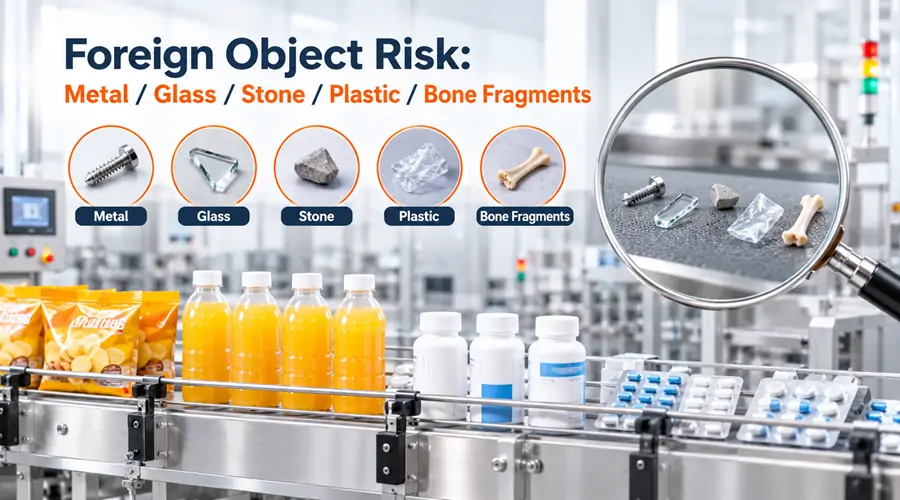
Foreign object contamination seldom traces back to just one stage of production. Stones, fine metal fragments can arrive already mixed into incoming raw materials. Cutters, grinders wear over time, flaking off tiny bits of equipment. Packaging stock, routine maintenance work open up yet more contamination pathways.
Food and pharma lines operate in very different worlds. Production environments vary. Product makeup differs. So does final packaging. Any inspection plan built to fit every scenario will almost always fall short.
Common Contaminants in Food Production
Meat, seafood, baked items, condiments and bulk food lots share similar foreign object trouble spots. Most unwanted debris comes from raw incoming stock, processing machinery, or packaging. Metal shards frequently break free from dulling cutters, conveyors, sieves and other mechanical parts. Glass, ceramic bits, stones and rigid plastic fragments creep in while handling raw materials. They can also appear when equipment cracks, or simply from surrounding plant conditions.
Bottled sauces, jarred preserves and canned goods bring another layer of complexity. Their packaging gets in the way of inspection. Metal packaging throws standard metal detectors off balance. X-ray inspection struggles with busy, layered backgrounds: container walls, jar bases, liquid product and overlapping packaging features all muddy the scan.
Foreign Matter Risks in Pharmaceutical Manufacturing
Pharmaceutical products span a wide range of forms: tablets, hard and soft capsules, powders, granules, blister packs, bottled medications, sachet-packaged preparations. Contaminants may originate from tableting equipment, mixing machinery, transport pipelines, sieving units, or packaging lines. Equipment wear generates metallic particles. Raw materials, excipients, and packaging can introduce other foreign matter.
In pharmaceutical manufacturing, inspection equipment must also align with the established quality management system. Selection hinges on operational stability, control over inspection parameters, reliability of isolating non-conforming products, and whether documentation meets traceability requirements.
Foreign matter detection is only one component of contamination prevention and quality control. It cannot substitute for proper management of raw materials and excipients, equipment maintenance, hygiene control, process validation, or other essential quality assurance measures.
Operating Principles of X-ray Inspection and Metal Detection
Both technologies support in-line foreign object detection. They rely on different criteria to identify contaminants. Understanding this distinction is the first step toward selecting appropriate equipment.
1. X-ray Inspection: Spotting Foreign Objects Through Density Differences
X-rays pass through the product. On the other side, a detector catches the transmitted signal and builds an image of what’s inside. How much a material attenuates those X-rays depends on a handful of things: density, thickness, chemical composition, the energy level of the beam. The system then reads grayscale values and other imaging features, looking for the spots that don’t belong.
Glass fragments, ceramics, stones, bones, metal, X-ray inspection can find all of them—provided they offer enough contrast in the image. That proviso matters. It is not a blanket guarantee.
In food, X-ray inspection covers packaged goods, bulk material, liquids, pastes. In pharmaceuticals, it fits tablets, capsules, granules, powders, and finished packaged products. How much it can actually detect? That depends on the product’s structure, on what the foreign object is made of, and on how the equipment is configured.
One limit is worth stating plainly. X-ray systems do not directly identify the chemical composition of every material. A foreign object can differ physically from the product and still be hard to see—if both attenuate X-rays in a similar way, the image may not separate them.
2.Metal Detection: Catching Metallic Contaminants Through Electromagnetic Response
Here’s the basic setup. A transmitter coil sets up an alternating electromagnetic field. A receiver coil sits there, balanced—until metal shows up. Then the balance breaks, a signal appears, and something trips: an alarm, an ejection mechanism.
Simple enough. The hard part is everything else.
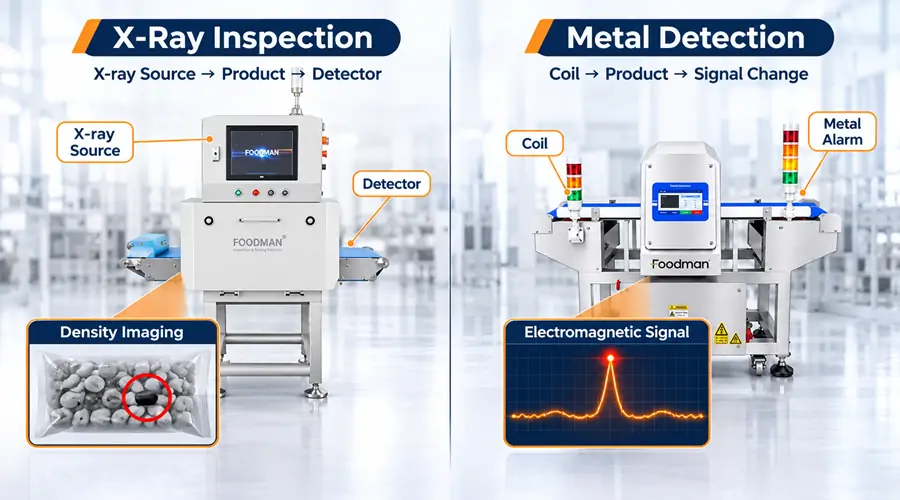
Signal strength? It moves with the metal—conductivity, magnetic properties, size, orientation as it passes through the field. Ferrous, non-ferrous, stainless steel: same unit, three different answers. And the product itself gets in the way. High moisture, high salt—stronger “product effect.” Some pharmaceutical formulations, high-moisture materials, specialized packaging, you have to test each one on its own. There is no shortcut there.
Get the detection parameters wrong and accuracy goes with them. That is not a small caveat. It is the whole game.
What these units do: control metallic contamination on production lines for food, pharmaceuticals, other goods. Broad application, yes. But be clear about the limits. Glass? Ceramics? Stones? Non-metallic foreign objects are simply beyond them. No single metal detector solves every contamination type.
3. Core Differences Between the Two Technologies
X-ray inspection relies on imaging analysis. Metal detection relies on electromagnetic response. The former covers a broader scope—detecting both metallic and non-metallic foreign objects. The latter focuses specifically on metallic contaminants.
This does not mean X-ray inspection outperforms metal detection in every scenario. For well-defined metal contamination control tasks, a metal detector may offer a more direct solution. For products packaged in glass, complex mixed-material products, or cases requiring identification of multiple foreign object types, an X-ray system is likely more suitable.
The final choice should rest on the specific foreign objects of concern, product characteristics, and validation results—not on a simple comparison of technical sophistication.
Applications in Food and Pharmaceutical Inspection
1. Food Sector: Bulk Materials, Finished Packaged Goods, and Aluminum Foil Packaging
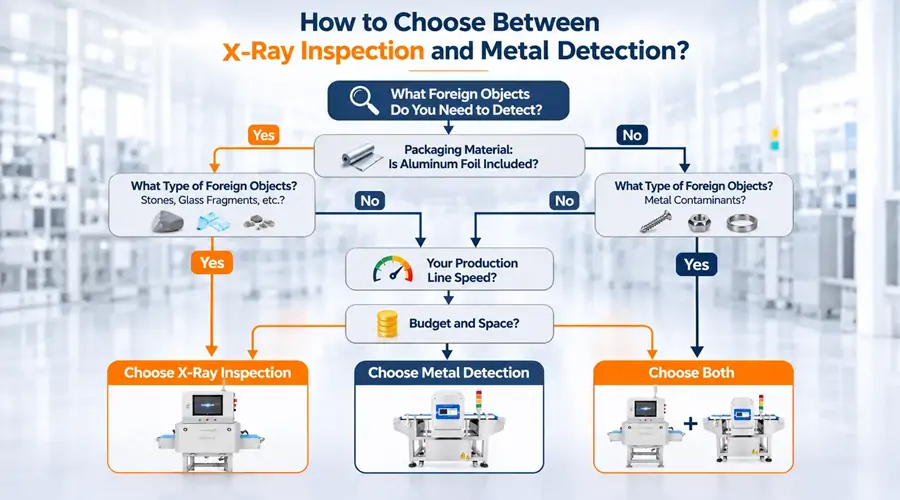
For bulk raw materials—nuts, grains, sugar, salt—the primary concerns are typically metal fragments and stones. Both metal detectors and X-ray systems work here. X-ray systems add the advantage of detecting glass and bone fragments. For finished packaged goods with non-metallic packaging—cardboard boxes, plastic film—metal detectors are generally more cost-effective and easier to maintain. With aluminum foil composite films or metal cans, electromagnetic interference renders metal detectors less effective. Pharmaceutical tablet x-ray inspection becomes the practical choice.
2. Pharmaceutical Sector: Tablets, Capsules, and Blister Packs
Pharmaceuticals carry foreign object risks you don’t see elsewhere. Where do contaminants come from? Active ingredients. Excipients. Equipment wear. Packaging materials. And every batch still has to be traced and validated, which raises the bar further.
Take tablet x-ray inspection. One pass checks several things at once: missing tablets, broken fragments, foreign objects, packaging integrity. Blister packs, bottles—aluminum foil doesn’t get in the way.
Metal detection plays a different role. It fits where you need high sensitivity to ferromagnetic metals, and where the packaging contains no metal—certain bulk materials, products in non-metallic packaging. Narrower, yes. But sharp where it applies.
So when you pick metal detection for pharmaceutical packaging and packaging lines, the question is not whether the system “can detect” a contaminant. Almost any unit can, under the right lab conditions. The real question: does it stay effective given the packaging materials in front of you, the product characteristics, the validation requirements you have to meet?
3. An Often-Overlooked Combination: Who Does What—Inspection, Checkweighing, Vision
Catching foreign objects is not the whole of quality control. Not even close.
Checkweighers have a narrower job: weight deviations, missing components. Vision systems watch something else entirely—labels, seals, product appearance, printed characters. And sorting equipment? It routes products by grade, or by whatever defect the upstream systems flagged.
If operated separately, these units remain merely individual pieces of equipment; however, when integrated—incorporating technologies such as X-ray or metal detection—they form a complete, unified production line, effectively creating an integrated system that spans the entire manufacturing process.
Foodman builds the full suite. The logic behind it is not “one machine does everything.” It is the opposite: distribute the inspection tasks according to the risks in front of you, and stop asking a single piece of equipment to carry the whole quality control job.
Detection Capability, Influencing Factors, and Technical Limitations
Here is where a lot of equipment selection goes wrong. People read the sensitivity spec in the product manual and treat it as actual detection performance—under every condition. It isn’t. Two things decide what a system can really catch: the equipment itself, and the product going through it.
1. Factors Affecting Metal Detection Performance
Start with the metal object. Material and shape both shape the signal. Ferromagnetic metals? Generally easier to detect. Stainless steel and aluminum are another matter—detectability there depends on the equipment type, on how it is operating. A spherical particle gives a more consistent response. Thin wires and flakes are trickier: they are more sensitive to orientation as they pass through the detector.
Then there is the product. High moisture, high salt, acidity—any of these can produce a “product effect,” and the detection parameters have to be adjusted to compensate. Packaging can get in the way too. Aluminum foil, metallized films, both can limit what the system sees. Add to that the detection aperture dimensions, the conveyor speed, and electromagnetic interference from nearby motors or variable-frequency drives (VFDs). All of it moves the result.
2. Factors Affecting X-ray Inspection Performance
Everything here turns on one thing: imaging contrast between the foreign object and the product. Let their densities and X-ray attenuation characteristics get too close, and detection gets hard. Same story with the product itself—excessive thickness, density that isn’t uniform, packaging with a complex structure. All of it pulls image contrast down.
Where the object sits matters too. A small particle. An object near the edge. Something buried behind a high-density structure. These are the cases that give X-ray inspection trouble.
Then there are the settings. Image processing algorithms and decision thresholds have to be configured with care. Set a threshold too strictly and false rejects climb. Set it too loosely and you start missing detections. Neither is acceptable. The only way to land on the right parameters is to test with actual products—not to guess from a spec sheet.
3. Limitations of the Two Technologies
X-ray inspection and metal detection each have their own scope. And neither one removes the risk entirely—a foreign object can still slip through.
When does that happen? For X-ray, when imaging contrast isn’t there. For metal detection, when the object fails to generate an effective electromagnetic response. Different failure modes. Same outcome.

One more thing worth saying. Inspection equipment is not a substitute for raw material acceptance, for equipment maintenance, for production hygiene management. It never has been.
So what does a more robust approach look like? Fold foreign object detection into the overall quality control process. Verify equipment performance periodically with test samples. Watch the rejection mechanism. Document anomalies—so that issues in the inspection process get identified and addressed while there is still time to act.
How to Choose Between X-ray Inspection and Metal Detection?
First identify the risks that need to be controlled. Then consider production processes and equipment configuration.
When should metal detection be prioritized?
If the primary risks involve ferrous metals, stainless steel, or other metallic contaminants—and both product and packaging suit metal detection—a conveyor-based metal detector may be a straightforward, effective solution.
For production lines handling powders, granules, or certain tablets, the optimal inspection point can be determined based on material state. Where the product itself generates a significant “product effect” (interference), testing should determine the appropriate equipment configuration and achievable detection sensitivity.
When should X-ray inspection be prioritized?
Glass, ceramics, stones, bone, metal—if the range of foreign objects you need to catch is that wide, X-ray inspection usually belongs at the top of the evaluation list. Same if the product is already packaged.
Tablets, capsules, bulk granular products: X-ray systems can look inside the product itself, given the right conditions. But validate first. For that product. For those foreign object types. A general detection claim is worth very little until it survives a real sample trial.
When should a combined approach be considered?
This one depends on where the risks sit. Metal contamination on one side, other foreign object types on the other—if no single technology adequately covers both, combining X-ray inspection and metal detection may be the right call. On a food line, that often looks like metal detection at raw material handling, then an X-ray system after packaging. Pharmaceuticals are less formulaic. Metal detection goes in wherever the specific risks call for it, and X-ray inspection gets added—if it is needed at all—for tablets or finished products.
Foodman Solutions for Food and Pharmaceutical Safety Inspection
Four technologies sit in the Foodman lineup: X-ray inspection, metal detection, vision inspection, checkweighing. Each one catches something the others miss. That is the first thing to understand—no single unit covers the whole line.
Why does the choice get complicated? Product types differ. Production processes differ. A tablet line and a bulk granular line do not present the same inspection problem, and a solution built for one will underperform on the other. There is no template worth applying across both.

What there is: assessment. Specific, real-world assessment—of the product going through the line, of the packaging around it, of the risks that matter in that particular plant.
The sections that follow take up foreign object control in food and pharmaceutical industries one case at a time. They are approaches to weigh, not a script to follow.
1. X-ray Inspection for Packaged Products
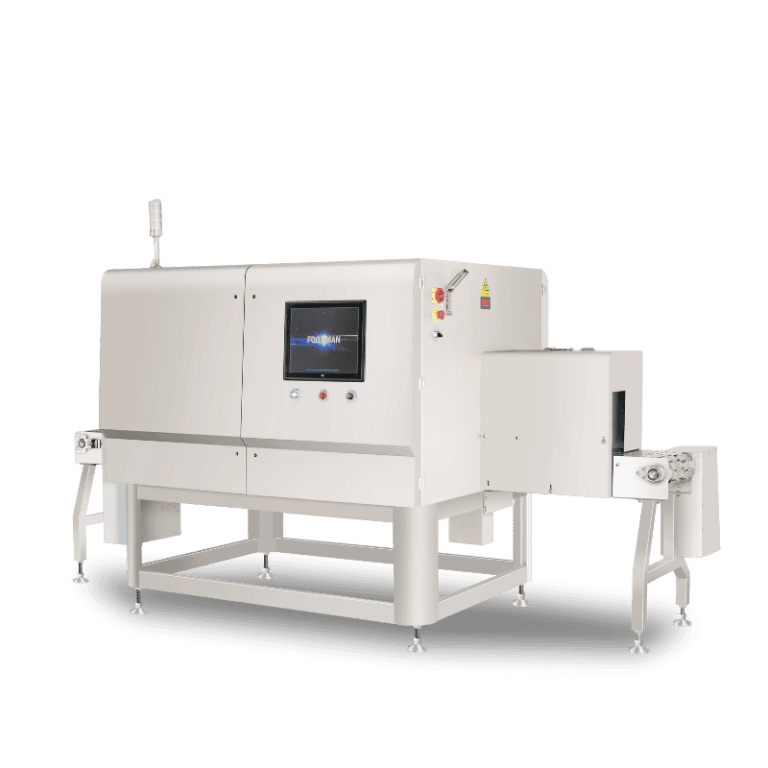
Bags, boxes, other packaging—for these, a conveyor-based X-ray inspection system is the usual fit. Foodman’s FXR-4017 is built for medium-sized packaged products and multi-lane applications. Food and pharmaceutical packaging, foreign object detection: that is the target.
But do not stop at the model number. Four things need a hard look first. Package dimensions. Product thickness. What kind of foreign objects you are actually trying to catch. And line speed—how fast the product moves through.
2. X-ray Inspection for Bulk Tablets and Granules
Unpackaged bulk material—tablets, capsules, granules—needs a system compatible with the specific feeding method. Here the Foodman FXR-S4017 is the one built for tablets, capsules, and other bulk materials.
Pharmaceutical use raises more questions. How is the product conveyed? How are foreign objects identified? Is rejection accuracy sufficient? Can the system be cleaned and maintained without a fight? None of these can be assumed. Each has to be verified on site.
3. Conveyor-Based Metal Detection
Food and pharmaceutical lines that suit electromagnetic inspection can take metal detection at several points: raw materials, mid-processing, before or after packaging. Where it goes is a judgment call, and five variables drive it. The target metal, product effect, packaging material, inspection aperture (channel) dimensions. Production throughput. Miss any one of them and the solution you end up with may not fit the line at all.
4. Equipment Configuration Based on Actual Samples
Foodman’s recommendation: evaluate inspection solutions against the client’s actual products and production conditions. Before locking in equipment selection, get the following in hand.
Product name, physical form, primary ingredients. Packaging materials, dimensions, product thickness. The foreign objects you need to detect—and their target sizes. Production speed, product orientation and arrangement. Where inspection will sit, and how contaminated products get rejected. Cleaning requirements, data logging and record-keeping needs, any other process-specific constraint.
Testing with actual samples tells you something a spec sheet cannot: where each system’s detection limits really fall. That cuts the risk of buying equipment that fails to meet the operational requirement.
Evaluating foreign object detection equipment for a food or pharmaceutical line right now? Send the product details through the official Foodman website. We can talk through X-ray or metal detection options and match them to your production process.
Conclusion
The choice between X-ray inspection and metal detection is not a debate over which technology is superior. It is a matter of matching technology to specific risks.
People frame this as X-ray versus metal detection. It is not a versus. Put both technologies against the same risk profile and the answer usually becomes obvious—one of them fits, the other does not.
Metal detection earns its place in specific situations. Metallic foreign objects, non-metallic packaging, a tight budget: that combination still points to a metal detector, and there is nothing second-rate about it.
X-ray inspection goes where metal detection cannot follow. Non-metallic foreign objects. Products sitting inside metal-containing packaging—pharmaceutical blister packs being the obvious case. Try to solve either of those with a metal detector and you will not get far.
Two things decide whether the choice holds up over time. First, find where contamination could actually enter the process, then test with real product samples—not demo samples, not catalog examples. Second, once the system is in, keep checking it: performance checks on a schedule, non-conforming products isolated, records kept. The equipment does not maintain itself.
Equipment performance, production processes, quality control. Integrate all three and the workflow is reliable, verifiable, sustainable. Integrate one or two and it looks fine on paper—right up until it fails in practice.
FAQ
X-ray inspection creates images by analyzing how materials attenuate X-rays, allowing for the identification of both metallic and non-metallic foreign objects, provided there is sufficient imaging contrast. Metal detectors, by contrast, identify metallic contaminants through electromagnetic response. As each technology has a different scope of application, the choice should be based on the specific type of foreign object and the characteristics of the product.
No. The two technologies operate on different principles; X-ray inspection is less sensitive to foreign objects with low density contrast, while metal detection can offer higher sensitivity for ferromagnetic metals in certain scenarios—often at a lower cost. Whether one should replace the other depends on the product, its packaging, and the nature of the foreign object risks, rather than the relative age of the technology.
Generally, yes—provided there is a sufficient density difference between the foreign object and the product matrix, and the object is not located in an area obscured by other elements. Detecting glass or stones that have a density similar to that of the product itself is significantly more challenging.