
Introduction
Dried fruit turns up everywhere—snacks, breakfast cereals, baking ingredients, confectionery, nut and dried fruit mixes, industrial food formulations. Raisins, dates, dried apricots, figs, prunes, cranberries, and other dehydrated fruits pass through multiple processing stages before reaching consumers or food manufacturers.
Contamination can enter at many points: harvesting, open-air drying on mats or racks, handling in field crates, transportation and logistics. The culprits range widely—stones, sand, glass, metal, plastic, woody stems. Bulk buyers increasingly ask for documented foreign object control. Retail customers expect none of it, especially stones, which pose a real risk if swallowed.
X-ray inspection for bulk food products adds a layer of security against physical contaminants. It works by analyzing differences in X-ray absorption rates between the food and potential foreign objects. Install a system at the right point on the line, and processors can screen bulk dried fruit before packaging—catching and removing contaminated material before it moves downstream.
Why is the inspection of dried fruit so challenging?

Certain physical characteristics of dried fruit make the detection of foreign objects far more difficult than one might expect.
Density variations. The density of dried fruit is not uniform. Depending on the type of stone and the moisture content of the fruit, a small stone and a raisin may exhibit very similar levels of X-ray attenuation. Dried apricots and dates are dense and thick, while raisins and dried cranberries are small and irregularly shaped. The products themselves create complex, highly textured X-ray images.
Product overlapping. Bulk dried fruit clumps and stacks. Raisins stick together. Dates overlap. Overlap adds effective thickness, and foreign objects buried in clusters become far harder to detect than those on the surface.
Sticky and fragile textures. Sticky product builds up on conveyor belts and inspection windows. Fragile items break during handling. Both outcomes can trigger false rejects or mask actual foreign objects.
A wide variety of potential foreign objects. Common risks include stones, fruit pits and pit fragments, glass, metal (wire or mesh from drying racks), hard plastic, woody stems. Different materials attenuate X-rays to different degrees.
Conventional metal detectors therefore fall short on dried fruit. They catch ferrous and various non-ferrous metals. They cannot catch stones or glass fragments. X-ray inspection for bulk food products closes this gap. It images by density rather than relying solely on electromagnetic response.
Working Principle of X-ray Inspection for Bulk Products
An X-ray inspection system emits a beam through products on a conveyor belt. A detector array on the opposite side measures the radiation received. Higher-density materials and those with a higher atomic number absorb more X-rays. They appear darker in the image. Lower-density areas appear lighter.
The system converts this data into a grayscale image. Image processing software then looks for unusual objects or patterns. Instead of relying on a single detection threshold, it analyzes differences in shape, density, and edges to identify possible contaminants. Modern systems combine shape recognition, density contrast analysis, edge detection, and region-based analysis. This allows the system to distinguish contaminants from the natural texture of the products themselves.
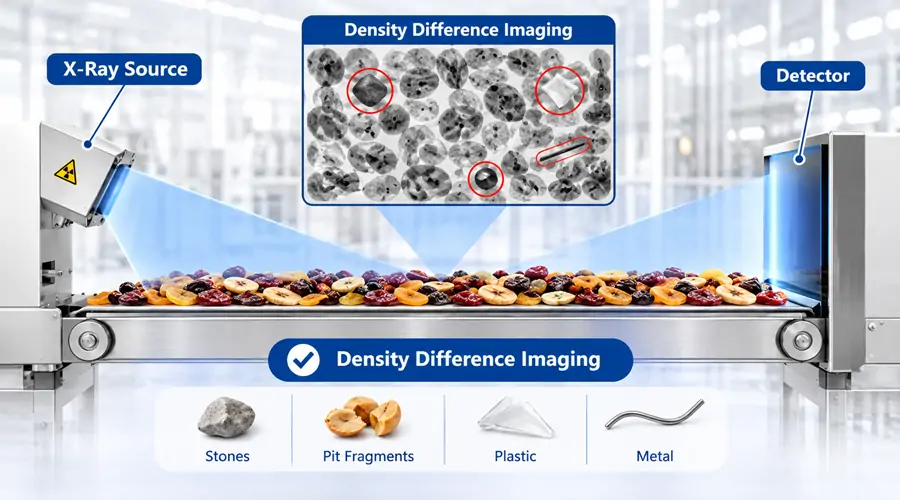
When inspecting bulk products, processors typically spread the items across the conveyor belt in a thin layer. Ideally, they create a single layer or minimize overlap as much as possible. The objective is to minimize overlap, ensuring that each individual item is as unobstructed as possible by other products when exposed to the X-ray beam. This is a critical design consideration: the performance of an X-ray inspection system for bulk products depends not only on the X-ray generator and detector but, to a significant extent, on how the products are presented.
Foodman’s X-ray inspection systems are built upon this principle. Foodman designs the inspection unit, conveyor, and rejection mechanism to work together. This arrangement helps present products in a way that supports effective inspection.
Application of X-ray Inspection for Dried Fruit Products
Different dried fruit products require specific production line configurations. The table below summarizes common processing approaches; however, the specific details are often more significant than the general classifications themselves.
Bulk Raisins, Seedless White Raisins, and Currants
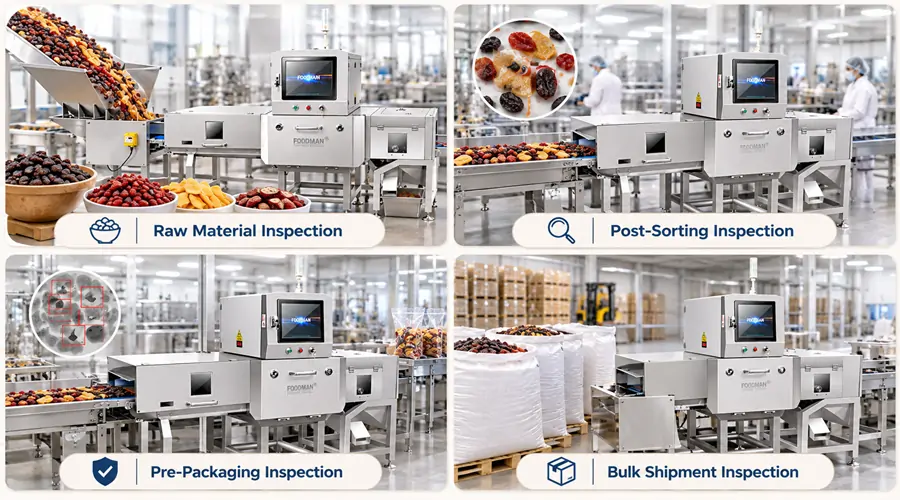
These products are typically inspected after washing but prior to packaging, at which stage they are spread out in a thin layer. Common contaminants include stones, fruit stems, wire, and glass fragments. Given the small size of individual pieces, the conveyor system should be configured to ensure the product is spread into a single layer as much as possible. Overlapping of the product is the primary obstacle to achieving optimal inspection sensitivity. Bulk X-ray systems can detect dense foreign objects mixed with raisins before blending or packaging. During product trials, processors should test the smallest contaminants of concern while checking whether the system can maintain the required processing speed.
Apricots, dates, figs, and prunes
These products are larger and denser. The challenges for inspection shift accordingly: the primary concern is no longer product overlap, but rather product thickness. A date with pit fragments attenuates X-rays differently than an intact date. Inspection parameters must therefore be validated on the actual product—not generic samples. Some processors inspect after pitting. That removes large, hard foreign objects (pits) from the risk pool and lets the X-ray system concentrate on glass, metal, or plastic.
Diced or sliced dried fruits
Diced mango, diced pineapple, and similar items are usually inspected in a loose, free-flowing state before mixing or packaging. Diced products form a relatively uniform layer, which facilitates inspection; however, the cut surfaces and sugar crystallization can introduce “image noise.” In such cases, algorithm tuning and appropriate software-based processing of the X-ray images—such as illumination simulation or enhancement—are essential.
Foodman Inspection Solutions for Bulk Dried Fruit
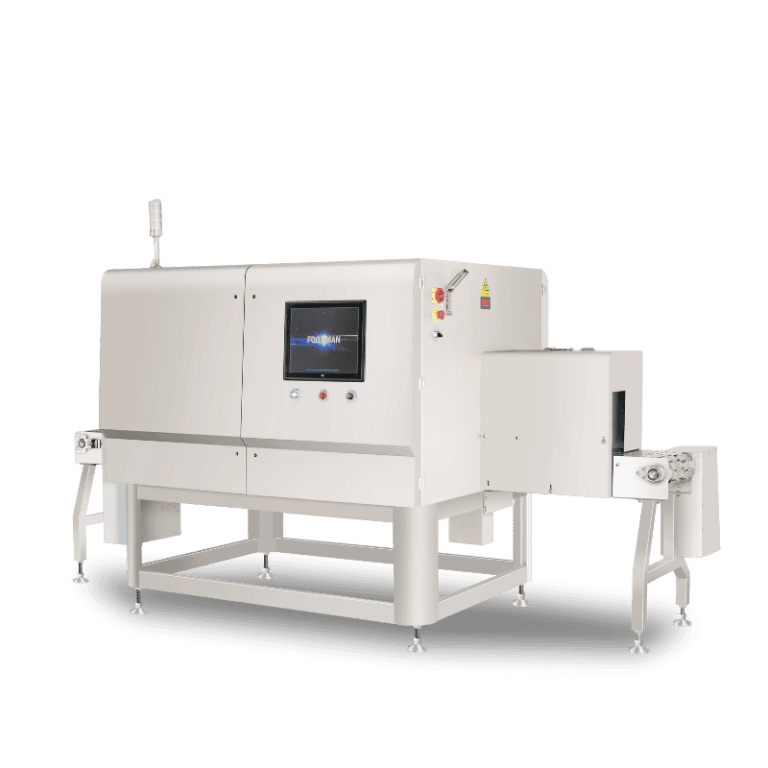
Foodman develops X-ray inspection systems for both bulk materials and packaged foods. For dried fruit processors, a bulk inspection system is a practical starting point. These systems are designed for products such as nuts and grains and may also suit dried fruit applications, depending on product size, density, and processing speed.
The following two systems illustrate the range of available solutions for bulk product inspection:
FXR-S4017 Medium-Scale Bulk Product X-Ray Inspection System: built for medium-scale bulk applications. Fit depends on product dimensions and throughput requirements.
FXR-S6035 Large-Scale Bulk Product X-Ray Inspection System: designed for large-volume bulk products—nuts, grains, coffee, and similar materials.
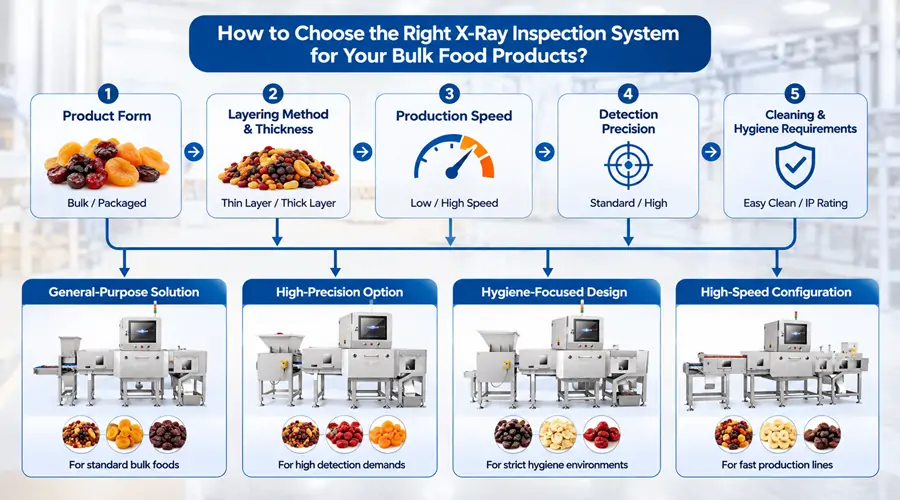
Model choice comes down to product flow, conveyor requirements, target contaminants, and installation conditions. The listed applications should not be construed as a guarantee of specific inspection results for every type of dried fruit.
If a facility requires inspection at multiple processing stages—including a separate step for packaged products—Foodman’s more comprehensive X-ray inspection systems may be considered.
To facilitate an accurate equipment assessment, processors should provide Foodman with details regarding the type of dried fruit (whole or diced), the target contaminants and their dimensions, the required throughput, and the intended installation location. These details will help determine the optimal configuration and an effective trial setup.
Conclusion
Dried fruit processing brings its own difficulties. Products are sticky, variable, and dense. Contamination comes in many forms: stones, glass, metal, hard plastics. X-ray inspection for bulk food products catches what metal detectors alone miss. Effectiveness, though, hinges on product presentation, the characteristics of the contaminants, and a robust validation process. The ideal system is tailored to your product, installed at the optimal point on your line, and verified with actual samples.
Evaluating X-ray inspection for a bulk dried fruit line? Foodman can help. We assess your application requirements, test your products, and configure a system that fits your existing processes. Contact our team to discuss the inspection challenges you face.
FAQ
It depends on material contrast and inspection conditions. X-ray systems can catch metal, stones, glass, ceramics, and certain hard plastics. Real-world performance depends on contaminant size, composition, and orientation—plus product thickness and flow consistency. Product-specific testing is the only way to establish actual detection limits.
Yes. Overlap increases effective thickness, which can mask contaminants. Spread the product into a thinner, more uniform layer—a vibratory feeder or spreading conveyor typically does the job—and inspection results improve.
Each technology has strengths. Metal detectors are built to find metallic contaminants. X-ray systems, given sufficient image contrast, can also detect certain non-metallic foreign objects such as glass and stones. The choice depends on the potential hazards, the product characteristics, and the scope of inspection required.