Introduction
The manufacture of liquid food products has unique challenges for foreign object detection. Sauces, dairy products, beverages, and other pumpable foods pass through pipelines, filling systems, and sealed packaging lines. Contaminants may be introduced during raw material handling, mixing, pumping, filtering, or equipment maintenance. Once a product has reached the filling stage, detecting such defects without disturbing production becomes an important quality control duty.
X-ray analysis finds foreign objects by comparing X-ray absorption between the product and the impurities. For manufacturers of processed sauces, dairy products, condiments, syrups, and other liquid or semi-liquid foods, X-ray inspection systems can assist in detecting foreign objects at appropriate stages of the production process.
However, detecting foreign items in flowing liquids is different from inspecting packaged solid food products. Detection performance is influenced by factors such as product density, flow conditions, pipeline design, contaminants’ sizes, and inspection speed. Before integrating the equipment into the manufacturing line, it is critical to have a solid grasp of these variables.
Challenges of Detecting Foreign Objects in Liquid Food Production
Liquid and semi-liquid dietary components behave differently than solids. Packaged cheese blocks or sealed cartons can be held in a fixed position for examination. In contrast, sauces or dairy products may flow continuously through a pipeline for x-ray inspection of food; their viscosity might alter with temperature, and they may contain suspended ingredients, creating a complicated background for imaging.
Foreign objects may infiltrate the product at different phases of production:
Raw material preparation: Stones, metal fragments, and other unwanted substances may be introduced along with the raw ingredients. Wear and tear on pumps, mixers, valves, and other processing equipment can cause metal shards or other debris to enter the product stream.
Maintenance and equipment replacement: During repairs or manufacturing line adjustments, small components, damaged tools, or material fragments may accidentally enter the product flow.
Packaging and filling: Depending on the packaging and filling equipment utilised, glass, metal, or other debris may enter the product after the primary processing stage.
Risk levels differ from one product and process to the next. Take foreign-object detection: finding contaminants in tomato sauce loaded with seeds and pulp is a far cry from inspecting smooth milk, thick mayonnaise, or dairy sauces with herbs suspended throughout. Each matrix poses its own distinct challenge.
Where you place an inspection system matters just as much as what you are inspecting. An upstream system shields downstream equipment and catches contaminants introduced during processing. A system positioned after filling, by contrast, examines the final packaged product—including anything that entered during packaging itself. These two inspection points guard against different risks. Treating them as interchangeable is a mistake.
How X-ray Inspection Detects Foreign Objects in Liquid Food Products
The Principle of X-ray Foreign Object Detection
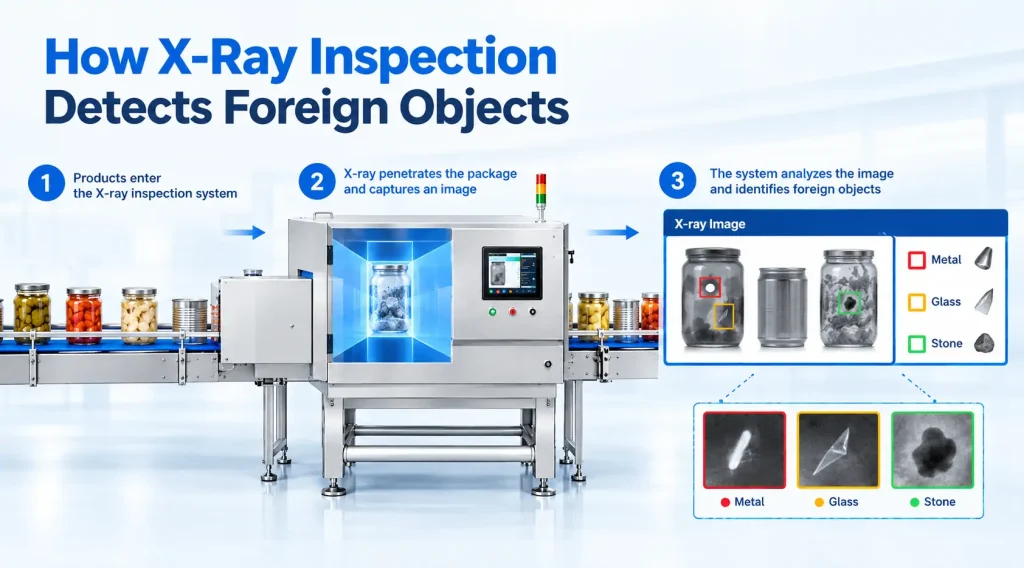
Industrial X-ray systems fire radiation through a product and gauge how much reaches a detector on the far side. Absorption hinges on composition, density, thickness, and the energy of the applied X-rays. The detector turns incoming radiation into an image. Image-processing software then reads attenuation patterns to flag possible foreign objects.
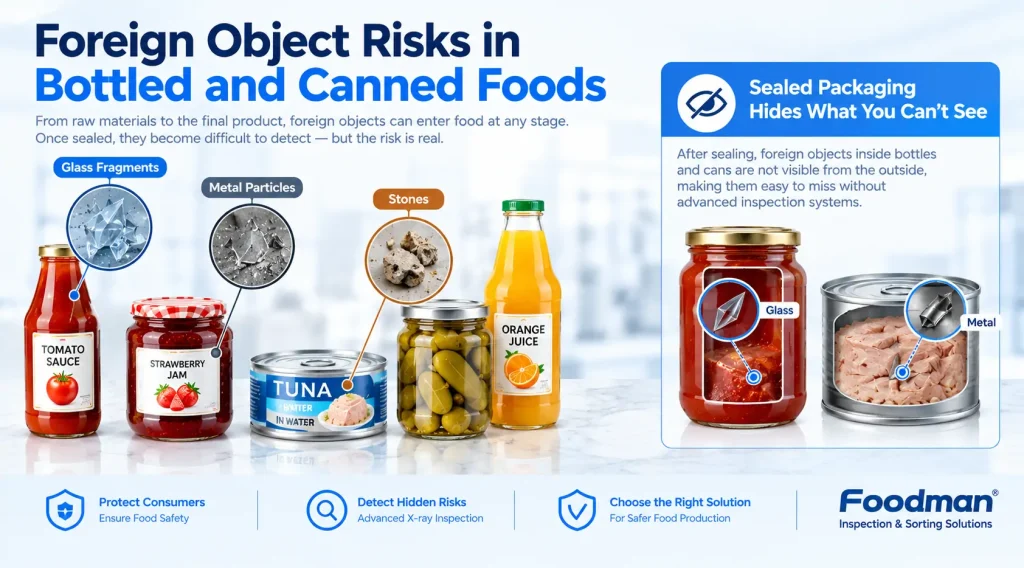
Some contaminants stand out clearly against liquid foods. Metal fragments, glass, stones, and certain dense minerals generate detectable contrast. Detection is never guaranteed, though—it turns on the object’s physical properties and the inspection conditions. A small metal shard may register sharp contrast in a fairly uniform sauce. A low-density plastic piece of similar size may absorb X-rays much as the surrounding food does, blurring the distinction. X-ray inspection therefore cannot catch every contaminant a product might carry. Detection depends on contrast—the foreign object against its surroundings.
How Pipeline X-Ray Systems Handle Flowing Products
Pipeline inspection involves installing an in-line X-ray inspection unit onto a sanitary-grade pipeline section, allowing for continuous product inspection as it flows through the detection zone. Commonly referred to as “pipeline X-ray inspection for food”, this method enables testing prior to the filling stage. This means that if contamination is detected, the product can be rejected before it reaches the packaging phase. Furthermore, this approach completely eliminates any X-ray attenuation caused by packaging materials.
Pipeline Inspection vs. Finished-Pack Inspection
Pipeline X-ray inspection examines products as they move through the processing line, whereas finished-pack inspection checks food items after they have been placed into their final packaging containers.
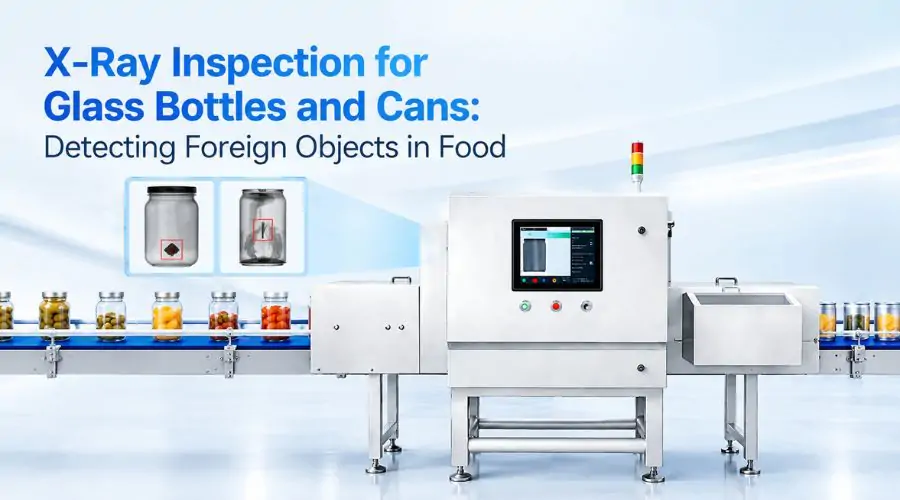
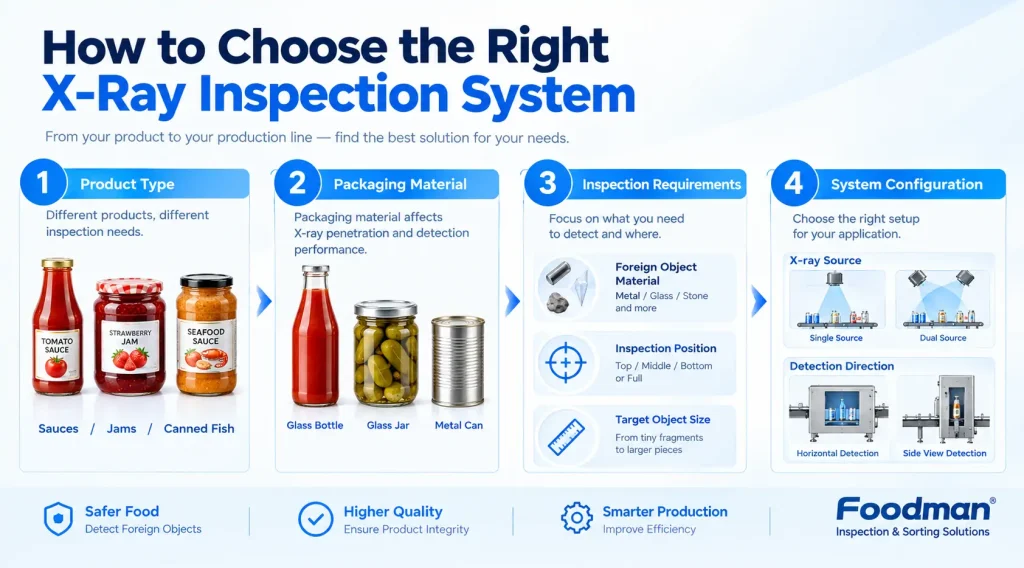
For solid packaged foods, the process is relatively straightforward: the product is either stationary or moving at a known speed, and the geometry of the packaging container is fixed. For liquids and sauces, however, there are two deployment models. Post-filling inspection runs filled cans, bottles, cartons, or pouches through standard X-ray equipment. For bottled and canned goods, specialised side-view systems are an option. Either way, the whole container gets scanned—seal area and headspace included. This is the go-to method for retail-packaged sauces and dairy products. It also slots in cleanly alongside checkweighing and labelling.
Applicability and Limitations of In-Line Pipeline X-Ray Inspection
In-line pipeline X-ray inspection is well-suited for the mass production of low-margin liquid products. Some products can be screened mid-flow, straight through the piping system from processing to the filling line. Milk, whey, fruit juice, liquid egg, brine, thin syrups, and sauces of uniform consistency all qualify. This approach pays off most when the inspection point sits far from the filling station. A foreign object entering the product stream there could otherwise spread through a large volume of finished goods. Early-stage inspection stops that risk before it escalates.
However, certain operating conditions are not suitable for pipeline inspection.
When a product has an extremely high viscosity or contains large solid particles—such as sauces or condiments with chunky ingredients or products containing visible pieces of vegetables or meat—it creates a complex X-ray background. While software can be trained to recognise these patterns, the sensitivity for detecting small contaminants decreases as the product’s non-uniformity increases. Furthermore, flow velocities within pipelines are often very high; faster flow rates reduce the effective inspection time per unit volume, which can cause small features to become blurred. Pipeline systems carry a built-in trade-off: throughput against sensitivity.
Many sauce and dairy lines work around it with a hybrid setup. Pipeline inspection handles the bulk stream. A second X-ray stage then checks the product after filling and packaging. The two systems are not redundant. Pipeline inspection catches major contaminants early and keeps a whole batch from being rejected. Post-filling inspection serves as final verification—confirming that packaged goods meet the quality control standards retail outlets demand.
X-ray Detection Capabilities for Sauces and Dairy Products
Three factors govern X-ray detection: the density gap between foreign object and product matrix, the object’s size and shape, and the total material thickness along the beam path.
Glass, metal, stone, and dense bone attenuate X-rays strongly. Even small fragments of these show up. Plastics, rubber, wood, and most organic substances barely attenuate at all. Catching them usually takes a larger volume—and sometimes they cannot be caught at all. Packaging compounds the problem. Aluminium foil and metallised films throw off strong attenuation signals that interfere with inspecting finished, packaged products. Pipeline-based systems sidestep this entirely; packaging never enters the beam path.
Factors Affecting Actual Inspection Performance
Product density and composition: dense components or natural particulates can shrink the contrast between contaminant and product.
Contaminant characteristics: material, size, shape, orientation, and location all matter.
Pipeline and inspection geometry: pipe material, wall thickness, flow path, and beam direction all shape the image.
Flow conditions: shifting flow rates, uneven product distribution, and air bubbles can corrupt inspection data.
Processing environment: vibration, temperature swings, and machinery status affect system stability.
Inspection settings: image-processing parameters must balance catching target contaminants against false rejects triggered by normal product variation.
A solid validation process defines the contaminants of concern, sets representative test conditions, and evaluates performance across the expected operating range. Results must be documented for each product and equipment configuration.
Foodman Solutions for Liquid and Sauce Inspection
Foodman provides food manufacturers with X-ray inspection systems, metal detectors, checkweighers, vision inspection systems, and sorting equipment. For sauces, dairy products, and liquid foods, we offer the following configuration solutions:
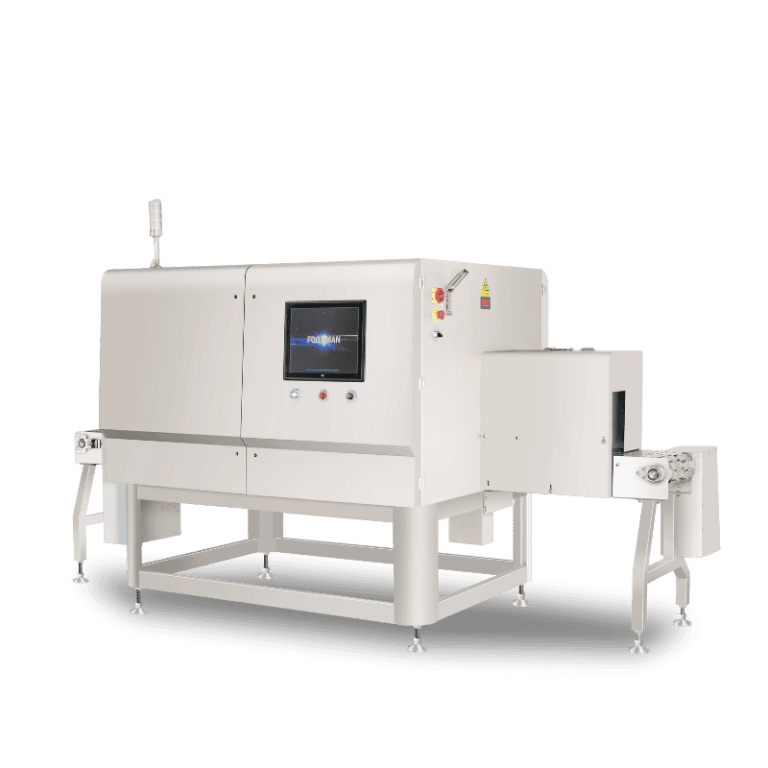
Pipeline X-ray Inspection Systems: Designed specifically for pumpable products, these in-line inspection solutions feature a sanitary pipeline design and are equipped with diversion/rejection mechanisms to effectively remove product segments containing contaminants. They suit milk, fruit juice, liquid egg, brine, syrup, and sauces of uniform consistency.
Post-Filling X-ray Inspection Systems: built for canned, bottled, cartoned, or pouched goods. These units pair with checkweighers and rejection conveyors to inspect finished, packaged products end to end.
Pipeline and Conveyor-Based Metal Detectors: these catch ferrous metals, non-ferrous metals, and stainless steel. They typically stand as the first line of defence inside pumping and piping systems.
Foodman’s checkweighers are designed for weight control of finished products, while its vision inspection systems are well-suited for verifying packaging integrity and product appearance. As these technologies serve different purposes, they should be integrated based on the specific quality requirements of the production line.
For liquid food manufacturers, the goal is not simply more inspection equipment. It is the right control points, validated inspection performance, and reliable handling of every rejected non-conforming product.
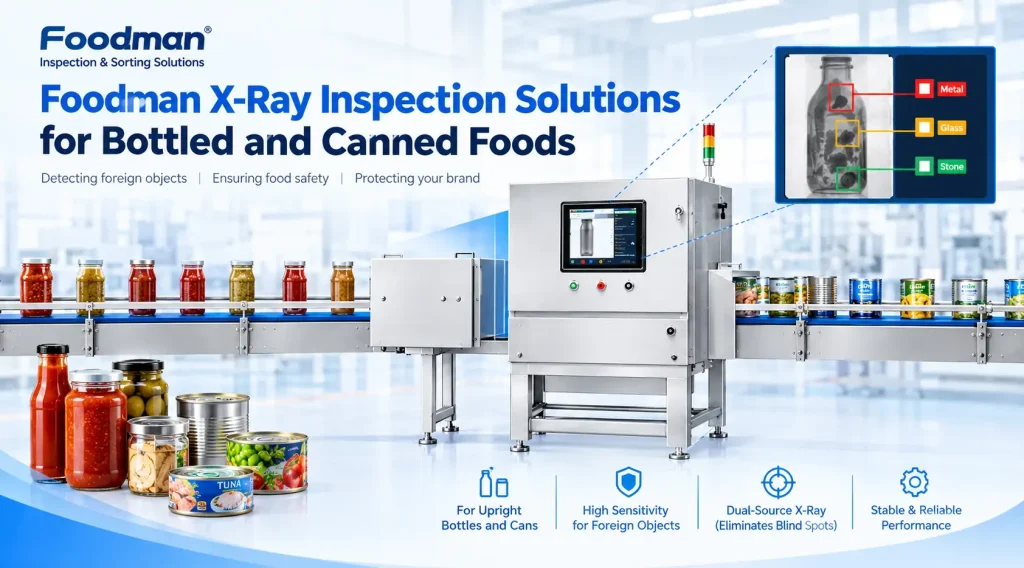
Before recommending a configuration, Foodman evaluates product samples, packaging formats or pipeline layouts, required throughput, and specific target-contaminant criteria. The chosen equipment then matches real production conditions—not generalised performance claims.
Conclusion
X-ray inspection lets manufacturers of liquid foods detect specific foreign objects in sauces, dairy products, syrups, and other pumpable items. How well it works depends on contaminant-to-product contrast, inspection geometry, material flow characteristics, and system configuration.
Weigh the risk profile first. If contamination can enter during processing—and a suitable inspection point exists on the line—an in-line (pipeline) solution deserves consideration. If the goal is instead to inspect sealed bottles, cans, jars, or other containers after filling, X-ray inspection of the finished, packaged product may fit better.
The most reliable selection process begins with clearly defined contamination risks and representative product testing. By evaluating actual production conditions, manufacturers can determine the most appropriate solution—whether it be an in-line X-ray system, a packaged-product inspection system, a metal detector, or a combination of multiple technologies.
For Foodman’s clients, the next step is to define product characteristics, target contaminants, production speeds, and installation requirements in order to evaluate inspection solutions against quantifiable quality control objectives.
FAQ
Neither is strictly better; both have their own advantages and limitations. In-line inspection can detect contaminants before filling and is unaffected by packaging materials; however, it often results in a higher volume of rejected product and is less suitable for viscous products or those containing large particulates. Post-filling inspection verifies the integrity of the final packaged product—a requirement for many retailers—though packaging materials can reduce detection sensitivity. Many facilities employ both methods.
X-rays pass through a specific section of the food product as it flows through the line. A detector collects data, which is then analysed to identify the characteristics of any foreign objects. If a potential contaminant is detected, the system sends a signal to an alarm, a production line controller, or a rejection mechanism. The success of the rejection process depends on the precise timing of the product flow in relation to the downstream handling system.
Detection is possible, provided that the composition, size, and position of the glass fragments create sufficient contrast; however, not all fragments can be detected. Factors such as product density, the geometry of the container or pipeline, and the angle of inspection all influence the results—which is why representative testing is essential.