Introduction
Pet food production is subject to rigorous quality standards, as pets rely entirely on manufacturers and owners to ensure the safety of their food. From dry kibble and treats to wet food, canned products, frozen items, and meat-based formulations, modern pet food production involves multiple processing stages. Each stage carries the risk of introducing potential foreign objects.
Foreign objects can originate from raw materials, processing equipment, packaging materials, maintenance activities, or accidental contamination during transport and handling. While metal fragments are a clear concern, they are not the only potential hazard; glass, stones, mineral fragments, dense bone, and certain high-density plastics can also end up in the finished product.
Consequently, pet food safety increasingly relies on inspection technologies capable of examining products without opening or damaging the packaging.
Among the various modern inspection technologies available, X-ray inspection has emerged as a key solution for manufacturers seeking to enhance pet food safety and improve product quality. Modern X-ray inspection systems used in the pet food industry can inspect packaged products while simultaneously providing information regarding foreign objects, product integrity, and certain physical defects.
How do X-ray inspection systems detect foreign objects in pet food?
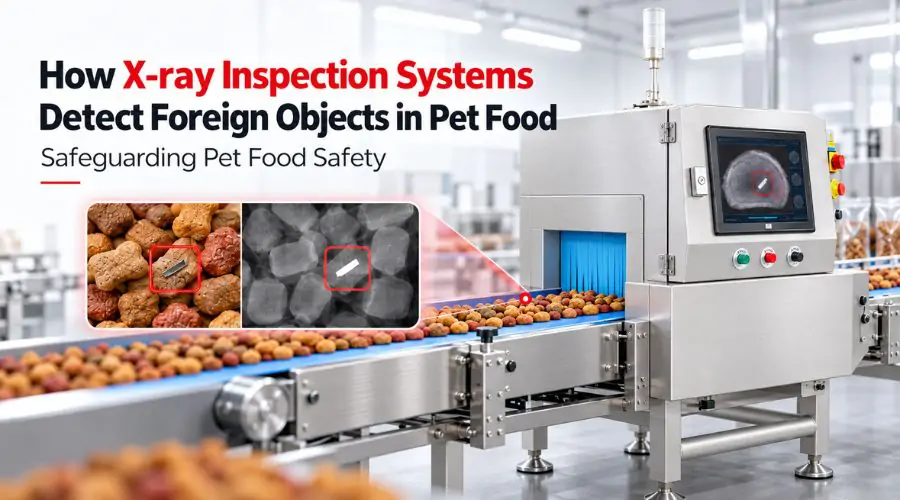
An X-ray inspection system acts much like a security scanner on a pet food production line, specifically designed to identify foreign objects mixed into the product.
The operating principle is straightforward: X-rays are projected from one side, and a detector on the opposite side captures the rays that pass through the product. Pet food has low density, allowing X-rays to pass through easily, whereas foreign objects—such as stones, metal, bone, or plastic—have higher densities and block more of the X-rays. The detector converts these variations into an image, which is then analyzed by software to identify anomalies. When an anomalous area exceeds a preset threshold, the system can trigger an automatic rejection mechanism.
Consequently, the manufacturer of the X-ray inspection system is crucial for pet food producers; the system’s overall performance depends not only on the X-ray source but also on detector quality, software algorithms, conveyor belt stability, rejection precision, and the overall machine design.
Product characteristics are particularly important when applying X-ray inspection systems to pet food. Granular pet food, meat products, treats, canned goods, and soft pouches can vary significantly in density and packaging structure. Therefore, inspection parameters must be adjusted according to the specific application.
What types of foreign objects in pet food can X-ray inspection detect?
A major advantage of X-ray technology is its ability to detect a wide range of high-density foreign objects. In the context of pet food safety, common targets for detection include:
Metal fragments: These may originate from processing equipment such as cutters, grinders, mixers, conveyors, or pumps. Ferrous and non-ferrous metals typically exhibit a significant density contrast with the food product, making them easy to identify.
Glass: Glass fragments may be transparent or concealed within the packaging, making visual inspection difficult. X-ray systems detect glass based on its density rather than its visual appearance.
Stones and mineral materials: Stones or other mineral materials may inadvertently mix with raw ingredients. X-ray inspection can identify these contaminants provided there is sufficient density contrast with the pet food and the application conditions and product state are suitable.
High-density bone fragments: Many meat-based pet food formulas naturally contain bone. The challenge lies in distinguishing between the product’s normal structure and anomalous bone fragments; therefore, proper application testing and software configuration are essential.
Certain high-density plastics: Not all plastics can be detected by X-ray systems. Detectability depends on factors such as material density, size, shape, orientation, product composition, and inspection conditions. Some high-density plastics generate sufficient contrast to be identified.
Consequently, when selecting an X-ray inspection system for the food industry, one should not rely solely on general sensitivity specifications but should instead conduct targeted testing based on the actual product.
Comparison of X-ray Inspection and Metal Detection for Pet Food
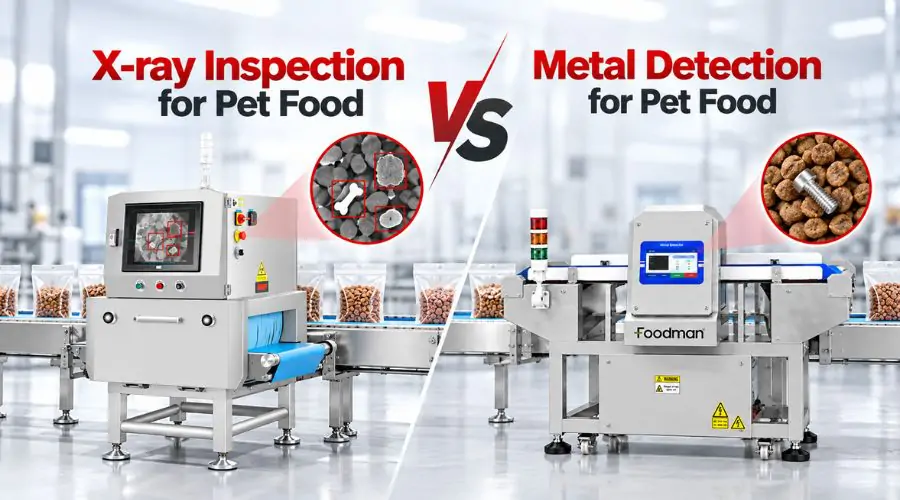
Metal detectors and X-ray inspection systems are both widely used technologies in food production; each has distinct characteristics and they can complement one another.
Metal detectors operate by generating an electromagnetic field and monitoring for disturbances caused by conductive metal contaminants; they are commonly used to detect ferrous metals, non-ferrous metals, and stainless steel. For many production lines, they offer a simple and efficient method for controlling metal contamination.
X-ray inspection works on a different principle. Instead of measuring electromagnetic conductivity, it analyzes differences in X-ray absorption rates and material density. Consequently, X-ray technology can detect a wider range of high-density foreign objects, including certain non-metallic contaminants.
When it comes to ensuring pet food safety, the choice of technology depends on specific factors such as the product’s risk profile, potential contaminants, packaging format, and the regulatory requirements of the target market. Many pet food facilities employ both technologies in tandem: using metal detection for highly sensitive control of metal foreign objects, while utilizing X-ray inspection for broader contaminant detection and quality assurance.
Therefore, evaluating the role of X-ray inspection systems in pet food production should be based on actual hazard characteristics rather than a simple comparison of the two technologies. Experienced manufacturers of X-ray inspection systems can assist producers in determining the most suitable solution—whether that involves X-ray inspection, metal detection, or a combination of technologies.
Installation Locations for X-Ray Inspection Equipment on Pet Food Production Lines
The installation location directly determines inspection effectiveness. X-ray inspection systems should be positioned after the final stage where foreign objects could enter the product stream, but before packaging obscures the image or the product takes its final form.
Common inspection points include:
Raw material inspection: Raw materials such as meat, grains, fish, minerals, and additives may contain foreign objects prior to processing. X-ray inspection may be considered if the material form and conveying method are suitable.
After grinding and mixing, but before extrusion: To capture metal fragments resulting from wear on blades, screens, and mixers.
After drying and cooling, but before coating: To detect bone fragments, stones, and plastic foreign objects originating from the conveying system.
After coating, but before primary packaging: To inspect the final product stream.
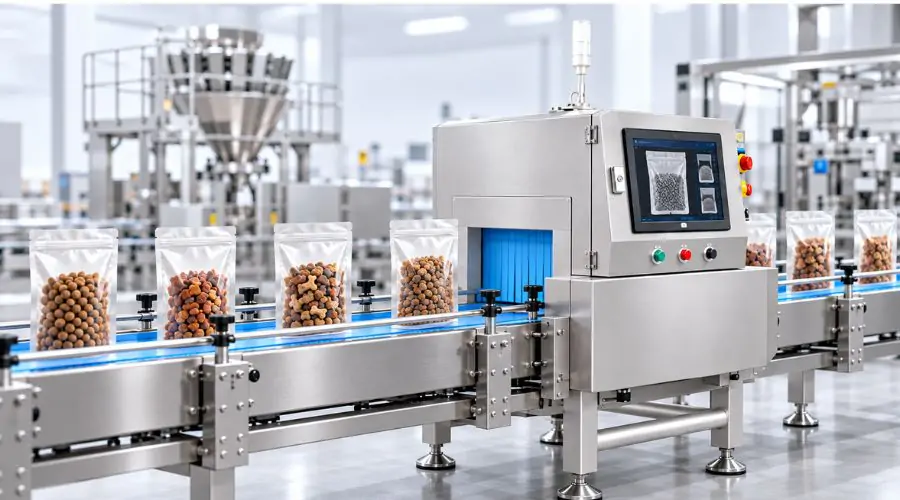
After packaging: To check sealed bags or trays for contaminants and verify fill quantities. Packaged finished products pass through the X-ray tunnel without needing to be opened; the system analyzes the entire package and automatically rejects non-compliant items.
For canned or pouched wet food, the optimal location is usually after filling and sealing, as the container itself is a factor in the inspection process. For raw frozen pet food, inspection should take place after freezing but before boxing, when the product is firm and uniform in shape.
Decisions regarding each installation location should be based on hazard analysis and validated using known test samples. Final inspection provides an additional verification step before the product enters storage, distribution, and retail channels.
Compliance and Standards for X-ray inspection systems pet food
Food manufacturers must consider both food safety requirements and the safety of the equipment itself.
Specific regulatory requirements vary depending on the target market, product category, production facility, and applicable laws and regulations.
Therefore, the design of professional inspection systems must fully account for factors such as materials in food-contact zones, hygienic design, electrical safety, radiation shielding, emergency controls, and inspection documentation.
X-ray equipment used in food processing must also incorporate radiation exposure controls. Robust shielding measures and safety interlocks are essential components of responsible system engineering.
When evaluating X-ray inspection equipment for the food industry, manufacturers should look beyond mere detection sensitivity. Hygienic design, equipment reliability, software traceability, rejection verification, safety protection, and system integration capabilities are equally critical.
For pet food manufacturers targeting international markets, it is highly beneficial to partner with X-ray inspection system suppliers who understand the requirements of different markets and can provide the technical documentation needed for equipment validation.
How to Choose the Right X-ray Inspection System Manufacturer
Selecting an X-ray inspection system manufacturer is a long-term strategic decision rather than a simple equipment purchase. When evaluating potential manufacturers, pet food producers should comprehensively consider the following key factors:
Application Experience: Does the manufacturer have experience handling products such as dry food, wet food, treats, meat products, or canned goods—or experience with similar applications?
Detection Performance: Can the system deliver stable and appropriate detection performance for target foreign objects under actual product conditions?
Software Capabilities: Modern X-ray inspection equipment depends on image processing software to analyze products accurately. Useful features include an easy-to-use interface, product memory, sensitivity adjustment, image logging, alarm management, and rejection monitoring. These functions can make daily operation more efficient.
Machine Construction: Pet food production can expose equipment to moisture, dust, oil, and frequent cleaning. Product changeovers may also be common. A hygienic machine design and suitable IP rating are therefore important for reliable operation.
Production Line Integration: The X-ray inspection system should communicate with upstream and downstream equipment and work smoothly with automatic rejection systems. Proper integration helps maintain a continuous production flow.
After-sales Support: Long-term performance also depends on after-sales support. Installation, commissioning, operator training, maintenance, spare parts, and remote technical support can all affect the overall value of the equipment.
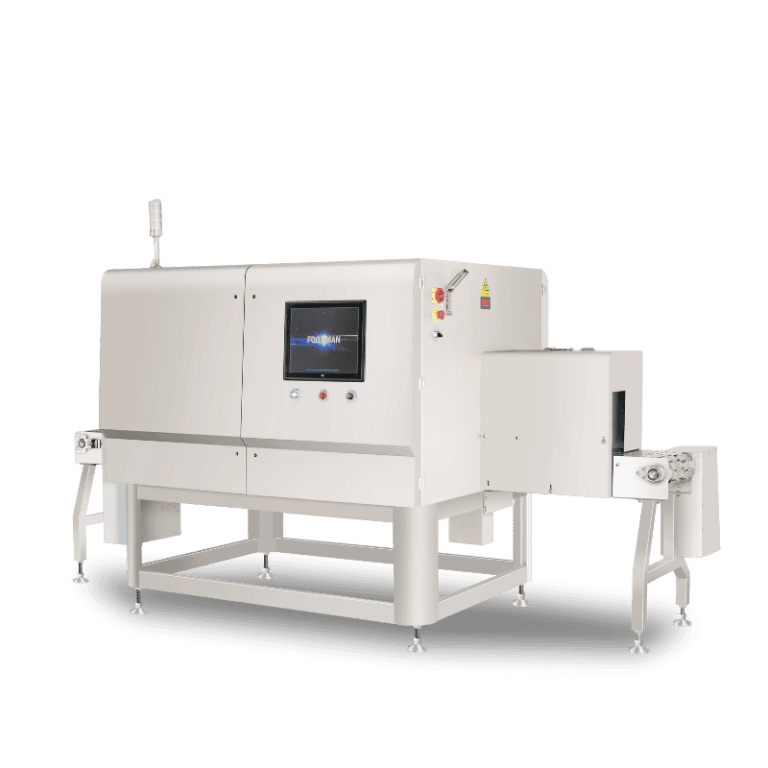
Take Foodman as an example. The company develops X-ray inspection systems for the food industry, including pet food applications. Its product range covers checkweighers, metal detectors, X-ray inspection machines, and sorting systems, with a strong focus on X-ray and vision inspection technologies.
This broader approach is useful because foreign object control is not usually solved by one machine alone. Different inspection technologies can work together at different stages of the production line, depending on the product and the risks involved.
Practical Application: X-ray Inspection in Pet Food Production Lines
Consider a dry pet food production line as an example. After raw materials are received and pre-processed, they undergo grinding and mixing; the formulated mixture is then formed into kibble, dried or cooked, and finally weighed and bagged.
At this stage, various quality control technologies work in tandem: checkweighers verify that each package meets the target weight, metal detectors specifically identify metal contaminants, and X-ray inspection systems scan the entire package to detect high-density foreign objects. This layered inspection approach establishes multiple quality control points.
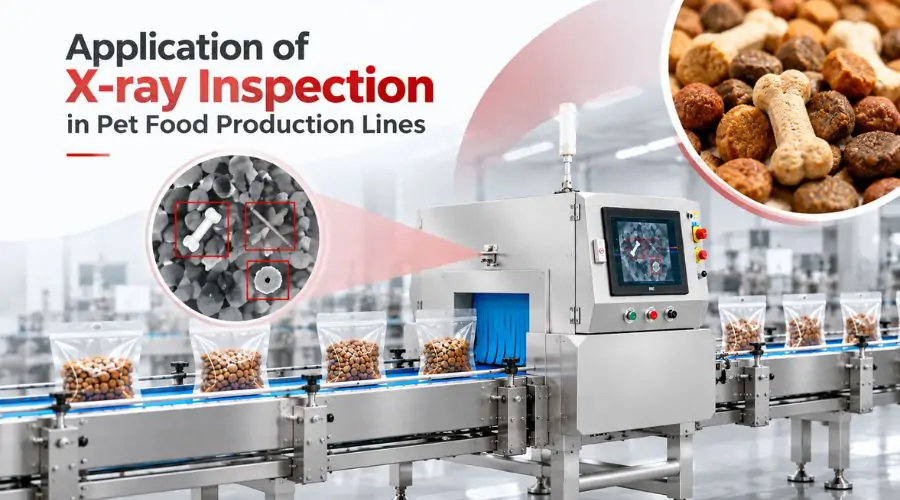
For instance, as packaged pet food enters the X-ray tunnel, the system generates real-time images, which are analyzed by software to identify areas of abnormally high density. If a foreign object is detected, the product can be automatically rejected from the production line. Depending on the system configuration, inspection data can also be utilized for production monitoring and quality documentation.
This integrated approach demonstrates that X-ray inspection systems in the pet food industry can serve as part of a broader food safety strategy, rather than functioning merely as isolated pieces of equipment.
Conclusion
As pet food production becomes more automated and product formats continue to change, manufacturers need reliable ways to control foreign objects. X-ray inspection systems are widely used in the food industry and can add an extra layer of protection for pet food safety.
The right system does not have to be the most complex one. It should match the product, packaging, contamination risks, production conditions, and inspection requirements.
Working with experienced X-ray inspection system manufacturers can help pet food producers develop a suitable inspection strategy, from raw material checks to finished product inspection. This supports consistent quality and more reliable foreign object control throughout production.
FAQ
X-ray inspection systems emit X-rays toward the product and measure the energy received by the detector. Materials of varying densities absorb X-rays to different degrees. By analyzing these density differences, the system identifies anomalous areas where foreign objects may be present.
Depending on the product and system configuration, X-ray inspection systems can detect metal, glass, stones, mineral fragments, dense bone, and certain high-density plastics.
X-ray systems used for food inspection are designed with shielding and safety controls to prevent radiation leakage outside the protected inspection zone. The equipment must be correctly installed, maintained, and operated in accordance with relevant safety requirements.