Introduction
In the fast-paced world of food production, the difference between a perfect product and a costly recall often comes down to a deviation of just one millimeter or a single ambiguous digit. For quality assurance managers, the stakes have never been higher. Retailers are implementing tougher compliance standards, consumers are more brand-conscious than ever before, and regulatory authorities are conducting audits more frequently.
As food producers attempt to maintain production speeds while preserving absolute correctness, manual inspection is no longer sufficient. Consequently, vision systems for label inspection have become a cornerstone of modern production lines.
It is against this backdrop that artificial intelligence has emerged, revolutionizing the landscape of quality control. Modern food vision inspection systems represent a paradigm shift in how quality control is conducted. By combining deep learning algorithms with high-resolution cameras, these advances make sure every product leaves the facility in flawless condition.
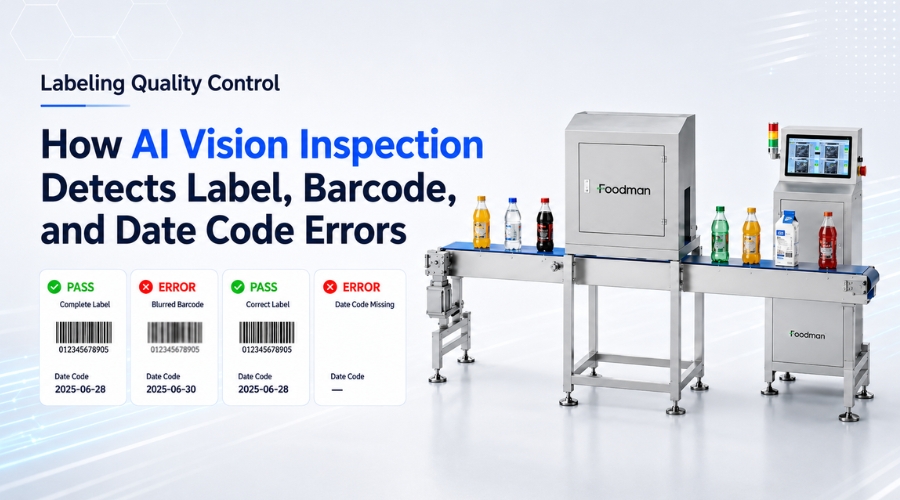
In this piece, we’ll be looking at how AI-driven vision technology detects crucial faults, how it fits smoothly into your existing operational workflows, and why using these tools is critical for modern food producers.
Label inspection goes beyond simply reading the label
Many people assume that label inspection is as simple as running an OCR (Optical Character Recognition) scan to verify text. However, a robust machine vision system for label inspection does far more than that.
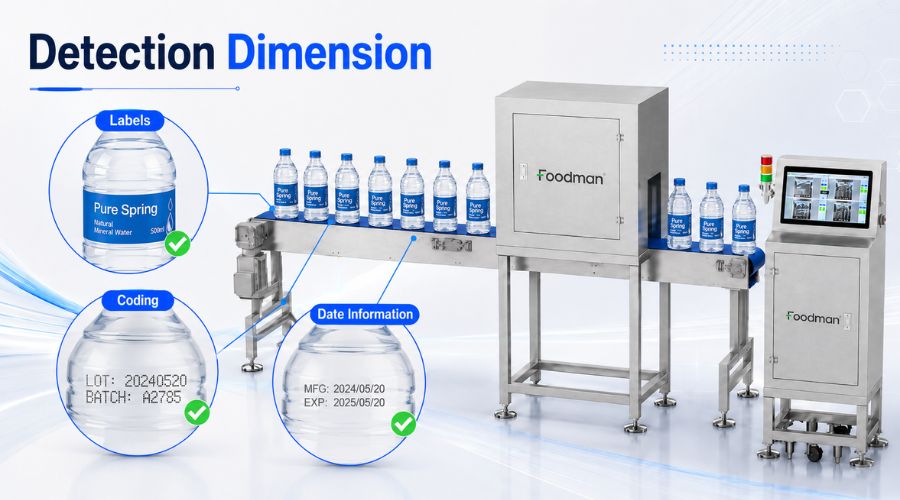
First, there’s the question of label integrity. This includes looking for physical flaws such wrinkles, air bubbles, rips, and misalignment. Even a slightly crooked label might give the impression of carelessness, which undermines consumer trust. More importantly, a missing or partially shredded label may obscure vital allergy information, providing a direct health risk.
Second, barcode and QR code verification involves more than a basic readability check. While ordinary scanners can read barcodes, AI-powered ones can evaluate print quality, contrast, and modulation. They ensure that barcodes are scannable throughout the product’s shelf life, including after refrigeration or handling. A barcode that fails to scan at the checkout might result in lost sales and customer frustration.
Finally, the verification of dates and batch numbers is perhaps the most legally sensitive aspect of labeling. An incorrectly printed “Best Before” date or erroneous batch number could result in a big and costly product recall. AI guarantees that these codes are not only plainly visible, but also logically correct—for example, whether a date has expired or if the format is wrong for the intended market.
Label vision inspection systems ensure that your products meet regulatory requirements as well as consumer expectations by treating the label as a full data package rather than a collection of characters.
How AI-Powered vision Inspection Systems Work
How do machines “know” if a label is correct? The key lies in the combination of high-speed imaging and artificial intelligence.
The Advantage of AI: Learning and Adaptation
In contrast, modern vision systems for label inspection employ deep learning—a subset of artificial intelligence. Instead of simply comparing images against a template, the system learns the characteristics of “good” labels by analyzing thousands of annotated images. This enables the system to detect natural variations in printing and packaging, in addition to discern between acceptable cosmetic faults and major product defects.
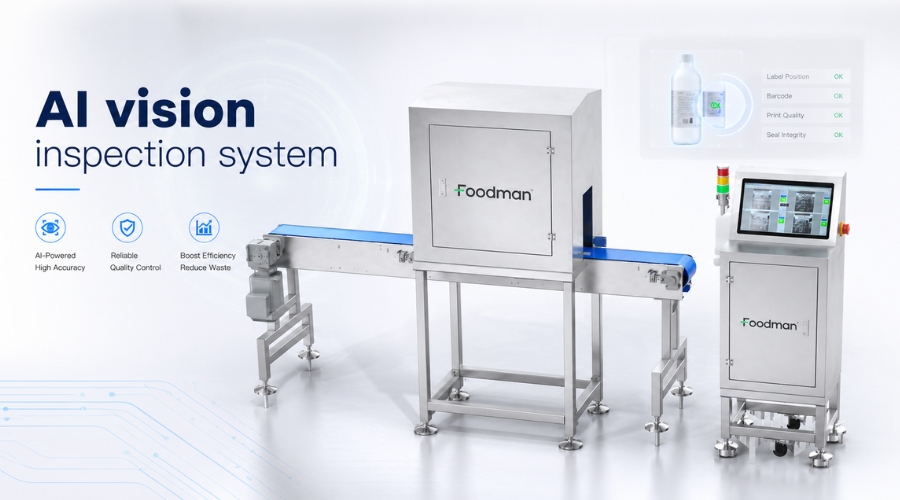
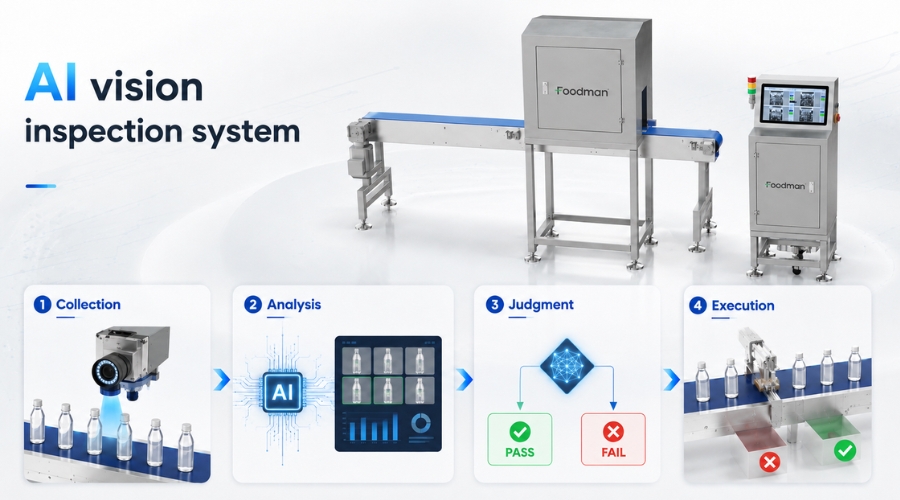
The process usually involves the following steps:
High-speed cameras capture images of products as they move along the vision inspection conveyor.
Preprocessing: The system filters out background noise and uneven lighting.
Inference: A trained AI model analyzes the images within milliseconds, segmenting labels, identifying barcode areas, and locating date code regions.
Verification: The AI performs multiple checks simultaneously. It verifies label placement, decodes and evaluates barcodes, and reads date codes using Optical Character Recognition (OCR).
Action: The system issues pass/fail signals based on configurable confidence thresholds. Products that fail inspection are automatically diverted from the production line.
Unlike traditional rule-based systems that require rigid programming, AI-driven food vision inspection systems continuously improve over time, becoming increasingly adept at distinguishing between acceptable minor deviations and genuine defects.
Integrating Vision Inspection into the Production Line
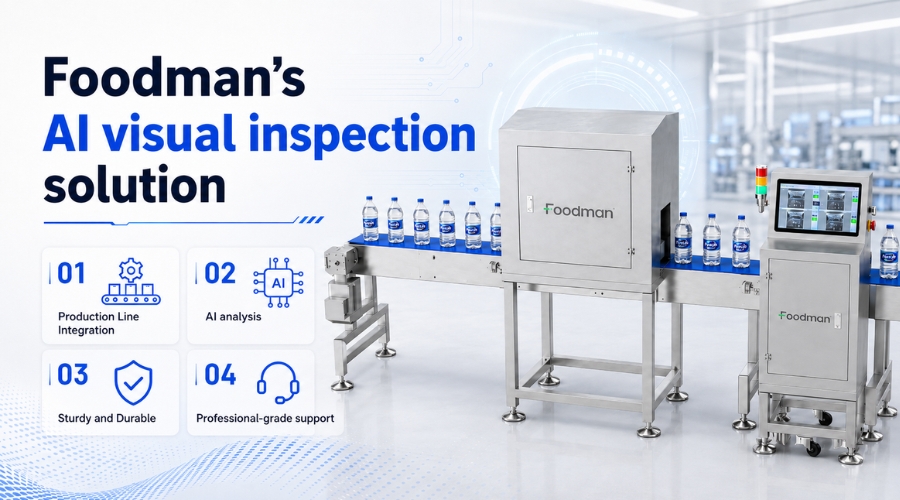
Seamless integration is key to maintaining production efficiency. Foodman’s solutions are designed to serve as modular extensions to your existing systems. Typically, these vision inspection conveyor systems act as a final checkpoint before products reach the secondary packaging or palletizing stages.
Whether you operate a high-speed filling line or a complex snack food production system, our label inspection vision systems are meticulously engineered to synchronize with existing PLC (Programmable Logic Controller) infrastructure. This enables the automatic rejection of non-conforming products, ensuring uninterrupted production flows while maintaining rigorous quality control.
Key Advantages for Food Manufacturers
Implementing an AI-driven vision inspection system for labeling delivers a transformative return on investment, with an impact that extends far beyond the quality control department.
1. Unparalleled Accuracy and Consistency
Humans get tired, distracted, and bored—but AI does not. Vision systems can inspect every product on the production line around the clock without interruption, maintaining the same level of meticulousness at all times. They can detect minute defects invisible to the naked eye, thereby significantly reducing the number of non-compliant products reaching the market.
2. Reduced Waste and Costs
By identifying errors early in the production process, manufacturers can avoid costly rework or product recalls. For instance, if the AI detects that a printer is beginning to fade, it can alert the operator before an entire batch becomes defective. This proactive approach saves materials and minimizes waste.
3. Enhancing Brand Reputation
Nothing damages a brand’s reputation more than a customer purchasing a product with an incorrect label or one that has expired. AI ensures that every product reinforces the brand’s commitment to quality and safety.
4. Regulatory Compliance and Traceability
Food safety regulations—such as the Food Safety Modernization Act (FSMA)—mandate rigorous record-keeping. AI systems generate digital records for every inspection, storing images of non-compliant products and pass rates. This data is crucial during audits, providing concrete evidence of due diligence.
Application in the Food Industry
The versatility of vision inspection conveyor systems allows them to adapt to various sectors of the food industry:
Dairy and Refrigerated Foods
Verifying cap seal integrity while simultaneously checking label placement and barcode readability.
Frozen Foods
Detecting labels that may be affected by condensation or temperature fluctuations during production.
Meat and Poultry
During meat processing, labels can become stained or damaged by fat or blood. Specialized food vision inspection systems utilize specific wavelengths of light and polarizing filters to enhance label images, ensuring that barcodes and expiration dates remain clearly visible and scannable.
Baked Goods and Snacks
These products are often packaged in transparent or high-gloss films. Robust vision inspection systems equipped with spherical lighting eliminate reflections and glare, ensuring accurate verification of printed information on transparent packaging.
Beyond food products, Foodman’s vision inspection systems can also inspect bottled cosmetics and skincare products for label, inkjet code, and seal anomalies, ensuring product consistency and enabling traceable serial number management.
Why Choose Foodman's AI Vision Inspection Solutions
At Foodman, we understand that quality control goes beyond individual components; it is about building a comprehensive safety ecosystem. While we are renowned for our checkweighers, metal detectors, and X-ray systems, the introduction of AI vision inspection perfectly complements our product portfolio.
Production Line Integration Advantages:
Seamlessly connecting Foodman’s vision inspection conveyor systems with existing inspection equipment effectively optimizes production workflows. Centralized management of X-ray, metal detection, checkweighing, and vision inspection systems via a unified platform minimizes interface issues between multi-vendor units and reduces costs associated with training, maintenance, and data management.
AI-Driven Adaptability:
Foodman’s AI deep learning technology rapidly identifies product variations and automatically optimizes inspection parameters. This reduces setup time and enables the production line to respond with greater flexibility and efficiency to diverse products and production requirements.
Rugged Durability:
Engineered to withstand the demanding environments of food production facilities.
Expert Support:
As a leading supplier of inspection equipment, we provide the localized support and technical expertise necessary to ensure smooth production line operations.
By choosing Foodman’s label vision inspection system, you are not merely purchasing hardware; you are selecting a partner dedicated to helping you achieve operational excellence.
Conclusion
The era of manual vision inspection and traditional machine vision based on rigid rules is drawing to a close; artificial intelligence has become a cornerstone of modern manufacturing. By adopting advanced AI-powered label inspection systems, food manufacturers can effectively ensure consumer safety, safeguard brand reputation, and enhance economic performance.
From label positioning and barcode quality analysis to the verification of production dates and batch information, AI-based vision inspection enables enterprises to detect packaging defects with greater precision and elevate their product quality management.
Foodman specializes in the R&D of intelligent inspection technologies, providing efficient and reliable vision inspection solutions for food and manufacturing enterprises. Our systems integrate seamlessly into existing production lines, helping brands boost production efficiency and quality control capabilities while laying a solid foundation for future growth.
Frequently Asked Questions
Yes. Our label vision inspection systems are designed for high-speed throughput and can be integrated into virtually any production environment.
Yes. Modern label vision inspection systems utilize specialized lighting techniques (such as hemispherical or coaxial lighting) and advanced algorithms to eliminate glare, ensuring clear code reading on reflective surfaces or transparent films.
Certainly. Our deep expertise in automatic checkweighers and X-ray inspection equipment gives us a unique advantage in seamlessly integrating food vision inspection systems into your existing production processes.