Introduction: Why Quality Inspection Is Crucial for the Cosmetics Industry
Product quality is no longer simply a customer’s expectation in today’s highly competitive beauty and personal care market; it has become a legal requirement and an essential element of brand survival.
Here is increasing demand on modern skincare manufacturers to deliver perfect goods while following stringent laws pertaining to product safety, labeling, packaging, and traceability. Product recalls, fines from authorities, bad reviews, and large financial losses can result from problems including contamination, missing labeling, leaking caps, or incorrect packing.
Based on industry data, a substantial number of consumer complaints in the cosmetics industry globally are connected to product flaws. Many of these issues are triggered by production line discrepancies rather than formulation defects and are difficult to reliably detect through traditional manual inspection.
For this reason, vision inspection procedures for cosmetics and skincare items have become essential.
Manufacturers may attain nearly 100 percent inspection coverage while increasing quality assurance and regulatory compliance by integrating advanced cameras, intelligent lighting, machine learning algorithms, and real-time image processing technology.
What is a vision inspection system?
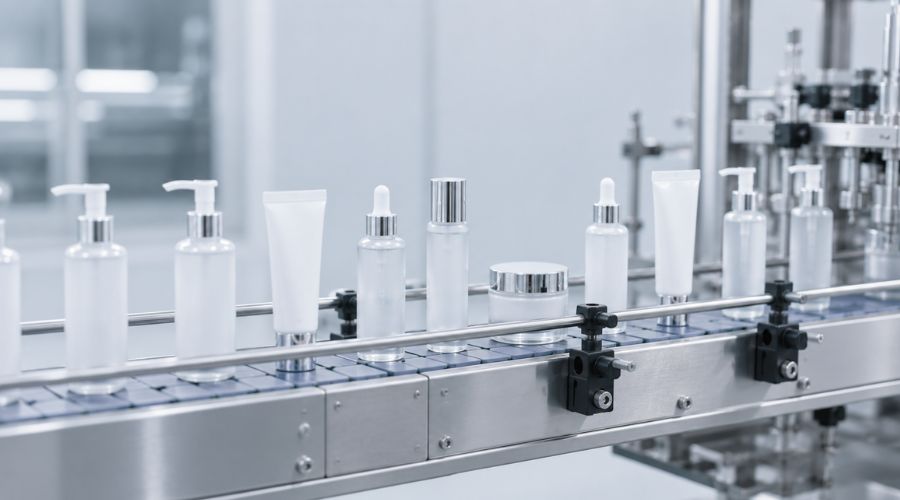
A vision inspection system is an automated quality control method that uses high-resolution sensors, industrial-grade optics, and artificial intelligence (AI) algorithms to evaluate physical objects in real time. It serves as an uncontrollable inline quality inspector for production managers and as a platform for verifiable quality data for quality assurance (QA) supervisors.
The main components of a typical vision inspection system are as follows:
Industrial webcams with high resolution: Correctly capture product details
A uniform LED lighting system: guarantees imaging stability.
Hardware for collecting and processing image data: allows the transmission of data at high speeds
AI inspection software: automatically detects defects like contamination, deformations, and scratches
Automatic rejection mechanism: instantly intercepts non-conforming products.
Data traceability module: Fully records faulty and batch data
The technology automatically rejects defective products before they reach the consumer by doing image capture and intelligent analysis in milliseconds as products—like skincare items—move quickly along the production line. Before a product is ever delivered to a customer, it is automatically identified and rejected.

Why Vision Inspection Is Becoming Essential in Cosmetics Manufacturing?
Requirements of regulatory compliance are getting stricter.
Production line capacities and speeds continue to be increasing.
It is a severe labor shortage in the manufacturing industry.
End-to-end traceability has grown more and more essential for brands.
Consumer demands for superior, flawless goods are always growing.
Given this, AI-powered vision inspection systems have become a crucial tool for cosmetics manufacturers looking to boost production, reduce rework costs, and build brand trust.
What defects are evident to skincare product inspection systems?
Skincare product vision inspection systems are now able to cover nearly all visible quality risk points, enabling comprehensive in-line inspection for bottled, pump-dispensed, and tube-packaged products, as the cosmetics industry places increasing demands on quality control and regulatory compliance.
Cap and Seal Defect Inspection
The condition of the cap directly affects product seal integrity and transport safety. The system accurately detects:
Missing, tilted, or loose caps
Improper sealing or missing induction seals
Damaged pump heads or incorrect colors
Cap alignment is frequently seen as a crucial vision sign of quality for luxurious serums and lotions.
Verification of Information and Label Compliance
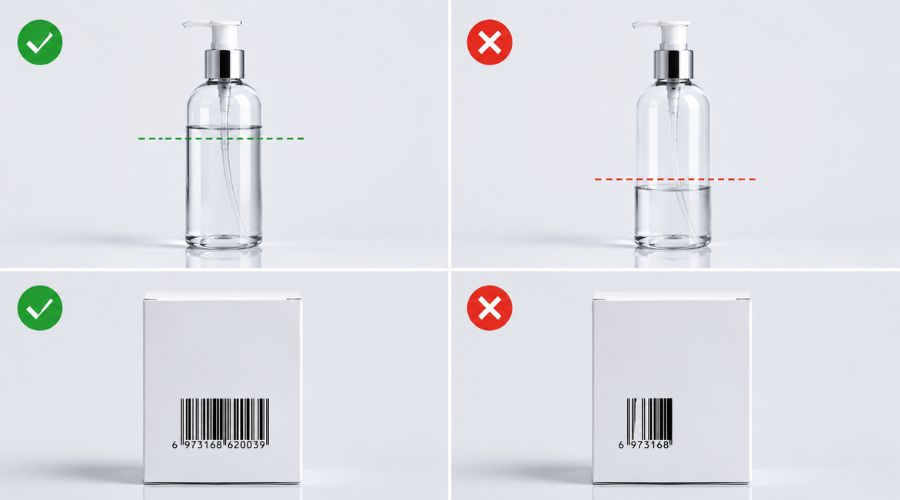
For cosmetics, label errors are the primary cause of compliance issues; label vision inspection systems of skincare can automatically confirm the following:
The presence of standardized labels, their correct position, alignment, and lack of wrinkles
Barcode and QR code readability and accuracy
Batch numbers and expiration dates are typical instances of character-based information (using OCR).
Consistency of Fill Level and Volume
To ensure a positive consumer experience and control costs, the system performs real-time monitoring of:
Liquid levels and cream fill volumes
Air bubbles, empty containers, or uneven filling
Fill volume consistently in transparent containers.
Detection of Packaging Appearance Defects
In the skincare industry, appearance is synonymous with the brand; the system can detect issues such as the following:
Scratches, dents, or cracks on the bottle body
Surface contamination or printing defects
Color deviations and gloss irregularities
Any appearance defect that affects consumer perception results in automatic rejection.
Seal Integrity and Tamper-Evidence Inspection
Skincare products containing active ingredients rely heavily on secure sealing; the system can detect the following:
Aluminum foil seal positioning and integrity
Condition of tamper-evident rings and sealing films
Risks of seal damage or contamination
Barcode, serial number, and traceability verification
In order to comply with legal and anti-counterfeiting responsibilities, cosmetic packaging inspection vision systems can confirm:
QR codes, Data Matrix codes, and GS1 barcodes
Batch details, production dates, and serial numbers
This enhances product traceability and offers data to help in market regulation and brand protection.
Compliance Rules for Manufacturers of Cosmetics
The US FDA, EU Regulation (EC) No 1223/2009, and ISO 22716 (GMP) all place strict criteria on product safety, labeling accuracy, and end-to-end traceability. Global cosmetics rules are growing increasingly stringent.
Regulatory warnings, fines, or even market restrictions can arise from errors in ingredient labeling, production records, or package information.
Why Manual Inspection Falls Short of Compliance Requirements
Although ISO 22716 allows for manual vision inspection, it also mandates:
Keeping thorough records of inspection
Putting in place staff rotation plans to avoid oversights caused by fatigue
Manual processes are finding it difficult to achieve high speed, zero omissions, and data traceability at the exact same time in real production.
How do vision inspection systems facilitate regulatory compliance?
Vision inspection systems deployed on skincare production lines directly support compliance management in the following ways:
Label and information verification: Automatically checking ingredient lists, volumes, “Period After Opening” (PAO) symbols, batch numbers, and barcodes/QR codes to prevent compliance risks caused by tiny fonts or blurred printing.
Process control and documentation: Every inspection generates an audit-ready digital log—including timestamps, images of defects, and product batch details—thereby meeting GMP requirements for documentation and traceability.
Consistent, reliable inspection: Unlike human inspectors, the system does not suffer from fatigue or subjective judgment variability, ensuring that every product leaving the factory meets regulatory and brand standards.
In the current regulatory landscape, vision inspection systems serve not merely as quality control tools but as vital infrastructure enabling cosmetics companies to mitigate compliance risks and improve audit success rates.
How Vision Inspection Systems Facilitate Cosmetics Compliance
Can vision systems reduce compliance risk? Certainly.
One of the greatest advantages of automated inspection is consistency. Unlike human operators, machine vision system for automatic inspection do not suffer from lapses in attention, fatigue, or operational instability during prolonged production runs.
1. Detect defects in real-time to prevent batch-wide incidents
While traditional methods often identify issues only after the fact, a vision inspection system can issue an alert the moment a defect appears, such as
Slightly misaligned labels
Blurred or missing printed codes
Misaligned caps or sealing irregularities
For instance, if a label vision inspection systems of skincare drifts out of alignment, the system can detect the issue and trigger an alarm within seconds, preventing thousands of defective units from proceeding to the next stage of production.
2. Automated documentation for effortless audits
Regulatory audits now focus as much on process records as on final results. vision inspection systems automatically generate:
Inspection logs and defect statistics
Batch reports and production history
Archived images of defects
These traceable electronic records significantly reduce the difficulty and stress associated with compliance audits.
3. Enhance Product Traceability
Global regulatory requirements for batch traceability are becoming increasingly stringent. Vision inspection systems can verify and record the following in real time:
Batch numbers and production dates
Product codes and serial numbers
Barcode and QR code data
In the event of a quality issue, companies can rapidly identify the specific batch and execute a precise recall, thereby minimizing losses and limiting the scope of the impact.
4. Eliminating human error and adapting to high-speed production
When production line speeds exceed 300 bottles per minute, the accuracy of manual inspection drops significantly.
In contrast, vision inspection systems maintain consistent performance:
They do not suffer from fatigue, lapses in attention, or emotional influence.
They are unaffected by day/night shifts or shift changes.
They maintain high precision even at high production rates.
A vision inspection system is far more than just a cosmetics quality control tool; it’s a vital component of infrastructure that helps firms deal with requirements like ISO 22716 (GMP), EU Regulation (EC) No 1223/2009, and FDA rules. It is becoming a normal strategy for skincare manufacturers to reduce risk and increase audit success rates in the face of increasingly strict regulatory oversight.
Real-World Production Application
Case Study 1: Facial Serum Packaging Line
For example, a high-end skincare manufacturer frequently received customer complaints.
At a production speed of 180 bottles per minute, manual inspectors could not reliably detect these defects.
After installing a machine vision system for automated inspection:
Labeling defects were reduced by over 90%.
Packaging-related complaints dropped significantly.
Rework costs decreased.
Brand reputation improved.
Case Study 2: Moisturizer Jar Inspection
Similarly, a cosmetics manufacturer exporting to Europe required stricter compliance controls.
The company implemented a multi-camera vision system for cosmetics packaging inspection to check for the following:
Lid alignment
Fill levels
Label positioning
Batch code printing
The results improved audit readiness and significantly reduced the volume of non-compliant shipments.
Case study 3: Sunscreen hose production
Likewise, a high-speed sunscreen manufacturer struggled with printing inconsistencies.
Using AI-driven cosmetic defect inspection technology, the manufacturer detected:
Missing printing
Blurred text
Incomplete identification
Date code error
The detection accuracy is greatly improved while reducing manual requirements.
What are the most recent advances in the field of cosmetic vision inspection?
Care quality control is going to become more advanced in the future. In addition to addressing complicated flaws that conventional techniques are unable to handle, AI-driven vision inspection solutions assist businesses in overcoming three significant obstacles: labor shortages, more stringent compliance regulations, and the shift to smart manufacturing.
Artificial Intelligence and Deep Learning
Traditional rule-based detection methods struggle to handle complex defects. AI-driven systems can learn from defect samples and improve detection performance over time. This is particularly useful for surface blemishes, packaging variations, reflective materials, and decorative containers.
360-Degree Comprehensive Inspection
Manufacturers increasingly require full product visionization. Multi-camera systems can now inspect the following:
Front
Back
Sidewalls
Bottom surface
Closure assemblies
This ensures comprehensive quality verification.
Smart Factory Integration
Industry 4.0 initiatives are driving the integration of:
Vision systems
MES platforms
ERP software
Production analytics
Inspection data is becoming a valuable source of operational intelligence.
Conclusion
“How quickly can I intelligently upgrade my existing production lines?” is now the central question instead of “Should I invest in a vision inspection system for skincare and cosmetic products?”
Manufacturers may improve product quality, reduce customer complaints, improve compliance, and increase operational efficiency with the use of modern vision inspection systems for skincare and cosmetics.
Machine vision technology is now an essential component of advanced skincare manufacturing, from label verification and fill-level monitoring to cosmetic defect inspection and traceability management.
Today, companies that invest in smart inspection technology are doing much more than just avoiding defects; they are protecting consumer interests, enhancing brand perceptions, and building a strong basis for long-term success in the fiercely competitive global cosmetics market.
FAQ
Using cameras and artificial intelligence (AI) software, a vision inspection system for skincare items is an automated quality control solution that checks cosmetics for flaws, labeling mistakes, packaging problems, and regulatory compliance.
Indeed. A variety of faults, including dents, scratches, missing caps, damaged seals, printing errors, and misaligned labels, can be found by modern vision inspection techniques for cosmetic packaging.
Of course, while retaining incredibly high inspection accuracy, several vision inspection systems are able to process hundreds of goods every minute.