Introduction
Consumers pay more attention to healthy diets. Meanwhile, meat quality standards continue to become stricter. As a result, fat content has become an important factor in meat production. Fat content affects taste, texture, and flavor. It also influences product formulation, nutritional value, production costs, and retail prices. The ratio of fat to lean meat is a key indicator of product consistency.
Lean Meat Percentage (LMP) represents more than a product specification. It directly affects raw material pricing and purchasing decisions. LMP affects the sensory quality of finished meat products. It also supports nutritional labeling compliance. Consistent LMP helps processors maintain the same formulation across production batches.
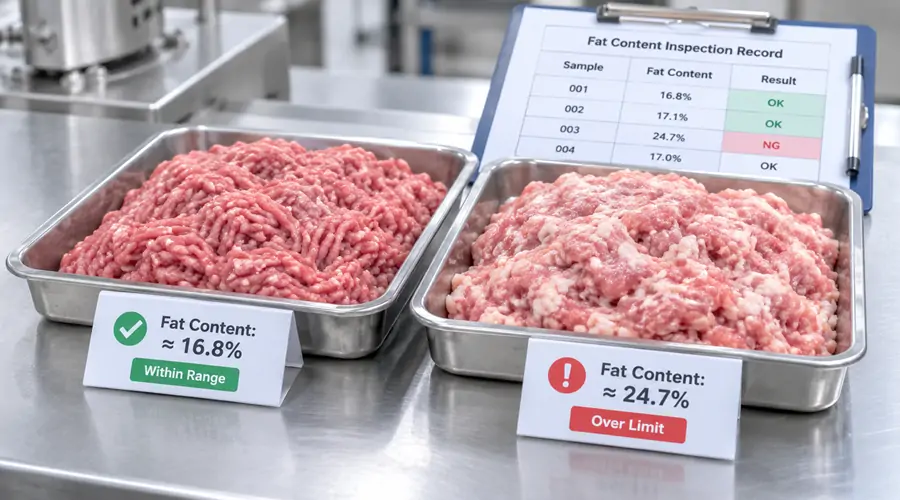
Traditional meat fat analysis usually involves manual sampling and laboratory testing. These methods provide reliable data, but they take time and destroy the tested samples. They also prevent manufacturers from inspecting every product continuously. In other words, it can’t give you a continuous, real-time picture of how raw material composition shifts on the production line.
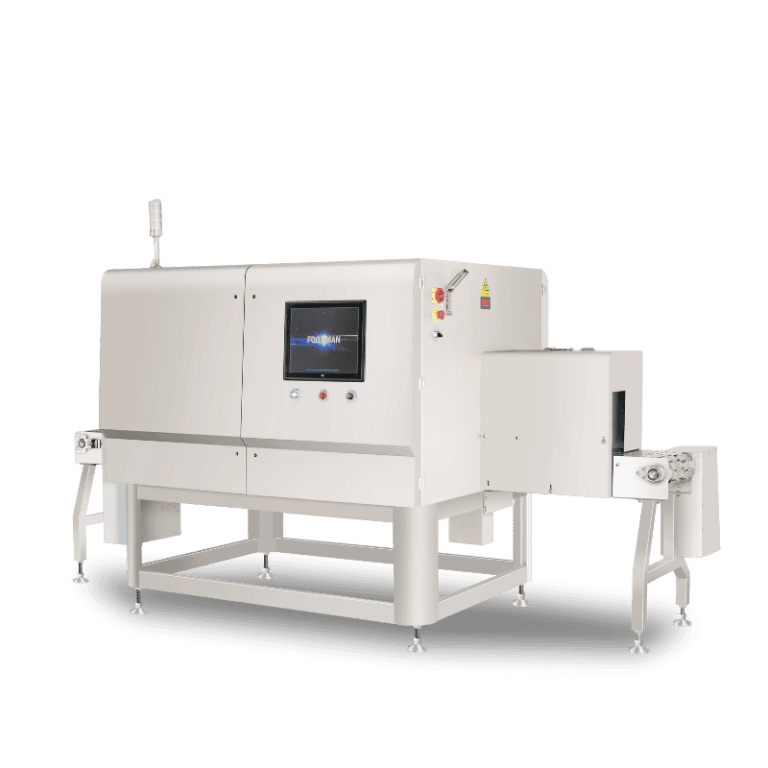
The Foodman inline fat analysis x-ray inspection system tackles this problem head-on. Meat passes through the inspection tunnel for rapid X-ray scanning. The system analyzes its composition and provides real-time fat content data throughout production. Processing facilities can then monitor the fat-to-lean ratio of their raw meat ingredients instantaneously.
Why is in-line fat analysis necessary for meat products?
Fat content plays an important role in meat processing and retail. It affects ground meat, sausages, and fresh meat products. It also influences product quality, production costs, regulatory compliance, and consumer confidence. Traditional off-line testing often struggles to meet modern production requirements. As a result, more meat processors now need in-line fat analysis to monitor product composition continuously.
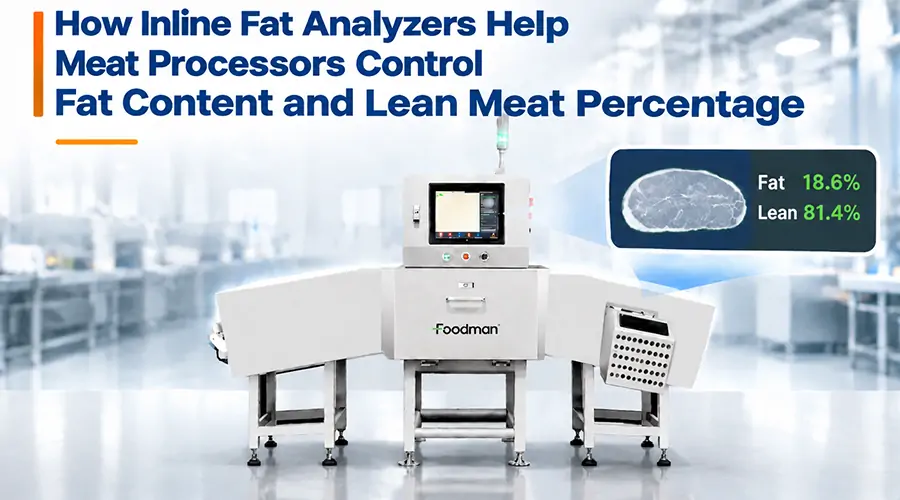
Sausage and minced meat production requires precise fat-to-lean ratios. Each formulation needs to meet specific product requirements. Excess fat can cause oil separation during processing. It may also create a greasy texture, reduce product yield, and shorten shelf life. Too little, and the product turns out dry and tough—no flavor, no elasticity. Raw meat naturally contains varying amounts of fat. Composition differs between animal species and carcass cuts. It can also change from one batch to another. Offline sampling and laboratory testing take time. By the time technicians receive the results, processors may have already processed a large batch of meat.
When the fat-to-lean ratio falls outside the target range, the entire batch may require reworking or even disposal, leading to substantial material loss. An in-line fat analyzer measures the lean-to-fat ratio in real time before further processing. Processors can use real-time data to adjust meat blending. This helps maintain consistent fat content across batches. It also supports uniform sausage texture and product specifications. More accurate formulation reduces unnecessary use of high-value lean meat.
Consumers increasingly pay attention to fat-to-lean ratios when buying fresh meat. This trend is particularly evident in supermarkets and fresh food retail stores. They increasingly want those ratios clearly labeled on fresh cuts and ground meat. Problem is, fat content can vary significantly between different cuts within the same category. Human visual estimation often gets it wrong, and standards end up inconsistent. Labels don’t match the actual product. Customer complaints follow.
Supermarkets also tend to price by tier based on fat-to-lean ratio—so that ratio directly sets the retail price. In-line meat fat analysis provides fast, non-destructive measurements of the fat-to-lean ratio. Retailers can use this data to support product grading and pricing. This allows retailers to grade fresh cuts and packaged ground meat more consistently. Clear labels also help consumers understand nutritional information and product specifications. Retailers can also sort products by fat content. This supports quality-based pricing and reduces manual grading errors.
In summary, whether it stabilizing formulations and reducing production losses in meat processing, or ensuring standardized grading and transparent labeling in retail, online fat analysis delivers real-time, continuous, rapid testing. It reduces the delays associated with laboratory testing. Continuous measurement also provides more production data than occasional manual sampling. The result: reliable data that supports precise control of fat-to-lean ratios in ground meat and sausage processing, and in fresh meat retail too.
How Meat Fat Analysis Systems Work
Foodman developed its Fat Analysis X-Ray Inspection System specifically for in-line meat fat analysis. The system uses dual-energy X-ray technology to analyze meat composition. It also applies specialized data processing models to estimate fat content. Dual-energy X-ray technology plays an important role in modern in-line meat fat analysis.
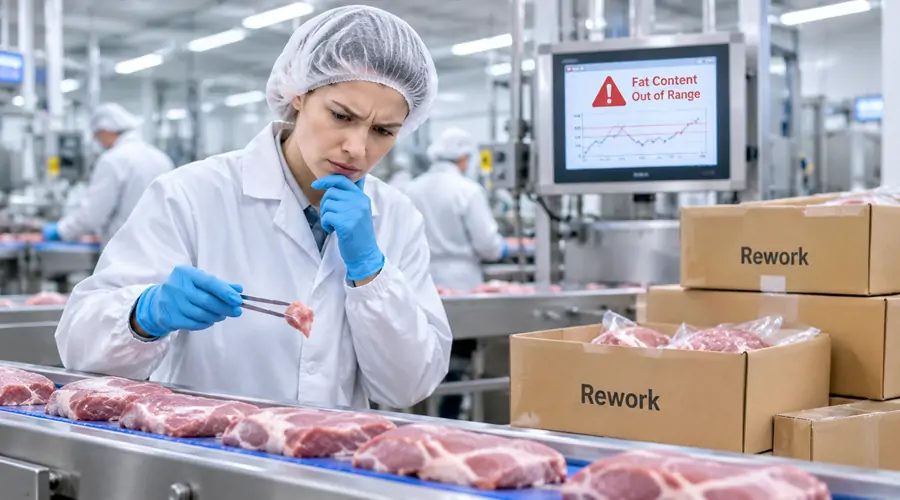
While many people associate single-energy X-ray systems mainly with foreign object detection. What they may not realize that such technology—specifically in its dual-energy form—can also be used for the precise analysis of fat content in meat. The principle behind dual-energy X-ray technology lies in the fact that X-rays of different energy levels attenuate (weaken) to varying degrees when passing through a substance. Fat tissue and lean tissue differ in chemical composition and physical properties. So when exposed to high- and low-energy X-rays, they show distinct absorption and attenuation characteristics.
In a production environment, meat products move at a constant speed along a conveyor belt through the inspection tunnel. An X-ray source emits high-energy and low-energy X-rays at the same time. As the rays pass through the meat, a detector captures the transmission signals and relays them to the system for analysis. By examining the relationship between these two sets of signals—and applying validated algorithmic models—the system estimates the fat content inside the meat products.
Compare that to standard single-energy X-ray inspection. Dual-energy systems use two energy levels to analyze material composition. This approach makes them more suitable for quantitative fat-to-lean analysis.
The whole inspection process is fast and non-destructive. No physical sampling of the meat is needed. The system uploads measurement data in real time. Production teams can use these results for raw material grading, recipe adjustments, and quality control.
Applications of In-Line Fat Analyzers in Meat Processing
Ground Meat and Minced Meat Production
The production of ground and minced meat is a primary application for in-line fat analyzers. Products often call for specific lean-to-fat ratios—80/20 or 70/30, for example. tYet in actual production, the fat content of raw materials can be highly inconsistent, varying significantly from one piece of meat to another.
Processors can install an in-line fat analyzer after the meat grinder or along a downstream mixing conveyor. The system then monitors fat content continuously. Operators then adjust the lean-to-fat ratio based on real-time data. Deviations caused by raw material variability get minimized. The final product’s fat content stays closely aligned with established specifications.
Sausages and Emulsified Meat Products
Emulsified sausages are highly sensitive to the ratio of fat to protein. That ratio doesn’t just determine the product’s nutritional profile. It also influences emulsification stability and texture. In this context, the value of in-line analysis lies not only in controlling total fat content but also in detecting anomalous fluctuations between batches—for instance, an unusually high fat content in a specific batch of raw materials could indicate an issue with a supplier or during the thawing process.
Patties, Meatballs, and Other Formed Products
Formed meat products, such as patties and meatballs, generally require a relatively consistent formulation. Consumers are highly sensitive to the sensory attributes of these products. Any significant fluctuation in fat content can can produce noticeable differences in flavor, texture, and overall product consistency.
Put an in-line meat fat analyzer after the mixing stage but before the forming equipment, and you can monitor the meat mixture continuously as it’s conveyed. Production staff can use these real-time results to verify whether the current formulation falls within the target range and make timely adjustments to subsequent ingredient additions. Better control over fat levels throughout the process. Less variability between batches of finished product.
Processing and Retail Sale of Shredded Meat, Sliced Meat, and Pork Belly
Shredded meat, sliced meat, pork belly—these products are everywhere in supermarket fresh sections, at chilled meat counters, in the pre-packaged meat market. They’re typically cut and portioned based on specific meat cuts, fat-to-lean ratios, or product specifications; consumers often prioritize appearance and the distribution of fat and lean meat when making purchasing decisions.
Meat processors can install in-line fat analyzers on conveyors after slicing or shredding. As meat passes along the line, the system measures fat content, helping businesses monitor fat-to-lean ratios across different batches and cuts. For instance, since the fat-to-lean ratio of pork belly directly influences product grading and market positioning, the data provided by these analyzers can serve as a valuable reference for raw material grading, product categorization, and the determination of packaging specifications.
Scope of Application and Limitations
In-line fat analysis isn’t right for every scenario. Measurement accuracy may be compromised when dealing with samples that have extremely low or highly uneven fat content, composite products containing significant non-meat additives, or processes where the thickness of the product varies drastically during transport. When choosing equipment, be honest about your specific product composition. If necessary, verify suitability through on-site testing.
How In-Line Fat Analysis Helps Meat Processors Optimize Production
For meat processors, in-line fat analysis offers more than a simple fat-content reading. Its real value comes from using measurement data to guide production decisions. For meat processing and quality control, the provision of real-time, continuous, and traceable compositional data addresses a long-standing challenge in traditional operations: the issue of information lag.
Precise Control of the Lean-to-Fat Ratio
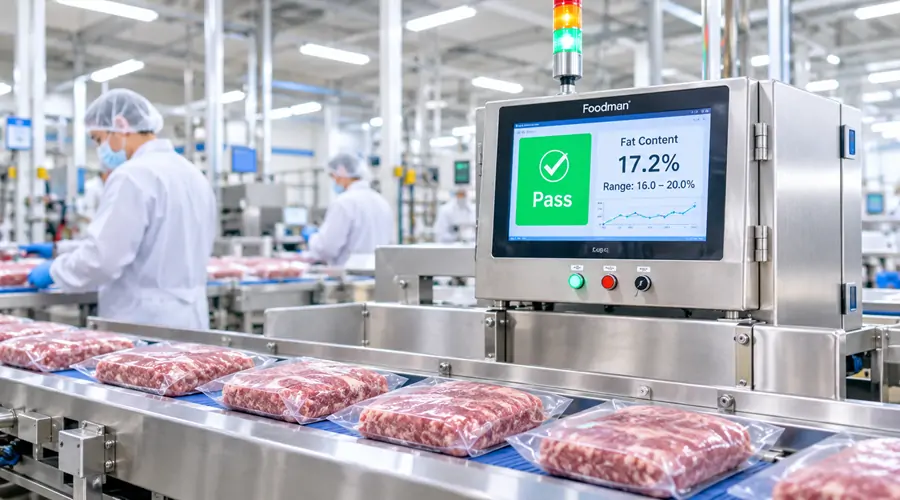
Traditional formulation methods often rely on historical data, human experience, or reference values provided by raw material suppliers. Raw material composition doesn’t stay constant. When it shifts, a fixed recipe can stop meeting product specs. That’s where in-line fat analysis for meat comes in: it measures the lean-to-fat ratio directly, so formulation adjustments can rest on data rather than guesswork.
Maximizing Raw Material Utilization and Reducing Waste
For meat processing plants, raw material utilization is a critical metric—especially when filling orders for different distributors. If a batch comes in with too much fat, lean meat has to be added to hit the right balance. Reverse situation: only lean meat is on hand, but the spec calls for a particular lean-to-fat ratio—then fat has to be added accordingly.
Without accurate analytical data, production staff may over-trim or make overly cautious adjustments. Either way, usable raw material gets wasted. And with high-value meat products, even small reductions in unnecessary trimming or small formulation deviations can add up to significant economic gains over the long term.
Ensuring Batch-to-Batch Consistency
Fat levels in raw meat bounce around constantly from one batch to the next. Miss those shifts early, and your final lean-to-fat ratio is toast. Running continuous checks right on the line lets QC teams size up incoming meat as it moves, catch anything out of spec, and tweak the blend on the fly. Furthermore, the ability to retain comprehensive batch data provides verifiable documentation for customer specification audits—a critical capability for meat processors supplying standardized products to major food brands, retailers, and foodservice supply chains.
Reducing Manual Sampling and Enhancing Inspection Efficiency
While manual sampling remains an essential quality control measure, it is inherently limited to spot checks and cannot cover the entire volume of material. In-line meat inspection systems connect directly to conveyor lines. They collect continuous data without stopping production. Compared to off-line laboratory testing, in-line inspection provides faster feedback and ensures that the meat products remain intact for sale. Before buying anything, just make sure the gear fits your actual setup—look hard at real-world throughput, belt speed, and how it handles your product flow.
How to Choose the Right In-Line Meat Fat Analyzer
Meat processing enterprises vary in terms of raw material types, production scale, and testing requirements. When selecting an in-line meat fat analysis system, one should look beyond the mere ability to display fat percentage; factors such as measurement stability, production line compatibility, data management, and long-term maintenance must also be considered.
Selecting the Appropriate Technology
Dual-energy X-ray fat analysis systems for suitable most types meat; however, their measurement results can be influenced by factors such as the physical form of the meat, its temperature, the uniformity of fat-to-lean distribution, and its thickness. It is essential to evaluate the system based on the specific characteristics of the material being tested—ideally through actual testing. It should be noted that a manufacturer’s stated accuracy specifications may not apply uniformly to all meat products; therefore, the actual accuracy must be verified using samples of the specific products intended for processing.
Integration with Production Lines and Data Traceability
An in-line meat fat analyzer shouldn’t just sit there on its own. It needs to work as part of the production line—its data output feeding straight into production management. For instance, by connecting the analyzer to a production management system, facilities can achieve batch recording, track testing results, and receive alerts regarding anomalies.
Hygienic Design and Maintenance Costs
Meat processing environments are typically characterized by high humidity, the presence of fats and oils, and the need for frequent cleaning. Consequently, the hygienic design of equipment is directly linked to both food safety and daily operational maintenance. Equipment built with hygienic materials and structural designs helps eliminate hard-to-clean “dead zones,” reduces the risk of cross-contamination, and simplifies the process of passing various audits.
When it comes to maintenance costs, never rely solely on the initial purchase price. Consider factors such as: How frequently do sensors require cleaning? How often do wear-and-tear parts need to be replaced? How much effort is involved in calibration? And how quickly does the manufacturer respond if the equipment breaks down? These long-term expenses often exceed expectations. When selecting equipment, it is essential to account for both hygienic compliance and total life-cycle maintenance costs to avoid a situation where the equipment is “affordable to buy, but too costly to maintain.”
Foodman In-Line X-Ray Inspection Solutions
For meat processors, fat content control and food safety aren’t two separate jobs. Processors must also prevent foreign objects from entering the production line. Common contaminants include metal fragments, bone shards, glass, and stones.
Foodman specializes in food quality inspection and automated quality control equipment. Our product portfolio includes a wide range of in-line inspection systems:
X-Ray Inspection Systems: detect foreign objects and analyze product composition.
Metal Detectors: catch metallic contaminants in food products.
Checkweighers: dynamic, in-line weight verification.
Vision Inspection Systems: inspect labels, production dates, product appearance, packaging defects.
Sorting Equipment: sort products by weight, dimensions, or appearance.
For meat processing applications, Foodman doesn’t just pull a standard X-ray configuration off the shelf. Every application is different. The right solution depends on the product type, what you’re actually trying to inspect, and how the production line runs.
By strategically integrating in-line inspection, check weight control, and foreign object detection, meat processors can build a comprehensive, automated quality management system that covers everything from raw material inspection and processing stages to final product quality.
Conclusion
Fat content matters to modern meat processors on several fronts. It shapes taste and final product quality, sure—but it also drives raw material utilization, formulation stability, and production costs. While traditional laboratory testing provides valuable reference data, it is often insufficient for continuous production environments, where manual sampling makes it difficult to track fluctuations in raw material composition in a timely manner.

In-line fat analyzers combine dual-energy X-ray technology with specialized meat analysis models. The system compares X-ray attenuation at different energy levels to estimate the fat-to-lean ratio. This enables enterprises to obtain testing data in real time.
Beef trimming, pork processing, blending of ground meat, prepared meat products—across all of these, in-line fat analysis supports raw material grading, formulation adjustments, product consistency management, and production efficiency optimization.
For meat processors advancing toward automation and digital transformation, selecting a fat analyzer tailored to their specific products and production conditions represents more than just the addition of a quality control step—it is a crucial move toward establishing a refined, data-driven production management system.
FAQ
An in-line meat fat analysis system is inspection equipment used during the production process to measure the fat content of meat. Some specialized systems utilize dual-energy X-ray technology; by analyzing the differences in attenuation between X-rays of different energy levels, these systems calculate the fat-to-lean ratio of the meat—all without damaging the product.
Common applications include various raw meat materials—such as beef and pork—as well as certain frozen meat cuts. The specific scope of application depends on factors such as the equipment design, maximum inspection thickness, product temperature, physical form of the material, and the analytical models used; suitability should be confirmed through testing with actual samples.
The two serve different purposes. In-line fat analysis is designed for real-time monitoring during continuous production, providing a broader range of production data. Laboratory testing, by contrast, is better suited for reference analysis, method validation, and periodic quality verification.