Introduction
In food production, packaging serves not only to protect the product and showcase the brand but also to convey essential information—such as product name, ingredients, allergen declarations, production dates, shelf life, batch numbers, and barcodes. Any missing, misaligned, or illegible label information directly impacts product quality management and increases the risk of product recalls; in more severe cases, it can even trigger a crisis of consumer trust in the brand.
As food packaging lines evolve toward higher speeds, greater automation, and increased product variety, traditional manual spot-checking is no longer adequate. Manual vision inspection system is inherently limited by human visual acuity and the inability to maintain sustained attention; it struggles to reliably detect subtle defects on high-speed conveyor lines. Furthermore, because spot-checking covers only a tiny fraction of total output, it carries a high risk of missing defects and lacks consistency. Over time, human eye fatigue can also lead to misjudgments and a “drift” in inspection standards.
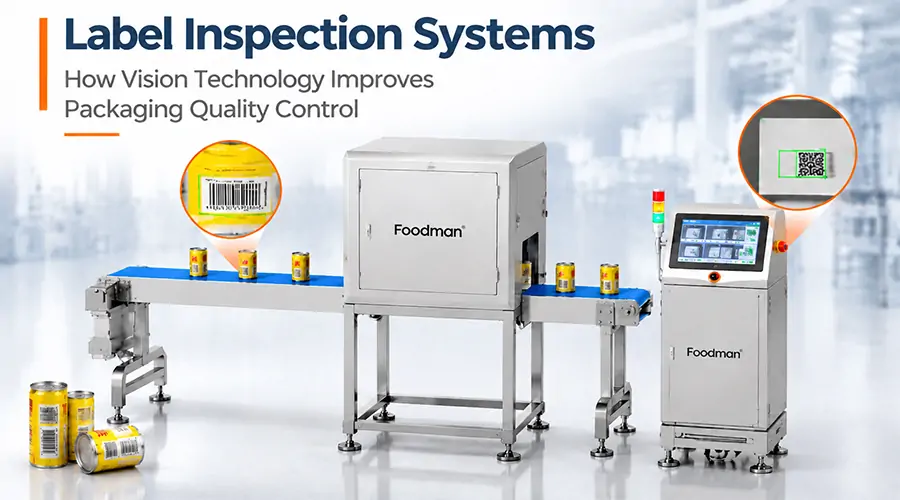
For these reasons, label inspection systems based on machine vision technology are becoming a critical component of quality control frameworks for food manufacturers.
What Is Label Quality Control?
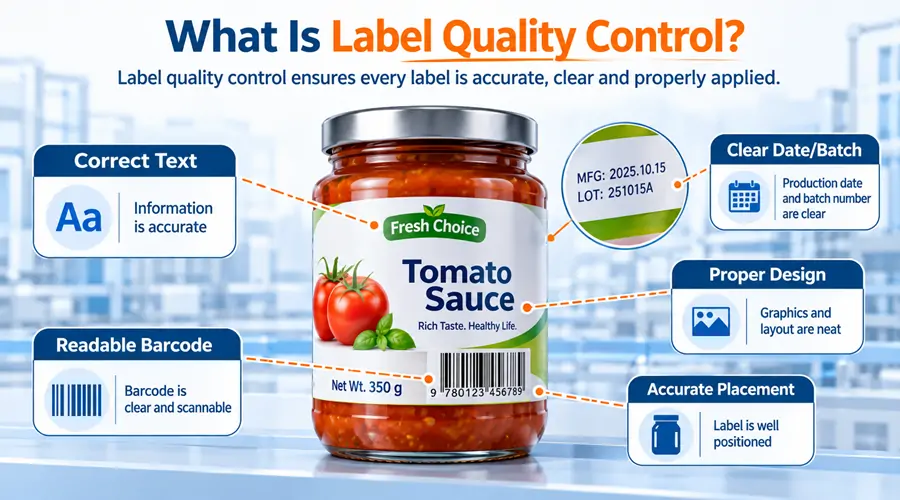
In the context of product labeling and packaging, label quality control is critical—not only for the product’s appearance but also for the accuracy of product information and downstream traceability. During production, issues such as missing labels, misaligned placement, surface wrinkles, or unclear printing can occur. The mere presence of a label on a product does not guarantee that it meets quality standards. Consequently, label quality control generally encompasses two key aspects: label inspection and label verification.
Label inspection focuses primarily on the physical appearance and print quality of the label itself. Inspection systems verify that the label is correctly applied and positioned according to specifications, while also checking for damage, wrinkles, stains, or missing content. On high-speed packaging lines, such defects can arise during continuous operation; relying solely on manual spot-checks makes it difficult to detect subtle flaws on individual products in a timely manner.
Label verification, by contrast, focuses on the accuracy of the information contained on the label, rather than just its physical integrity. This includes ensuring that the ingredient list matches the specific SKU, that allergen information is present, and that production dates, expiration dates, and batch numbers align with the production order.
For packaging that utilizes barcodes or QR codes for identification, verification also ensures that this data can be accurately read by scanning equipment or production management systems. A clearly printed label does not necessarily contain correct information—which is precisely why label verification is an indispensable component of quality management.
These two processes are complementary: inspection addresses whether a label “looks correct and complete,” while verification addresses whether the label’s content “is what it ought to be.” A robust label quality control system requires the synergy of both, ensuring comprehensive risk coverage throughout the entire process—from the receipt of printed labels to the final application on the finished product.
Why Label Verification Is Crucial in Food Production and Packaging
Label verification goes beyond simply checking whether a label has been applied correctly or if it is complete; it ensures that the information on the label is accurate and that the packaging aligns with the requirements of the specific production run. For food manufacturers, labeling errors can lead to significant complications.
Compliance and Recall Risk Mitigation: Mislabeling allergens or providing incorrect expiration dates are among the primary causes of product recalls in the food industry. Label verification systems compare the label content against the production order immediately after application, catching errors at the end of the production line—before they can reach the market.
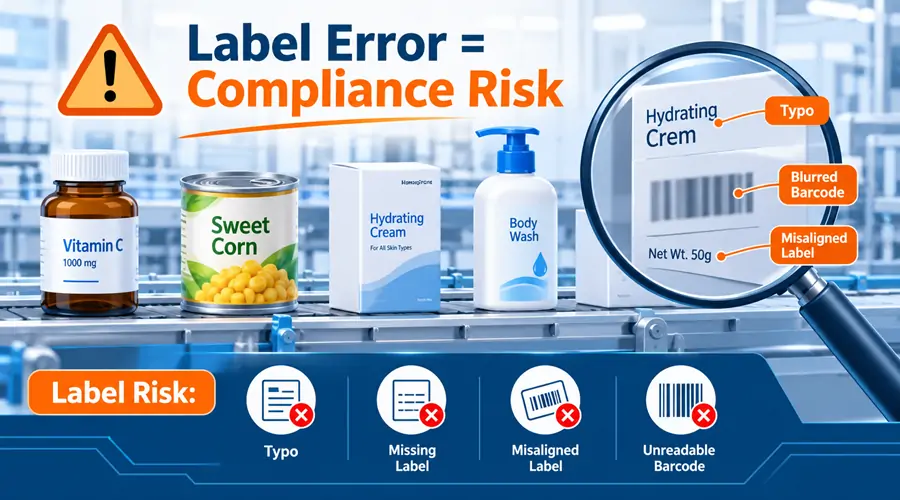
Brand Image and Consumer Trust: These often hinge on details that are easily overlooked. Labels serve as a vital window through which consumers learn about a product. Whether it is the production date, nutritional information, or product instructions, consumers rely on this data to gauge a product’s reliability. If a date code is illegible, a nutritional table is misaligned, or information is missing, consumers may begin to question the brand’s professionalism—even if the product itself is of high quality. For food companies, such details are far more than just a matter of packaging aesthetics.
Product traceability relies on accurate label information. During food production, batch numbers, QR codes, and traceability codes serve to identify products and link them to relevant data. Errors in data at any stage—from production records and warehousing to logistics and final retail—can compromise the entire traceability process. Label verification involves not only confirming that variable information is printed correctly according to production specifications, but also ensuring that barcodes and QR codes are readable and that the captured data is accurately transmitted to the appropriate management systems.
Reducing quality-related losses is another key reason for companies to implement label inspection systems. If label defects go undetected on the packaging line, the affected products may proceed to boxing, warehousing, or even reach the market. By the time such issues are discovered—often through customer complaints or the need for large-scale rework—the costs of resolution have typically risen significantly, potentially involving product disposal, recalls, or compliance risks. Integrating label inspection into the production process allows for the timely identification of anomalies through automated checks, helping to mitigate unnecessary losses. In continuous packaging operations, the earlier a problem is detected, the lower the costs associated with subsequent corrective actions tend to be.
Working Principle of a Vision-Based Label Inspection System
A label inspection system is a solution—comprising industrial cameras, image processing software, and machine vision technology—designed to automatically examine product labels and their associated printed information. Based on predefined inspection criteria, the system can identify issues such as missing labels, positional offsets, printing defects, incorrect labels, or anomalous codes, subsequently issuing a “pass” or “fail” signal.
By integrating vision-based quality control into the production line, food manufacturers can reduce the subjectivity inherent in manual inspections, achieve more consistent in-line monitoring, and obtain continuous data to support packaging quality management.
The system’s operation is fundamentally based on a vision-driven quality control workflow: imaging, analysis, decision-making, and—in the event of a defect—triggering an alarm or rejection mechanism.
Product Positioning and Imaging
As products enter the inspection zone via a conveyor belt, a sensor or trigger device sends an acquisition signal to the vision system. An industrial camera then captures the image and transmits it to the processing system.
Image Processing and Algorithmic Analysis
The system compares the captured image against a standard template or work-order data. Using image recognition algorithms, it isolates the label area and extracts specific features, such as edges, contours, colors, and text.
Label Feature Recognition and Verification
Once the label is located, the system performs checks based on preset thresholds. This includes image comparison, position verification, defect or print-anomaly detection, and the use of OCR (Optical Character Recognition) to identify product names, production dates, and batch numbers.
Inspection Outcome and Rejection
Based on the preset thresholds, the system determines whether the product is acceptable. Non-conforming items trigger an alarm, are removed from the line (using methods such as air blasts, pushers, or diverter flaps), or are marked. The inspection results and corresponding images are archived, creating a traceable quality record.
Label Inspection Solutions for Various Industries
Label inspection and verification are not limited to the food industry. Any product that relies on labels to convey information—such as specifications, batch details, or usage instructions—requires rigorous label quality control.
Food and Beverage: Production lines in this sector often utilize diverse packaging formats, including bottles, cans, and pouches. Key inspection priorities include allergen declarations, expiration dates and date codes, nutritional information, and the correct sequence of ingredients. In environments where multiple SKUs are produced on the same line, vision-based label inspection systems are essential for identifying incorrect labels or the accidental mixing of labels between different products.
Pharmaceuticals and Health Products: Pharmaceutical packaging typically includes product names, specifications, batch numbers, and expiration dates. Errors in label content or poor print quality can compromise product identification, inventory management, and traceability.
Consumer Goods and Personal Care: Products such as shampoos, body washes, skincare items, and cosmetics—often packaged in plastic or glass containers—require careful monitoring for multi-language label consistency, anti-counterfeiting markers, and high-end print quality. Inspection systems in this sector must address both physical appearance defects and the accuracy of the label content.
For food manufacturers, selecting a label inspection solution should go beyond focusing on single parameters like camera resolution. Instead, priority should be given to the system’s ability to handle rapid SKU switching, verify variable data, and integrate seamlessly with existing packaging lines.
Advantages of Advanced Label Inspection Technology in Quality Control
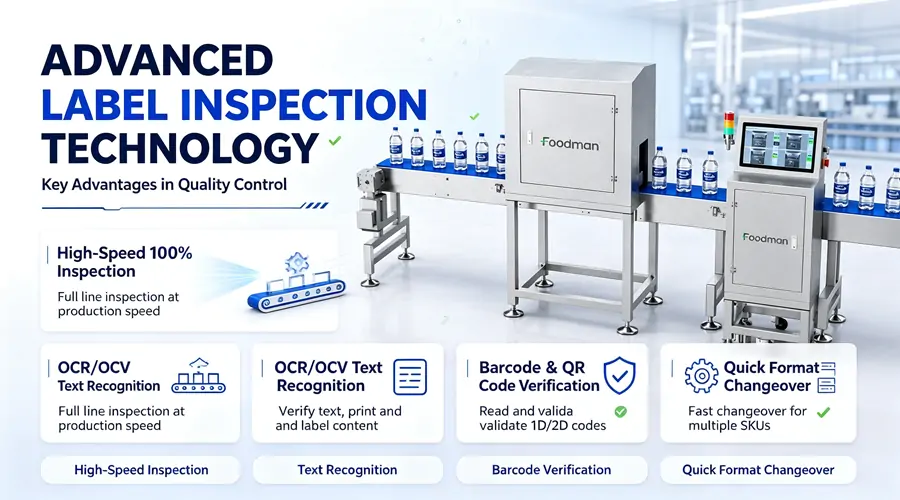
Compared to traditional manual inspection, vision-based label quality control offers several advantages, including continuous, comprehensive inspection, standardized criteria, and a high degree of automation.
1. Continuous, In-Line Label Inspection
Vision systems can automatically capture images as products pass through the inspection zone, eliminating the need for operators to manually handle and examine each item while ensuring that every product undergoes a full inspection. Once validated against actual production speeds and sample sets, the system can be calibrated to match the required in-line inspection throughput, thereby reducing the risk of defects being overlooked—a common drawback of manual sampling.
2. Enhanced Consistency in Defect Detection
Manual inspection is often susceptible to variables such as lighting conditions, viewing angles, and individual subjective judgment. In contrast, machine vision systems perform inspections based on predefined inspection zones, reference templates, and specific decision parameters, which helps maintain consistent inspection standards.
However, the effectiveness of the inspection remains dependent on factors such as image quality, the nature of the defects, product positioning, and system configuration; therefore, it should not be assumed that vision-based systems are capable of detecting every single label defect.
3. Support for Combinations of Multiple Inspection Tasks
Modern visual inspection systems can combine various inspection tasks to meet specific production requirements. For instance, on a bottled food production line, a system can simultaneously verify the presence and correct positioning of labels, the clarity of production dates, and the readability of barcodes. By appropriately configuring inspection modules, companies can reduce the need for manual inspection stations and enhance the continuity of their packaging quality control processes.
4. Adaptability to Diverse Product Specifications
Food manufacturers often need to switch between products with different capacities, flavors, or packaging designs on the same production line. Visual systems allow for the creation of specific inspection recipes and reference templates for each SKU. When transitioning between production tasks, operators—based on their authorized access levels—can select the relevant recipe and confirm the inspection parameters. This approach helps mitigate the risk of using incorrect labels or applying the wrong inspection standards during product changeovers.
5. Data-Driven Support for Quality Analysis
If a system is equipped with image storage and data statistical capabilities, it can record the types and frequencies of label defects over various time periods. By analyzing this inspection data, companies can further optimize their label-application processes, printing parameters, and overall production management workflows.
Foodman Label Vision Inspection Solutions
Foodman has long specialized in the R&D and manufacturing of food inspection equipment, with label vision inspection systems serving as a key product line in our packaging quality control portfolio. Designed for the real-world production environments of food manufacturers, Foodman’s label inspection systems offer the following capabilities:
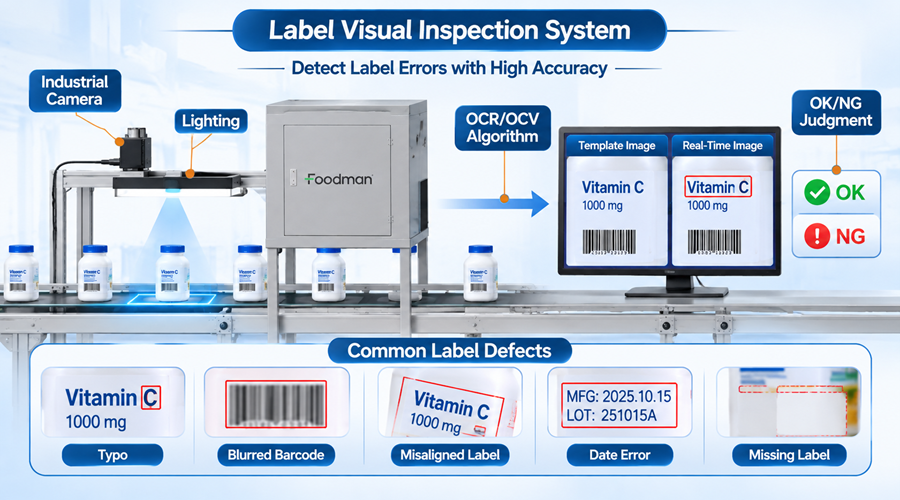
Label Appearance and Positioning Inspection: Utilizing industrial cameras to capture product images—combined with advanced image processing and AI-driven data analysis—the system verifies the presence of labels and ensures they are correctly positioned within designated areas. It also detects issues such as significant misalignment, tilting, wrinkling, or damage. This solution is ideal for bottled sauces, beverages, canned goods, and various other pre-packaged products.
Label Content Verification and Variable Data Inspection: Focusing on product labels and printed code areas, the system employs OCR/OCV (Optical Character Recognition/Verification) technology to read data—such as date codes, batch numbers, ingredient lists, and allergen information—and cross-references it against production orders. This automates the label verification process, effectively reducing the risk of human error during product changeovers.
Integrated Production and Packaging Lines. Foodman’s proprietary vision inspection system is designed for seamless integration with existing labeling machines, rejection mechanisms, and production line control systems—minimizing the need for modifications and accelerating deployment.
Data-Driven Quality Management. Inspection results, images of defects, and statistical data are managed centrally, facilitating quality traceability and trend analysis. This empowers quality control teams to shift from reactive problem-solving to proactive prevention.
Optimized for the Food Industry. The equipment is engineered specifically for food production environments, featuring robust ingress protection and designs that simplify cleaning and maintenance, ensuring a balance between high inspection precision and operational practicality.
If you are seeking a label inspection solution for bottled food, beverages, condiments, or other packaged goods, Foodman can help you evaluate the ideal vision inspection configuration based on your specific samples, label designs, and production line requirements.
Conclusion
Labels are a vital component of food packaging, serving to convey essential product information. Issues such as missing labels, incorrect placement, mismatched content, or unclear printing not only detract from a product’s appearance but can also hinder consumers from identifying key information and impede a company’s ability to perform quality traceability.
As automation in food packaging continues to advance, label inspection systems are becoming an integral part of quality control on production lines. By leveraging technologies such as industrial cameras, image processing, OCR (Optical Character Recognition), and barcode recognition, these vision-based inspection systems enable continuous, full-scale, in-line inspection, automated verification, and data traceability—offering manufacturers a highly reliable solution.
For food producers, establishing an effective label inspection process goes beyond simply adding a piece of inspection equipment; it means integrating label quality control into daily production management. Foodman provides tailored vision-based inspection solutions designed to meet the specific requirements of various food packaging types, helping manufacturers enhance the consistency of label checks, improve control over the production process, and elevate the overall standard of packaging quality management.
FAQ
Label inspection focuses on the physical and printed condition of a label (e.g., missing labels, misaligned labels, or printing defects), while label verification focuses on the logical accuracy of the label content (e.g., ensuring that ingredients, allergens, dates, and batch numbers match the production order). Comprehensive label quality control requires a combination of both.
Common applications include bottled products—such as soy sauce, vinegar, chili sauce, beverages, and dairy—as well as canned goods, bagged snacks, and other pre-packaged food items. The equipment must be configured based on factors such as packaging dimensions, materials, label placement, and production line speed.
Typical issues include missing or misaligned labels, wrinkles and air bubbles, printing smudges or registration errors, missing or blurred characters, poor-quality barcodes, and errors in the reading or validation of variable data such as date codes and batch numbers.